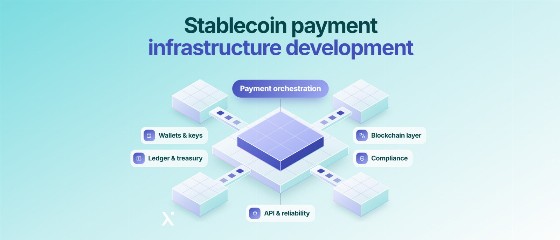
Stablecoins have officially entered their “this is getting serious” era. What began as a crypto-native asset is now attracting growing attention from businesses and the wider payments industry.
Stablecoins offer a more direct way to move money across borders as they operate 24/7 with fewer intermediaries than traditional bank-based payment rails. This can shorten settlement times, reduce transaction costs, and simplify reconciliation. These benefits are already supporting adoption in remittances, B2B payments, and treasury operations.
The market is growing just as rapidly. Stablecoins processed around $28 trillion in real economic volume in 2025. Adjusted stablecoin volume is projected to reach $719 trillion by 2035 through organic growth alone, while macro catalysts could push that figure toward $1.5 quadrillion. Stablecoin payment volumes could also rival those of Visa and Mastercard between 2031 and 2039.
As businesses start using stablecoins for more than simple transfers, the technology behind those payments also needs to become more sophisticated. Yes, stablecoin development for payments goes beyond adding a crypto payment option. A reliable setup needs an infrastructure layer that connects payment flows, routing, wallets, ledgers, treasury, compliance, security, and other moving parts.
So, what does it take to build it? Let’s take a closer look.
Payment gateway or full infrastructure: what’s the difference?
A payment gateway is essentially the entry point for a payment. It accepts a payment request, connects it to a provider or blockchain network, and returns the transaction result. For a straightforward payment flow, that may be enough.
A full stablecoin payment infrastructure has a much broader job. It coordinates what happens before, during, and after a payment — from creating the payment intent and choosing the right route to updating balances, reconciling transactions, and making sure funds reach the intended recipient.
Here’s how the two approaches differ:
Payment gateway vs stablecoin payment infrastructure: key differences
| Capability | Payment gateway | Payment infrastructure |
| Payment intents | Creates a basic payment request | Manages the full payment lifecycle from initiation to completion |
| Idempotency | Helps prevent duplicate requests | Prevents duplicate payments across the entire payment flow |
| Routing | Connects the payment to a provider or network | Applies routing rules based on cost, liquidity, availability, limits, and other factors |
| Payment status | Returns basic transaction status | Tracks every stage, from pending to completed, failed, or expired |
| Ledger | Usually relies on an external system | Maintains internal balances and transaction records |
| Treasury | Usually handled elsewhere | Handles liquidity, funding, and stablecoin treasury management across accounts and networks |
| Reconciliation | Usually handled by another system | Matches on-chain transactions with internal ledger records |
| Reporting | Provides basic transaction-level reports | Supports operational, financial, and reconciliation reporting |
| Delivery | Confirms that a payment request was accepted or processed | Tracks whether funds were delivered and manages failures and retries |
| Service levels (SLA) | Focuses mainly on API availability | Covers end-to-end payment performance and reliability |
The difference becomes especially important when payments move across several blockchains, wallets, currencies, and financial partners. Stablecoin payment platform development therefore requires more than connecting a gateway API. The infrastructure needs to coordinate these moving parts and give the business a consistent view of every payment, regardless of what happens underneath.
A gateway can still be an important part of this setup. For example, crypto payment gateway development can provide the layer through which customers initiate or accept stablecoin payments, while the broader infrastructure handles the operational logic behind them.
Crypto Payment Gateway: Costs, Benefits, Implementation

Blockchain in Payments: Top 8 Use Cases and Their Benefits
Under the hood: how stablecoin payment infrastructure is built
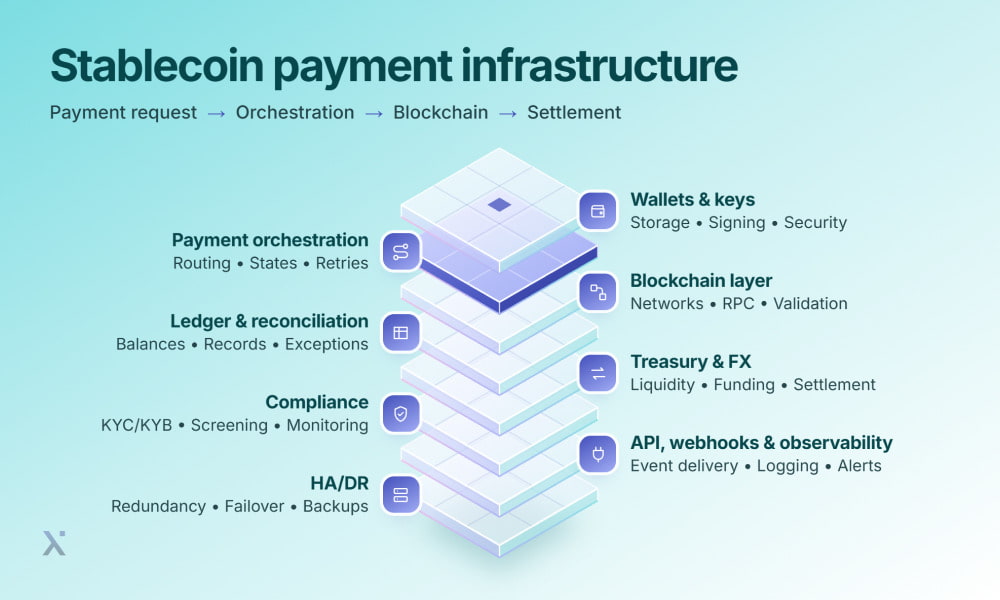
A reliable stablecoin payment infrastructure is not a single system. It is a set of interconnected layers that work together to move, track, secure, and reconcile funds. Each layer has a specific role, but the payment flow should remain consistent from the initial request to final settlement.
Key and wallet layer
This layer controls where assets are stored and how transactions are authorized. It typically includes:
- Wallet infrastructure for different networks and use cases
- Key management and secure key storage
- Hot, warm, and cold wallet policies
- Signing rules, approval thresholds, and transaction limits
Payment orchestration layer
The orchestration layer coordinates the payment from start to finish. A payment state machine tracks each stage, while routing logic determines where and how the transaction should be processed.
Key functions include:
- Payment creation and state management
- Network and provider routing
- Transaction lifecycle management
- Retries, failures, and terminal statuses
Chain abstraction and node/RPC layer
This layer connects the platform to multiple blockchain networks without forcing the rest of the system to handle each network separately. It manages:
- Multichain connectivity
- Primary and backup RPC (Remote Procedure Call) providers
- Blockchain confirmation tracking
- Address and network validation
Ledger and reconciliation
The internal ledger provides a single source of truth for customer and operational balances. It records blockchain activity and connects it with the platform’s accounting records.
A typical setup includes:
- Double-entry ledger
- Internal balance tracking
- On-chain event processing
- Reconciliation and exception handling
Treasury and FX
Treasury logic ensures that the platform has enough liquidity to process payments and settle obligations. It can cover:
- Liquidity and balance management
- Funding and settlement
- Stablecoin conversion and foreign exchange (FX)
- Transfers between wallets and accounts
Compliance hooks
Compliance checks should be connected directly to the payment flow rather than handled as a separate manual process. Depending on the business model and jurisdiction, these can include:
- KYC/KYB checks
- Wallet and address screening
- Transaction monitoring
- Sanctions screening
- Travel Rule requirements

The Travel Rule Crypto Requirements Across Jurisdictions

Know Your Transaction (KYT) Explained: Understanding its Role in Financial Compliance
API, webhooks, and observability
A stablecoin payment API connects the infrastructure with merchants, financial platforms, and other external systems. Webhooks and event handling keep those systems updated as payment states change.
This layer covers:
- APIs and authentication
- Webhooks and event delivery
- Logs and audit records
- Monitoring and alerts
HA/DR
High availability and disaster recovery (HA/DR) keep payment services running when infrastructure fails. The architecture should include:
- Redundant services and infrastructure
- Automatic failover
- Defined RTO and RPO targets
- Backup and disaster recovery procedures
The layers above can be summarized as follows:
Stablecoin payment infrastructure architecture layers
| Layer | Responsibility |
| Key & wallet | Asset storage, key management, wallet policies, and transaction signing |
| Payment orchestration | Payment states, routing, transaction lifecycle, and retries |
| Chain abstraction & node/RPC | Multichain connectivity, RPC access, confirmations, and network validation |
| Ledger & reconciliation | Internal balances, double-entry records, on-chain events, and exceptions |
| Treasury & FX | Liquidity, funding, settlement, and currency conversion |
| Compliance hooks | KYC/KYB, screening, monitoring, sanctions, and Travel Rule checks |
| API, webhooks & observability | Integrations, event delivery, logging, monitoring, and alerts |
| HA/DR | Redundancy, failover, backups, and disaster recovery |
All these layers need to work as one system. A strong architecture keeps payment processing, blockchain connectivity, accounting, liquidity, compliance, and reliability closely connected while giving each component a clear responsibility. This kind of approach makes the platform easier to scale, integrate with new networks, and adapt to new payment use cases.
With experience in payment software development, PixelPlex can help design and build the technology behind modern payment systems, such as stablecoin-based infrastructure.
Choosing your payment rails: networks and stablecoins
Choosing the right stablecoin payment rails is really two decisions: where transactions should run and which stablecoin should move through those networks. These choices affect everything from transaction costs and settlement speed to liquidity, compliance, and operational risk.
There is no single network or stablecoin that works best for every business. The right combination depends on your payment volumes, target markets, supported currencies, liquidity needs, and risk tolerance.
Which blockchain should you choose?
The first question is where your payments should run. You can use a Layer 1 (L1) such as Ethereum or Solana, a Layer 2 (L2) such as Arbitrum or Base, or a permissioned network designed for a more controlled environment.
Each option has its own advantages and trade-offs.
Ethereum, for example, offers deep stablecoin liquidity and broad ecosystem support, but fees can become expensive during periods of high demand.
Solana provides fast transactions and low fees, while networks such as Base and Arbitrum can offer lower-cost access to the Ethereum ecosystem.
Permissioned networks can provide greater control over participants and transaction rules, but usually have a smaller ecosystem and require more operational coordination.
Choosing a blockchain network for payments
| Criterion | L1 | L2 | Permissioned network |
| Finality and confirmations | Depends on the network and confirmation policy | Usually fast from the application’s perspective | Can offer predictable finality |
| Fee volatility | Can be significant during congestion | Generally lower, but varies by network | Usually more predictable |
| Stablecoin liquidity | Often deepest on major networks | Growing, but varies by network and asset | Usually more limited |
| Compliance tooling | Broad selection of third-party tools | Increasingly supported by compliance providers | Can be built into the network |
| Operational complexity | Node/RPC, wallet, and network management | Adds L2-specific infrastructure and settlement considerations | Requires coordination with network participants |
The network choice should follow the payment use case rather than popularity alone. For example:
- Ethereum can make sense when deep liquidity, ecosystem coverage, and broad asset support matter most
- Solana is a strong option for high-volume payments where speed and low fees are priorities
- Base or Arbitrum can work well when you want lower-cost transactions while staying close to the Ethereum ecosystem
- Permissioned networks may be a better fit for banks, consortia, or businesses that need tighter control over participants and transaction rules
In reality, larger platforms may not need to choose just one. A multichain setup can route payments based on liquidity, fees, availability, supported assets, and destination. The stablecoin payment rails should therefore include a clear network-routing strategy rather than treating each blockchain as an isolated integration.
Engineers should also account for operational mistakes. If the same stablecoin exists on several networks, a user can easily send funds to the wrong network. The platform can reduce this risk with network-specific addresses, explicit network selection, validation before signing, deposit monitoring, and clear procedures for unsupported transfers.

Ethereum Development from A to Z: Features, Use Cases, and Costs

A Network of Networks: How Canton Is Redesigning Financial Infrastructure
Choosing a stablecoin: what should engineers look at?
Choosing a stablecoin means deciding which assets, such as USDC, USDT, PYUSD, or EURC, your payment infrastructure will support. The choice affects liquidity, redemption, network coverage, compliance, and risk management. Engineers should look at how each asset is backed, how it can be redeemed, where it is supported, and what controls come with it.
Engineering criteria for stablecoin selection
| Criterion | What engineers should check |
| Issuer and reserve model | Who issues the stablecoin, what backs it, and how liquid those reserves are |
| Attestations and audits | How often reserves are reported and whether they are independently verified |
| Redemption mechanics | Who can redeem the stablecoin, through which channels, and under what conditions |
| Freeze and blacklist functions | Whether the issuer can restrict addresses or transactions and how this affects operations |
| Network coverage | Which blockchains support the stablecoin and where sufficient liquidity is available |
| Depeg behavior | How the stablecoin has behaved during periods of market stress and what risks exist |
| Limits and risk policies | Exposure limits, transaction thresholds, and conditions for pausing or rerouting payments |
The platform should also have a predefined response to a depeg. Depending on the severity, rules can automatically tighten limits, pause deposits or payouts, reroute transactions through another stablecoin, or temporarily disable the affected asset.
This makes stablecoin selection part of the platform’s risk-management strategy rather than just another asset integration.
From payment request to blockchain: wallets, keys, and orchestration
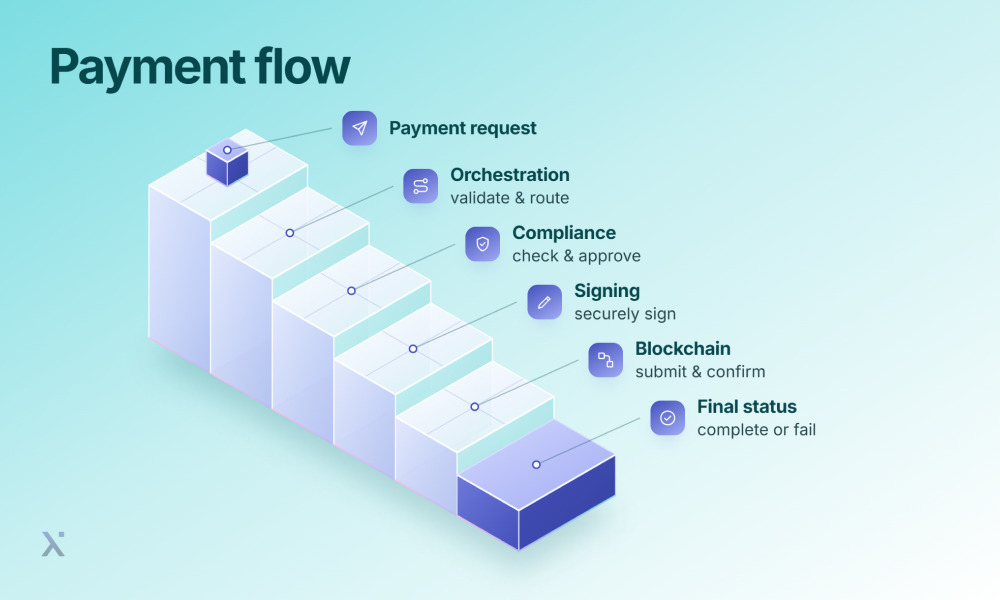
A stablecoin payment may look simple from the outside: a customer clicks “Pay,” and the recipient gets the funds. Behind that button, however, the system has to make several decisions before it can safely submit a blockchain transaction.
During stablecoin payment platform development, this flow typically connects wallets, key management, payment orchestration, and blockchain infrastructure. The goal is to turn a payment request into the right transaction, sign it securely, submit it to the correct network, and keep tracking it until the payment reaches a final state.
This is one of the core parts of stablecoin payment infrastructure, because even a well-designed wallet setup can become difficult to operate at scale without clear transaction controls and orchestration.
Key management models and considerations
Private keys are one of the most sensitive parts of a payment system. They control access to funds, so the infrastructure needs to protect them while still allowing authorized transactions to be signed quickly.
There are several ways to organize key management. The right model depends on transaction volume, security requirements, custody responsibilities, and how much control the business wants to keep in-house.
Key management models for payment operators
| Model | Advantages | Main trade-off | Best suited for |
| MPC/TSS (Multi-Party Computation / Threshold Signature Scheme) | Splits signing authority across multiple parties or components, reduces reliance on a single private key | More complex architecture and operational setup | High-value payment operations and businesses that need strong key protection |
| HSM (Hardware Security Module) | Provides dedicated hardware protection for cryptographic keys and signing operations | Can require more infrastructure and specialized management | Enterprises with strict security and compliance requirements |
| Smart contract wallets | Support programmable controls such as spending limits, multiple approvals, and recovery mechanisms | More complex than standard wallets and dependent on smart contract logic | Businesses that need flexible transaction policies |
| External custodians | Outsources key custody and some operational responsibilities | Less direct control and dependence on a third-party provider | Businesses that prefer managed custody or want to reduce internal operational overhead |
The infrastructure should also define signing speed and transaction approval rules before going live. For example, low-value payments can potentially use automated signing within predefined limits, while larger transfers may require additional approval.
Recovery is equally important. Key loss or a compromised signing environment should not leave funds permanently inaccessible. Businesses can use recovery procedures, backup mechanisms, spending limits, and separate approval paths to reduce this risk.
It is also useful to set hot wallet limits so that only the amount needed for day-to-day operations is immediately accessible. Larger reserves can be kept under stronger controls. Finally, separation of duties helps prevent one person, system, or credential from having unrestricted control over funds.
For businesses that need help designing the wallet layer, PixelPlex also provides crypto wallet development services.

MPC Wallet Development Cost: Pay Now or Pay After a Breach

Custodial vs. Non-Custodial Wallet: Everything You Need To Know
How the payment orchestrator keeps transactions moving
Once a payment request reaches the system, the orchestrator takes over the operational flow. In simple terms, it decides what should happen next: which network to use, which wallet should send the funds, how the transaction should be signed, and how its status should be tracked.
This stablecoin orchestration layer acts as the control center between the application, wallet infrastructure, blockchain networks, and supporting services. It turns a business-level payment request into a blockchain transaction and keeps monitoring it until the payment is completed or reaches a terminal state.
A typical orchestrator manages controls such as:
Payment orchestrator controls
| Control | Purpose |
| Network and provider routing | Selects the appropriate network or provider |
| Idempotency | Prevents duplicate payments when the same request is submitted more than once |
| Payment state transitions | Tracks pending, completed, failed, and expired payments |
| Nonce management | Keeps blockchain transactions ordered correctly |
| Fee management | Adjusts transaction fees when needed |
| Retries and fallbacks | Handles temporary provider or network failures |
| Terminal statuses | Clearly closes the payment lifecycle |
As transaction volumes rise, these controls become more critical. A temporary RPC provider outage, a stuck transaction, or a repeated API request should not result in a lost payment or two payments being sent for the same order.
The orchestrator should therefore use replay protection and idempotency to recognize repeated requests, while transaction tracking helps distinguish between a payment that is still pending and one that has actually failed. Retry rules and fallback providers can then handle temporary problems without requiring manual intervention.
In a production system, stablecoin orchestration is not just about sending transactions. It provides the logic that keeps the entire payment lifecycle predictable, traceable, and safe as the infrastructure handles more networks, wallets, currencies, and payment flows.
Moving money in and out: ramps, banks, and liquidity
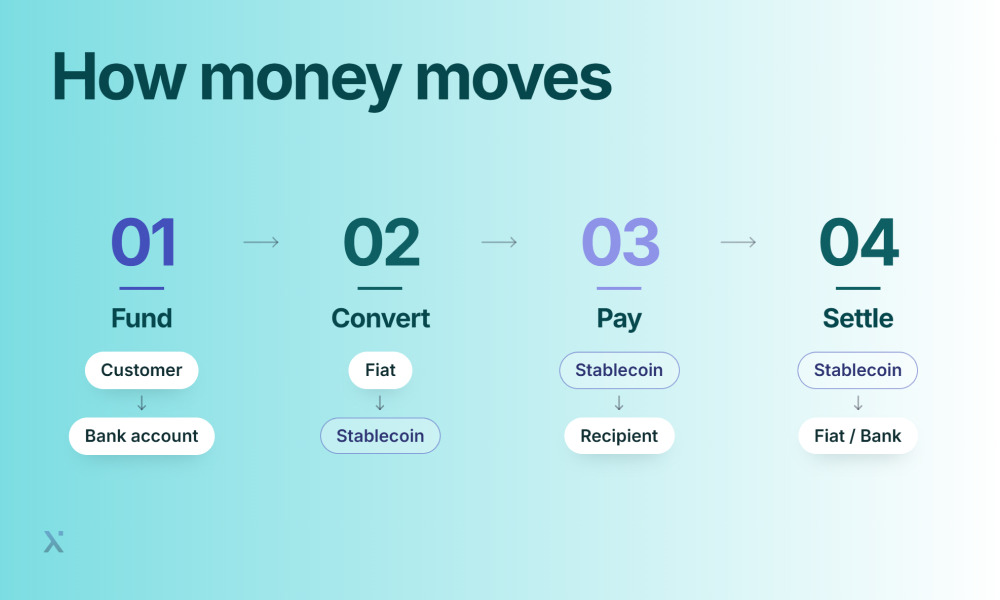
Stablecoin payments still need connections to the traditional financial system. Businesses may need banks, fiat on/off-ramps, and liquidity providers to fund wallets, convert currencies, receive customer funds, and settle payments.
Fiat connectivity: banks and ramps
Banks provide fiat accounts and settlement infrastructure, while on/off-ramps connect fiat currencies with stablecoins. Depending on the business model, funds may be held by the business, a bank, custodian, or another regulated partner. This choice affects the payment architecture, compliance requirements, and reconciliation process.
Ramp providers can differ in supported currencies and networks, geographic coverage, transaction limits, pricing, and settlement times, so the right choice of providers depends on the business’s payment flows and target markets.
Liquidity and fallback providers
Liquidity providers help ensure enough stablecoin or fiat liquidity is available to complete payments. Pre-funding makes payments more predictable but ties up capital. Just-in-time liquidity reduces idle funds but increases dependency on provider availability.
Using multiple banks, ramps, or liquidity providers can also reduce single points of failure. If a primary provider becomes unavailable or reaches a transaction limit, the infrastructure can route eligible transactions through a fallback provider.
Treasury and payment costs
Treasury management coordinates balances across bank accounts, wallets, stablecoins, and liquidity providers. Automated rules can replenish operational wallets, move excess funds to more secure storage, or trigger transfers when balances fall below defined thresholds.
In addition to that, the infrastructure can track network fees, provider fees, FX spreads, and other payment costs at the transaction level. This gives the business a clearer view of payment margins and helps optimize routing and liquidity decisions.
Compliance without the bottleneck: building checks into the payment flow
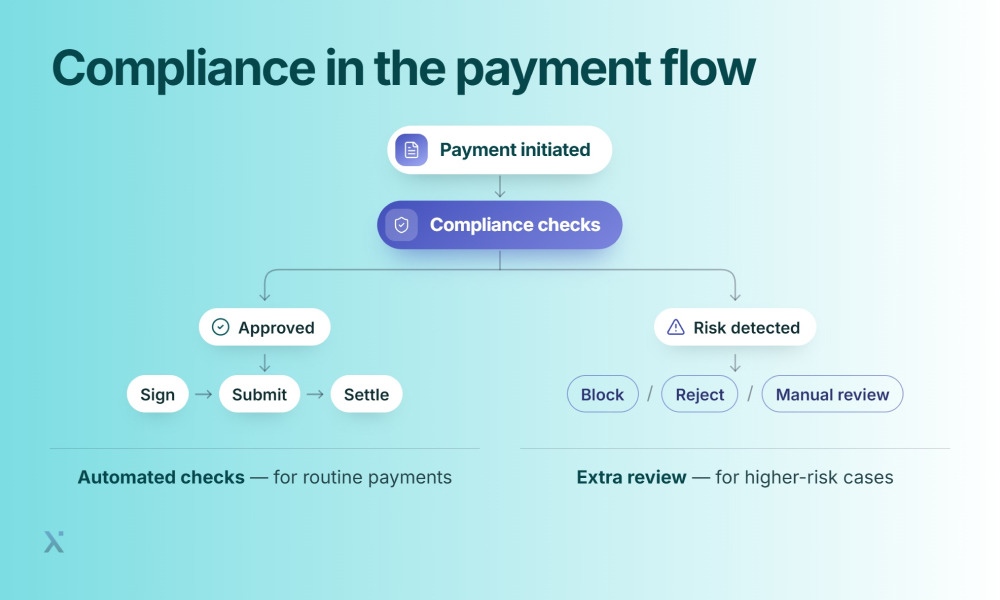
Stablecoin compliance works best when it is built into the payment lifecycle rather than handled as a separate back-office process. The exact requirements depend on the business model, target markets, assets, and services provided.
A payment infrastructure can include the following compliance and risk controls:
- KYC/KYB: Customer and business verification helps establish who is using the payment service and whether they meet the relevant eligibility requirements.
- Address screening: Wallet addresses can be checked against sanctions lists, risk databases, and other sources to identify potentially risky counterparties.
- Transaction monitoring: Ongoing monitoring can flag unusual transaction patterns, suspicious activity, unexpected volumes, or other risk signals.
- Sanctions screening: Screening customers, counterparties, and transactions helps identify activity involving sanctioned individuals, entities, or jurisdictions.
- Travel Rule: Where applicable, information about the originator and beneficiary must be collected and transmitted with a crypto transfer. This enables regulators and service providers to identify the parties involved and monitor transactions.
- Transaction blocking: When a payment fails a compliance or risk check, the system can automatically block it, place it on hold, or send it for manual review.
- Reporting: Compliance data and transaction records provide the information needed for regulatory reporting, audits, investigations, and internal reviews.
- Licensing and custody model: The required licenses, registrations, permissions, and safeguarding arrangements depend on the services provided, the jurisdictions involved, and whether the business holds or controls customer funds.
These checks can connect directly to the payment orchestrator. For example, a payment can move through initiated → compliance check → approved → signed → submitted, while a failed check can send it to a blocked, rejected, or manual-review state.
This approach helps prevent compliance from becoming a manual checkpoint for every payment. Routine transactions can pass automatically when they meet the rules, while higher-risk cases can be escalated for additional review.
Regulatory requirements and how they vary by region
The compliance layer also depends on where the payment infrastructure operates. Different markets have their own rules for crypto assets, payments, AML, custody, and money transmission, so the same payment flow may require different controls or licenses from one region to another.
The table below highlights some of the main regulations and frameworks that can affect stablecoin payment infrastructure across major markets. It is not an exhaustive list, but it provides a starting point for understanding the regulatory landscape.
Key regulatory requirements by region
| Region | Key regulations and frameworks | What they cover for stablecoin payment infrastructure |
| US | Bank Secrecy Act (BSA), FinCEN MSB requirements | The BSA and FinCEN requirements cover AML/KYC, money transmission, registration, and reporting obligations that may apply to payment businesses |
| GENIUS Act | The GENIUS Act establishes a federal framework for payment stablecoins, including requirements for permitted issuers, reserves, disclosures, and oversight | |
| EU | Markets in Crypto-Assets Regulation (MiCA) | Rules for cryptoasset services and stablecoin-related activities, such as authorization, custody, and requirements for asset-referenced tokens and eMoney tokens |
| Transfer of Funds Regulation (TFR) | Information requirements for transfers of funds and certain cryptoasset transfers, including Travel Rule requirements | |
| UK | Financial Services and Markets Act 2000 (Cryptoassets) Regulations 2026 | Establishes the UK’s new regulatory framework for cryptoasset activities, plus requirements for regulated cryptoasset businesses |
| APAC | Singapore Payment Services Act | Licensing and regulatory requirements for payment services, including certain digital payment token services |
| Japan Payment Services Act | Registration and requirements for cryptoasset exchange and related services | |
| MEA | UAE CBUAE Payment Token Services Regulation | The UAE has a dedicated regulatory framework for payment stablecoins, covering their issuance, conversion, custody, and transfer, with licensing, reserve, AML/CFT, and operational requirements. It also prohibits algorithmic stablecoins and restricts the use of foreign stablecoins for payments |
| VARA regulations | Licensing and regulatory requirements for virtual asset activities in Dubai, including custody, brokerage, exchange, and related services |
Regulatory requirements can change quickly, and the same stablecoin payment model may be treated differently across jurisdictions. To keep up with these requirements, businesses can use specialized crypto compliance solutions that integrate screening, monitoring, transaction controls, and other compliance measures directly into the payment infrastructure.
Build compliance checks directly into the payment flow so that transactions can be screened, approved, blocked, or escalated before funds move.

MiCA Regulation Explained: New Framework for Regulating Crypto Assets

From Chaos to Compliance: How Cryptocurrency Regulation Is Shaping Up
Security and reliability: preparing for what can go wrong
A production-ready stablecoin payment infrastructure needs more than basic transaction security. It needs to stay available when a provider goes down, a blockchain connection fails, traffic spikes, or a recovery event occurs.
The main goal is to protect funds and payment data while keeping critical payment flows running.
Security controls
The core security layer typically covers:
- Key protection and hot wallet limits to reduce exposure of operational funds
- Multi-person approvals and separation of duties to limit the impact of a compromised account or insider threat
- API and webhook authentication to prevent unauthorized requests and fake payment events
- Replay and double-payment protection to prevent the same transaction request from being processed more than once
Reliability and recovery
Operational resilience helps the infrastructure continue working when individual components fail. This can include:
- Redundant nodes and RPC providers with automatic failover
- Queues and backpressure to handle traffic spikes without overwhelming the system
- Monitoring and alerts to detect failures and unusual behavior quickly
- RTO/RPO targets that define recovery expectations
- SLA commitments for availability and service performance
- Backups and disaster recovery to restore operations after major failures
Security audits and risk management can provide an additional layer of assurance by identifying vulnerabilities, operational risks, and gaps in existing controls before they affect payment operations.
From idea to live payments: roadmap, timeline, and cost
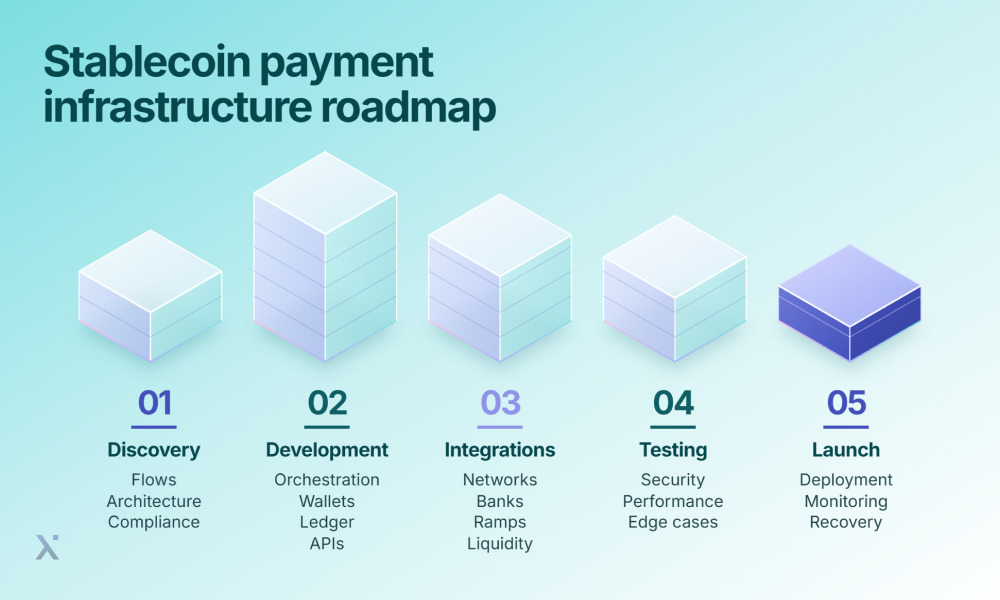
Building stablecoin payment infrastructure is a gradual process. The timeline and budget depend on how many payment flows, networks, integrations, and operational controls the platform needs. A focused first release can go live relatively quickly, while a full-scale multichain infrastructure takes much more time.
What does the development roadmap look like?
A typical development roadmap can look like this:
- Discovery and architecture — 3–4 weeks
The team defines the payment flows, supported assets and networks, custody model, integrations, compliance requirements, and overall architecture.
- Core infrastructure development — 6–12 weeks
The main payment orchestration, wallet and key-management layer, ledger, transaction processing, and API infrastructure are built.
- Integrations — 4–8 weeks
Blockchain networks, RPC providers, banks, ramps, liquidity providers, compliance services, and other external systems are connected. Some of this work can run in parallel with core development.
- Testing and security — 3–6 weeks
The platform goes through functional, integration, performance, and security testing. Payment edge cases and failure scenarios are also tested before launch.
- Production launch — 1–4 weeks
The infrastructure is deployed to production, monitoring and recovery mechanisms are configured, and the first payment flows are introduced gradually.
In general, a focused MVP may take around 4–8 months, and a more advanced production platform can take 8–12 months or more.
What does stablecoin payment infrastructure development cost?
The cost of building stablecoin payment infrastructure can vary significantly depending on the scope. A platform that supports a few networks, external payment providers, and basic payment flows will cost considerably less than a multichain system with its own ledger, treasury logic, banking integrations, advanced compliance, and high-availability requirements.
| Scope | Typical cost range | What it may include |
| Focused MVP | $100,000–$200,000 | 1–2 networks, basic payment flows, wallet integration, core orchestration, APIs, and essential monitoring |
| Production platform | $200,000–$450,000 | Multiple networks and stablecoins, internal ledger, reconciliation, external ramps, compliance integrations, treasury logic, and stronger security |
| Advanced infrastructure | $450,000–$800,000+ | Multichain routing, banking integrations, sophisticated treasury and FX, advanced compliance, high availability, automated failover, and complex payment flows |
These are indicative ranges. The final stablecoin payment infrastructure cost depends on the number of integrations, supported jurisdictions, custody model, security requirements, development approach, and how much infrastructure is built in-house or provided by third parties.

The Real Cost of Stablecoin Development: What You Pay For and Why

Blockchain Development Cost in 2026: What Goes Into the Price Tag
Build, buy, or mix both?
There are three main ways to approach stablecoin payment infrastructure: build the entire stack in-house, rely mostly on external providers, or combine the two. The right choice depends on how much control the business needs, how quickly it wants to launch, and how central payments are to its product. Let’s take a closer look at these three:
- Build in-house — fits businesses that need maximum control over payment logic, security, data, and infrastructure, or plan to make payments a core part of their product. It requires more development time, specialized expertise, and ongoing maintenance.
- Buy or outsource — fits businesses that want to launch faster and have less internal infrastructure to maintain. External providers can handle functions such as wallets, compliance, ramps, banking, or blockchain connectivity, but this approach creates greater dependency on vendors.
- Use a hybrid approach — fits most businesses launching B2B stablecoin payments. Core components such as payment orchestration, the ledger, and business logic remain under the company’s control, while established providers handle specialized functions such as networks, ramps, banking, liquidity, and compliance.
For many businesses, the hybrid model offers the best balance between control, speed, and cost. Companies with highly specialized requirements, large transaction volumes, or plans to operate payment infrastructure as a core product may lean more toward a custom-built stack.
Launch with the core payment flows first, then add networks, integrations, and advanced features as transaction volumes and business needs grow.
Why build your stablecoin payment infrastructure with PixelPlex?
PixelPlex can help design and build stablecoin payment infrastructure around the parts that matter most, from payment and wallet development to blockchain integrations, compliance, and security. Our expertise covers:
- Payment and wallet development for payment flows, wallets, and transaction management
- Blockchain and stablecoin integrations across different networks and assets, including regulated or permissioned networks
- Key management solutions for secure transaction signing and access control
- Compliance and transaction monitoring to support KYC/KYB, address screening, risk checks, and ongoing monitoring
- Security audits to identify vulnerabilities and strengthen the infrastructure before and after launch
- Treasury and payment workflows to support liquidity management, settlements, and operational payments
For businesses looking for broader crypto payment solutions, these capabilities can be combined into a payment infrastructure tailored to the required flows, networks, and level of control.
FAQ
No. Traditional businesses can use it for cross-border payments, supplier settlements, customer payments, payroll, marketplace payouts, and other money-movement use cases without making crypto their core business.
Yes, of course. Stablecoin functionality can be added to an existing payment stack through APIs, webhooks, wallet services, and blockchain integrations. This allows businesses to introduce stablecoin payments without replacing their entire payment infrastructure.
Yes. A payment flow can be designed to convert received stablecoins into fiat or another supported asset. This can reduce the business’s exposure to stablecoin prices or liquidity risks.
Yes. Refund workflows can be built into the payment system. Based on the original payment flow, a refund may return the same asset to the original wallet or follow a separate conversion and payout process.
The payment system can identify whether the received asset matches the expected payment. Depending on the business rules, an unsupported asset can be rejected, held for review, or handled through a separate recovery process.
Yes, provided the architecture is designed for scale. Transaction queues, horizontal scaling, redundant infrastructure, efficient blockchain connectivity, and appropriate processing limits can help support higher payment volumes.