A gold token may look like a simple digital receipt for a bar in a vault, but its value rests on what sits off the blockchain: the custody agreement, the reserve reports, and the redemption terms.
A margin call lands at four on a Friday. The bank holds gold worth ten times the call, sitting in a London vault, and has no way to deliver it before the deadline. So it pays in cash it would rather keep. What it lacks is speed: bars sit in vaults, and moving them is slow. Tokenized gold changes how ownership of those bars is recorded. It’s a ledger record, created through tokenization, that represents a set quantity of physical gold. The metal itself is held by a custodian, a firm that stores assets for others.
Buyers ask what the token represents and whether they can swap it for metal. Banks and central counterparties (CCPs) ask something harder. CCPs are clearing houses that stand between trading parties and collect collateral from both. Their question: can gold be pledged and recovered as quickly as bonds? This guide covers both: how gold tokens are issued, verified, and redeemed, and how a 2024 pilot on Canton Network tested gold as collateral.
What is tokenized gold?
A gold token is a ledger entry that stands for a set amount of vaulted gold, usually one troy ounce or one gram. The issuer creates (mints) tokens against metal it holds, records them on a blockchain, and promises to keep them backed. Tokens change hands while the bars stay put.
So what do you actually own? The answer is in the issuer’s legal terms. Some products give you an interest in specific numbered bars (allocated gold). Others give you a share of a common pool of metal (pooled gold) or simply a contract with the issuer, settled in metal or cash. The difference matters most if the issuer goes bankrupt.
Gold belongs to the wider field of blockchain tokenization of commodities, and its standard bar sizes make it one of the clearer cases of real-world asset tokenization. Still, gold tokenization depends on what happens off the blockchain: vaults, auditors, and contracts. For the general model, see what asset tokenization is.
Unlike a currency-pegged stablecoin, a gold token’s value moves with the gold price. Here’s how it compares with other ways to hold gold.
What different forms of gold exposure represent
| Form | Underlying asset | Holder’s claim | Transaction record | Access to physical redemption |
| Physical possession | Bars or coins held by the owner | Direct possession | Dealer receipts | Already physical |
| Allocated account | Identified bars at a custodian | Ownership of identified bars | Custodian bar list | Usually available, subject to delivery terms |
| Unallocated account | Metal pooled at a bullion bank | Claim against the provider for a quantity of gold | Account statements | Requires allocation first |
| Gold exchange-traded product | Bullion held for the fund | Fund shares; the fund owns the metal | Securities settlement records | Usually limited to large institutional participants |
| Gold token | Metal held by the issuer’s custodian | Set by issuer terms: allocated, pooled, or contractual | Ledger plus issuer and custodian records | Depends on eligibility, minimums, and fees |

How to Tokenize Gold?

Introduction to Stablecoins. Use Cases and Examples
How a gold token is issued, audited, and redeemed
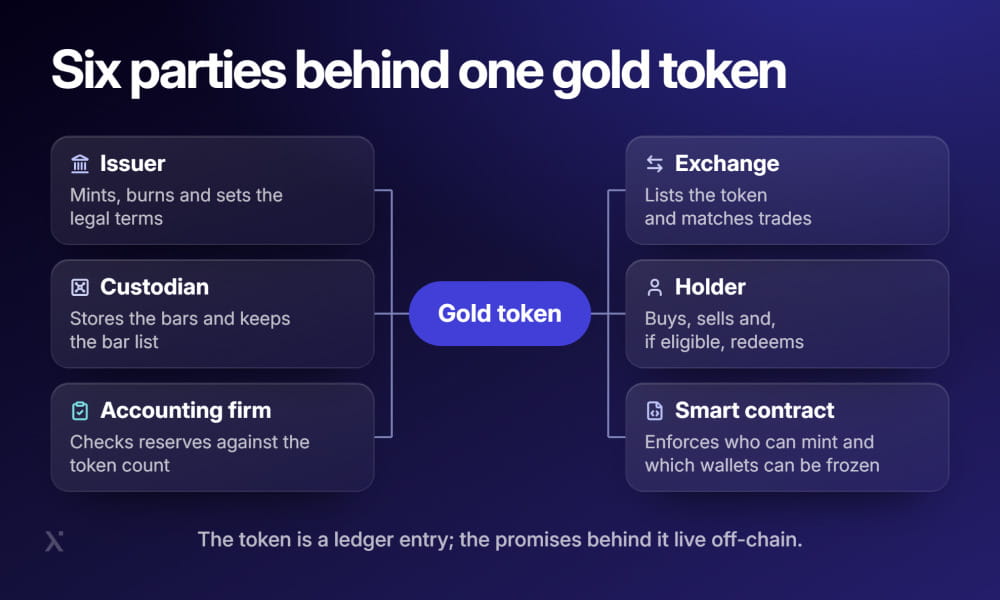
Every gold token follows the same lifecycle. Gold goes into a vault, tokens are created, they trade, and they’re destroyed (burned) when someone swaps them back for metal or cash. At each step, the vault record and the blockchain record must match. That’s why teams working on tokenization platform development map this lifecycle first.
Storage and custody
Most issuers use London Good Delivery bars, the wholesale standard set by the London Bullion Market Association (LBMA). Each bar holds between 350 and 430 troy ounces of fine gold, usually around 400. The custodian keeps a bar list with each bar’s refiner, serial number, weight, and purity, and holds the metal under a custody agreement with the issuer.
That agreement decides what happens if the issuer fails. If bars are segregated, meaning kept apart from the issuer’s own assets, holders are usually in a stronger position. The token sits on top of this arrangement without changing it, so the custody agreement is the first document to read.
Reserve verification and audits
How do you know the gold is really there? Issuers usually offer one or more of these:
- Proof of reserves: a public comparison of tokens in circulation with the gold the custodian reports
- Attestation: an accounting firm checks the issuer’s reserve figures on a specific date
- Financial audit: a full review of the issuer’s accounts over a period, including its debts
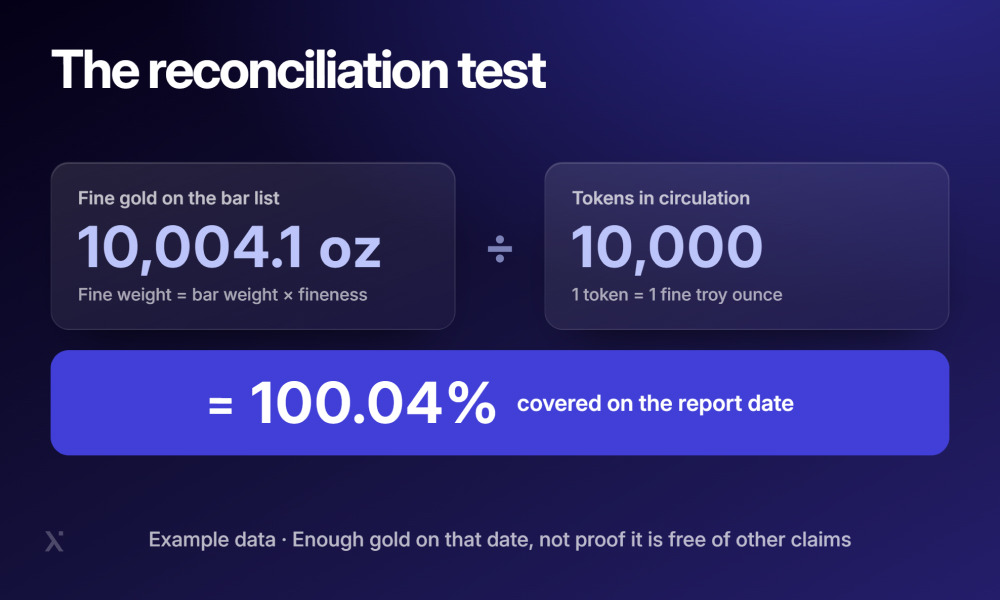
The core test is reconciliation: checking that the number of tokens matches the ounces in the vault. Passing it doesn’t prove the gold is free of other claims or that you can redeem it.
A reserve report shows that on its date the custodian reported at least as much gold as there were tokens, and that an accounting firm checked this. A published bar list lets anyone match serial numbers and weights.
It can’t show what happened between reports, whether the gold is also pledged to someone else, how a court would treat it in a bankruptcy, or whether your redemption will be processed on time. Those answers sit in the custody agreement, the governing law, and the redemption policy.
Issuance, circulation, and redemption
New tokens are minted when a verified customer sends cash or gold to the issuer and the issuer confirms the metal is in the vault. Most buyers never see this step. They buy existing tokens on an exchange, which changes the owner but not the total number of tokens.
Redemption works in reverse. An eligible holder returns tokens, the issuer burns them, and the holder receives bars, smaller bullion, unallocated metal, or cash. Selling on an exchange is different: you get the market price, the tokens keep circulating, and you have no claim on the issuer.
Here’s a simple example with a hypothetical product. Each token represents one ounce, and physical redemption starts at one full bar. You hold 500 tokens and ask for metal. The issuer assigns you a bar containing 401.2 ounces, burns 401.2 of your tokens, and charges a delivery fee. Total supply drops by 401.2 tokens. You keep the remaining 98.8 tokens, which you can hold or sell. Had you sold all 500 on an exchange instead, you’d get cash and supply wouldn’t change.
Rules such as who can mint and which wallets can be frozen are coded into smart contracts. Good smart contract development keeps that code consistent with the legal terms. Conditions differ by product, so check:
- Eligibility: whether you need identity checks to mint or redeem directly, and which countries are excluded
- Allocation: whether you get specific bars, a share of a pool, or a claim on the issuer
- Fees: storage and transfer charges, and how they’re collected
- Reserve reports: how often they appear, who prepares them, and whether a bar list is public
- Redemption minimums: the smallest amount you can redeem and where gold can be delivered
- Timing: business days, cut-off times, and how long delivery takes
Gold token lifecycle and control points
| Stage | Responsible party | Off-chain evidence | Ledger action | Holder-facing restriction |
| Bullion intake | Custodian and issuer | Bar list, assay data, custody receipt | None yet | None |
| Minting | Issuer | Custody confirmation, payment or metal receipt | Tokens created to an approved wallet | Direct minting limited to verified customers |
| Circulation | Holders and exchanges | Exchange records, compliance screening | Transfers between wallets | Approved-wallet lists or freezes where supported |
| Reconciliation | Issuer and accounting firm | Bar list versus token count; attestation | Token count read from the ledger | Reports only on a fixed schedule |
| Redemption | Issuer and custodian | Request, delivery or payment record | Tokens burned | Eligibility, minimums, fees, delivery locations |

Asset Tokenization 101

How to Launch a Security Token Offering Platform: Comparing Custom STOs vs Ready-Made Options
The tokenized gold market today
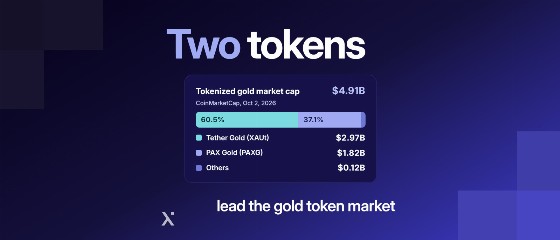
Two products dominate. PAX Gold (PAXG), issued by Paxos, and Tether Gold (XAUt), issued within the Tether group, are by far the largest by market value, as the figures below show. Smaller issuers use other units, such as grams, and other vaults. PAXG and XAUt run on public blockchains, including Ethereum. They aren’t Canton-native and weren’t part of the Euroclear pilot.
Before buying a gold token on an exchange, check the contract address against the one on the issuer’s website. Fake tokens can copy a name.
Major gold token products at a glance (as of October 2, 2026)
| Issuer | Token | Backing unit | Disclosed custody arrangement | Direct redemption eligibility |
| Paxos Trust Company (product page, white paper) | PAX Gold (PAXG) | One fine troy ounce of gold from a London Good Delivery bar | LBMA vaults in London (Brink’s, per the white paper); bar details viewable by wallet address | Paxos account holders: USD at market price, or whole London Good Delivery bars (the white paper puts this at about 430 PAXG, the maximum bar weight; the exact amount depends on the bar assigned); smaller amounts through partner dealers |
| TG Commodities, S.A. de C.V., Tether group (FAQ) | Tether Gold (XAUt) | One troy ounce of fine gold on an LBMA Good Delivery bar | Vaulted in Switzerland; delivery only within Switzerland; bar details viewable by wallet address | Verified (KYC/KYB) customers, excluding U.S. persons; whole bars only; Swiss delivery or sale for USD, 25 bps fee |
On public blockchains, every transfer is visible to anyone. Use a block explorer to compare the token count with the latest reserve report. It’s a quick consistency check.
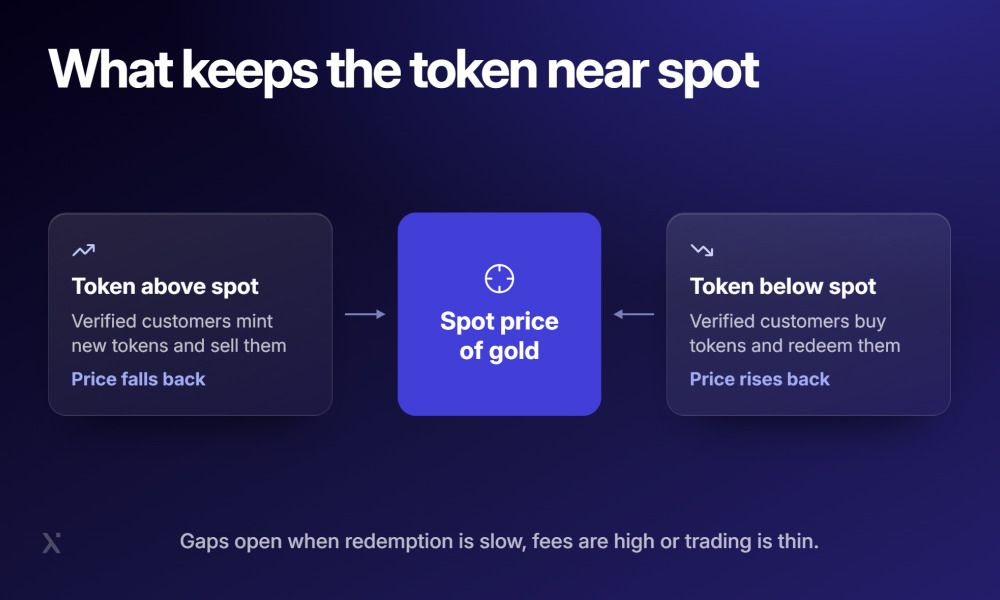
The tokenized gold price follows the spot price (the current price for immediate delivery) of the gold each token represents. Verified customers keep it close: if the token trades above spot, they can mint and sell; if below, they can buy and redeem. Gaps still open on small exchanges, when redemption is slow, and in market stress. Purchase, redemption, and delivery fees also reduce what you get back.
Tokenized gold market cap is the number of tokens in circulation multiplied by their price. It doesn’t show how much gold is in the vault, how much is traded, or how easily you could sell a large amount (liquidity). A gold-backed token with a high market cap can still be hard to trade on any single exchange. Data providers also count differently, so check each figure’s source, date, and definition. None of these totals shows how much gold banks use as collateral.
As of October 2, 2026, CoinMarketCap’s Tokenized Gold category showed a combined market cap of about $4.91 billion and 24-hour trading volume of about $397 million. Tether Gold ($2.97 billion) and PAX Gold ($1.82 billion) made up roughly 98% of that total. The figure covers only market caps CoinMarketCap has verified, and the category also includes a few tokens that aren’t backed by gold.

An All-Encompassing Guide To Real Estate Tokenization

Diving Into Carbon Credit Tokenization: From Definition and Benefits to Project Implementation
Gold-backed tokens versus gold as institutional collateral
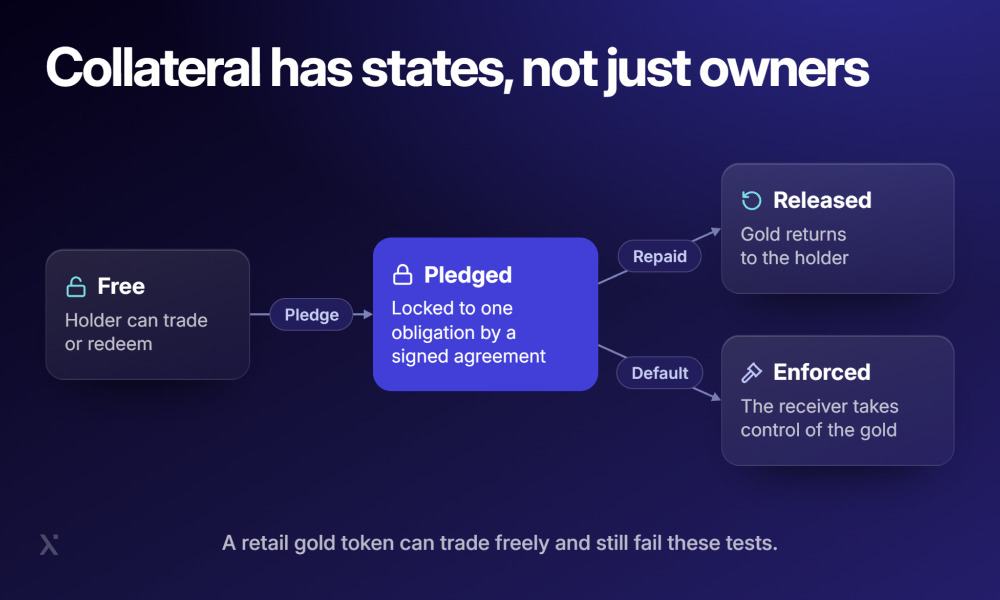
A retail gold token is built to be held, traded, and sometimes redeemed. Collateral has a tougher job. It’s an asset handed over to secure a debt, so the lender must be able to lock it, value it, and take it over if the borrower defaults. A gold-backed token can trade freely and still fail these tests.
For real-world asset tokenization to support collateral use, the lender needs enforceable rights to the gold and a way to take control if the borrower defaults. We cover the wider effects on banks in our article on tokenized gold and the financial industry. The table shows what to check when gold tokenization targets collateral use.
Retail gold tokens and institutional collateral requirements
| Dimension | Typical retail gold token | Requirement to evaluate for collateral use |
| Purpose | Ownership, trading, saving | Securing a specific obligation under a signed agreement |
| Eligible users | Anyone with an exchange account or wallet | Verified counterparties and agents only |
| Transfer restrictions | Open transfers, with issuer freeze powers | Transfers limited to approved parties and workflows |
| Rights | Claim defined by issuer terms | Rights the collateral receiver can enforce |
| Valuation | Exchange price | Agreed price source and haircut (a safety discount on value) |
| Pledging or locking | Generally not supported | Assets locked to an obligation and released on agreed events |
| Enforcement | Holder sells or redeems | Receiver takes control on default, with the custodian following its instructions |
| Integration | Wallets and exchanges | Links to collateral, risk, and custody systems |
Why gold is rarely used as collateral
Gold was eligible as collateral long before tokens appeared. According to the pilot report, ISLA (an industry body) and many CCPs recognize gold as eligible collateral in margin and other transactions. Yet it is rarely used, because the metal is hard to move and store (pilot report, p. 4).
Owning bars isn’t the same as delivering them the moment a margin call arrives. Gold tokenization can ease some of the obstacles, as the table shows.
Collateral constraints and the changes tokenization can support
| Constraint | Potential operational response | Limitation that remains |
| Physical location | Transfer the record and rights while bars stay in the vault | Local law still governs access to the vault |
| Bar differences | Standard unit plus a separate record of bar details | Purity, weight, and location still affect value |
| Settlement hours | Ledger settlement outside business hours | Custodian approvals may still follow office hours |
| Several intermediaries | One shared record for custodian, borrower, and lender | Each custodian must connect and accept ledger instructions |
| Documentation | Ledger referenced in collateral agreements | Agreements may still need changes |
| Control on default | Assets locked to an obligation, with closeout steps in smart contracts | Enforceability depends on law, not code |
| Systems integration | Connections between ledger and collateral platforms | Older systems may not handle real-time events |
The Standard Gold Unit and the two-token design
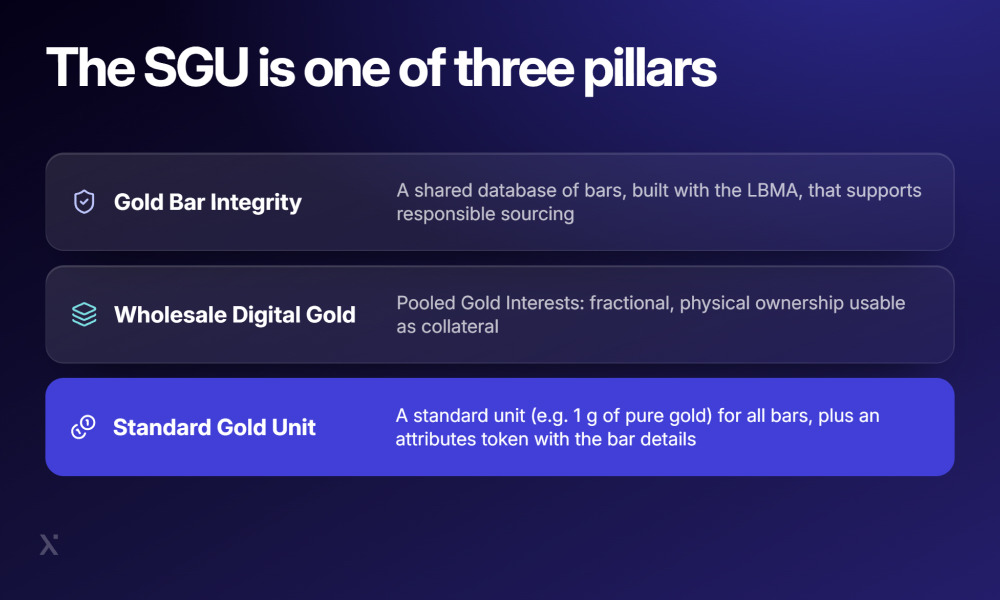
The pilot split gold into two linked records. The Standard Gold Unit™ (SGU) carries the money value of a standard amount of gold. The report uses one gram of pure gold as an example, not a fixed size (pilot report, p. 4). A separate attributes token records the purity, weight, and location of the bars behind those units. Together they form one digital asset representing the same gold.
Why split it? Bars differ from one another. Separating value from bar details lets units be treated as interchangeable in lending and margin deals, while custodians and lenders can still see which bars stand behind them. The WGC argued this could let any gold of trusted quality serve as collateral regardless of its features or location. However, the report also says location affects price (p. 11), so it still matters for valuation and enforcement.
The report doesn’t name a token standard for the attributes token, and other products don’t need two tokens. The SGU is one of three strands of the WGC’s broader Gold247 program. The WGC’s later paper Digital Gold: The Case for a Shared Infrastructure sets out wider proposals for gold tokenization. Check their current status with the WGC.
The two components of the pilot’s gold representation
| Component | Purpose | Represented information | Relationship to the underlying bullion |
| Standard Gold Unit (SGU) | Unit that moves in transactions | Value of a standard quantity (example: one gram of pure gold) | Represents the value of the stored bars; not a separate reserve |
| Attributes token | Record of the bars’ physical details | Purity, weight, and location | Describes the same bars; no extra gold claim |
What the Euroclear and World Gold Council pilot demonstrated
In June and July 2024, Digital Asset, Euroclear, the WGC, and a group of banks, investors, custodians, and market infrastructure firms tested tokenized UK government bonds (gilts), international bonds (Eurobonds), and gold. They used them in linked repo deals (short-term loans secured by bonds), margin calls, and securities lending. The results were announced in October 2024.
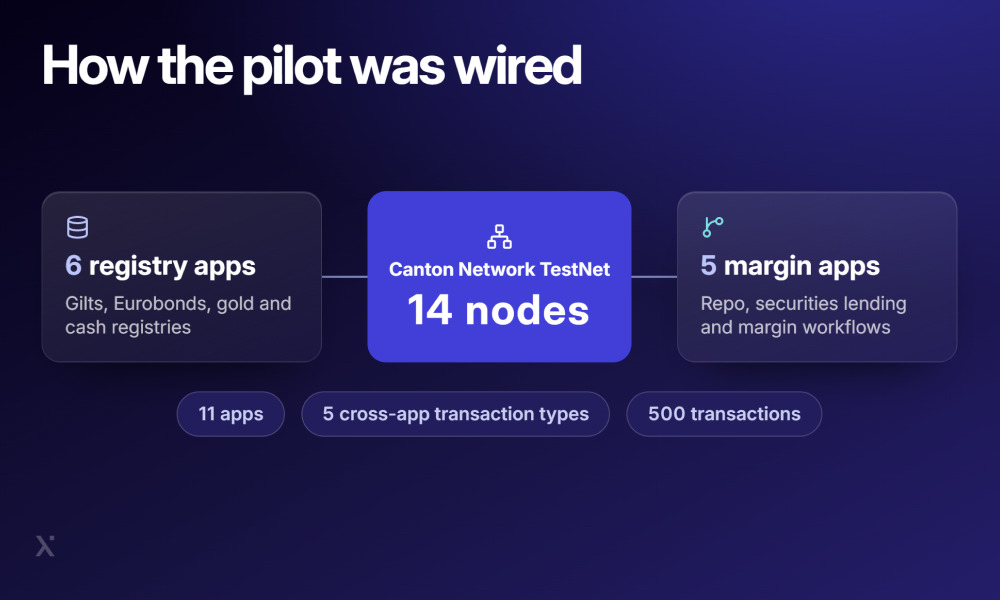
The pilot involved 27 organizations, 11 of them observers. Together they ran 14 Canton nodes and over 500 transactions across a simulated three-day period on Canton Network TestNet, a test version of the network. It treated real-world asset tokenization as a collateral problem. Each token was a “digital twin”: a record mirroring an asset that stays locked in its original system.
The Canton Network Explained blog article covers the basics. Two features matter here. Each participant sees only the data it’s entitled to. And separate applications can complete one transaction atomically, meaning every part settles or none does, so nobody hands over an asset without receiving the other side. Unlike PAXG or XAUt transfers, pilot transactions were visible only to the parties involved. Smart contracts written in Daml, Canton’s contract language, connected the bond, gold, and cash registries with the repo, lending, and margin apps.
Our guide to tokenizing RWAs on Canton covers real-world assets (RWAs) more broadly. Comparable workflows require Canton blockchain development across registries, apps, and custodian systems. PixelPlex didn’t take part in this pilot.
The gold scenarios followed a Day 1 cash leg: a prime broker (a bank that serves hedge funds and other large investors) borrowed GBP in a repo against tokenized gilts and pledged that cash to the CCP as variation margin.
Gold as collateral in securities lending
In securities lending, one firm borrows bonds or shares and hands over collateral in return. On simulated Day 2, a prime broker borrowed Eurobonds from an investor and offered gold as collateral. After the gold custodian approved, the gold was tokenized as an SGU and an attributes token. One atomic transaction then gave the Eurobonds to the prime broker and the gold to the investor. Both could be reused right away.
Gold for a CCP variation margin call
Variation margin is a payment that covers daily losses on open trades. Later on Day 2, the CCP issued a further variation margin call on cleared derivatives, and the prime broker met it by pledging gold tokens. The custodian approved, and the gold was locked to that obligation. A pledge isn’t a sale: the gold could still be released or taken over later. Many CCPs require variation margin in cash, so this tested a mechanism, not current CCP practice.
Taking control of gold after a prime broker default
On Day 3, the prime broker defaulted in the simulation. It was removed from the workflow, and the closeout, meaning the takeover of its pledged assets, ran between the margin app operator, the CCP, and the custodians. It followed the default rules in the standard contracts for derivatives, repo, and securities lending: the ISDA Master Agreement, the Global Master Repurchase Agreement (GMRA), and the Global Master Securities Lending Agreement (GMSLA). The CCP chose which pledged assets to take, the cash and gold custodians approved, and ownership passed to the CCP in one atomic transaction.
The closeout could start only after offline steps, such as signed documents, were complete (p. 14). Locking mattered too: the GBP cash pledged on Day 1 and the gold pledged on Day 2 were tied to their obligations, so the prime broker couldn’t move them before the default. Code didn’t seize a bar. The custodians’ approval and their agreement to act on the CCP’s instructions gave the CCP control.
Lawyers from Clifford Chance observed the pilot and suggested existing contracts might work with small changes, depending on their wording. ISLA later published a Digital Assets Annex for the GMSLA. No court has ruled on this scenario.
Three gold collateral scenarios demonstrated in the pilot
| Scenario | Obligation | Participants | Gold action | Demonstrated outcome | Limit of the evidence |
| Securities lending | Secure a Eurobond loan | Prime broker, investor, gold custodian | Gold tokenized and delivered together with the bonds | Loan settled against gold in one step | One lender–borrower pair |
| CCP variation margin | Meet a margin call | Prime broker, CCP, gold custodian | Gold pledged and locked | Real-time pledge | No CCP rule change shown |
| Simulated default | Enforce the pledge | CCP, app operator, custodians | Locked gold transferred to the CCP | CCP gained control | Lawyers’ views, not court rulings |
The report describes gold as a high-value, low-risk asset that converts easily to cash. It lists these outcomes: a new pool of collateral, real-time posting and recall through atomic settlement that removes settlement risk between the parties, and control over both the token and the underlying gold (pp. 4, 14, 17). These are results from a simulation, not a promise of 24/7 service from any custodian or CCP.
What happened next? Digital Asset said it would work toward a production solution, and Euroclear later announced further collateral mobility work with Digital Asset. A January 2026 report by The VX describes live 2025 trades on Canton Network in which tokenized US Treasury bills were exchanged for stablecoins in short-term repo deals. Those trades involved Treasuries, not gold.

How Canton Solves the Privacy Problem for Institutional On-Chain Finance

Canton Network's Next Chapter: From Infrastructure to the Application Economy
What changes for treasury and risk teams
Go back to that Friday margin call. On a shared ledger, the bank’s gold could be pledged in real time, as it was in the pilot, but only if the CCP accepts gold, the custodian can approve outside office hours, and the bank’s own systems can see the position. That makes gold collateral less about logistics and more about data and controls. Holdings appear as ledger balances, but whether gold qualifies still depends on bar details and each counterparty’s rules. Margin calls can arrive faster than staff can approve them, and access settings decide who sees which holdings.
In the live Treasury trades, participants found that old systems and manual steps, such as onboarding and sanctions screening, slowed the benefits (VX report, p. 17). That evidence comes from Treasuries, but gold would need the same integration work, usually handled through enterprise blockchain development. Questions to answer early:
- Do counterparties that accept gold also accept it in token form?
- How will collateral systems read SGU balances and bar details next to bonds and cash?
- Who approves pledges, releases, and swaps outside office hours?
- Which price source and haircut apply, and how is vault location reflected?
- How are ledger balances matched with bar lists and internal books?

DAML Development Services: Everything You Need to Know
Canton Network 2026’s DeFi Boom: Top Profitable Solutions to Build
Risks and limitations
Custodial risk and redemption rights
A token is only as strong as the custody and legal setup behind it. If an issuer or custodian fails, what holders recover depends on segregation, local bankruptcy law, and the issuer’s terms. Direct redemption is often limited to verified customers above a minimum amount, so everyone else depends on selling on an exchange.
Storage jurisdiction
Vaulted gold is subject to local law, court orders, and export rules. Moving a token changes the record of who owns what. It doesn’t change which court or authority controls access to the vault.
Secondary-market liquidity
Liquidity for a gold-backed token depends on how many exchanges list it, whether market makers quote prices, and whether verified customers can mint and redeem to close price gaps. When few people trade, the spread (the gap between buy and sell prices) widens, and tokens limited to approved holders may barely trade. Easier transfers don’t create buyers, and liquidity can vanish in a crisis.
Regulatory recognition
Three questions are separate: can the token be transferred, does the law treat it as a claim on gold, and will a given institution accept it as collateral? Answers vary by country. Our overview of regulatory approaches to gold tokenization summarizes the main models. This isn’t legal advice.
Risks, evidence to request, and residual limitations
| Risk | Evidence to request | Residual limitation |
| Issuer or custodian failure | Custody agreement, segregation terms, legal opinion on bankruptcy | Outcome depends on facts at the time |
| Redemption | Terms, eligibility rules, fees, processing times | Terms can change; processing can pause |
| Storage jurisdiction | Vault location, governing law, access procedures | Local courts and authorities can block access |
| Secondary-market liquidity | Order book depth, spreads, exchanges | Trading can dry up in stress |
| Regulatory recognition | Issuer licensing, written acceptance from counterparties | Varies by country and institution |
| Contract and key management | Code audits, admin key controls, freeze policies | Audits don’t rule out bugs |
| Valuation and price feeds | Price source, backup rules, adjustments for bar details | Feeds can lag in volatile markets |
Ask for evidence, not assurances: each risk above has a document behind it. If an issuer can’t show it, that’s an answer too.
How to evaluate a tokenized gold product
Start with what the token legally represents, then check custody, evidence, costs, and access. Two documents answer most of these questions: the custody agreement and the redemption terms. They explain what you can claim, when you can redeem, and what happens if the issuer fails. Institutions considering collateral use also need answers on control, contracts, valuation, and eligibility.
Due diligence questions for a gold token product
| Question | Evidence to request | Why it matters |
| What does one token legally represent? | Terms of service or offering document | Defines your claim if something goes wrong |
| Where is the gold, and who holds it? | Custody agreement, vault location, bar list | Determines access and governing law |
| How is backing verified? | Attestations, proof-of-reserves data, audit reports | Shows how often and how deeply it’s checked |
| What does holding cost? | Fees for storage, transfers, minting, and redemption | Fees reduce value against the gold price |
| Who can redeem, and how? | Redemption policy, minimums, delivery options | Redemption keeps the price close to gold |
| Where does it trade? | Exchange list, official contract address, spreads | Affects exit cost and exposure to fake tokens |
| Can transfers be blocked? | Freeze functions and sanctions policy | Affects access to your holding |
| Can it be pledged and enforced? | Collateral agreements, control mechanism, legal opinions | Required for institutional collateral use |
Warning signs worth taking seriously:
- No named custodian or vault location
- No public bar list, or reserve reports that are out of date
- Redemption only for cash, or minimums far above your holding
- Terms that let the issuer change fees or freeze tokens without notice
- A contract address that differs from the one on the issuer’s site
Teams designing or reviewing an implementation can work with an asset tokenization company on ledger and workflow design. Reserve checks, legal opinions, and investment decisions stay with auditors, lawyers, and investors.
How PixelPlex helps
PixelPlex brings 13+ years of blockchain experience to real-world asset tokenization and works directly on Canton. We operate a validator, hold General Foundation Member status, and have co-authored three Canton Improvement Proposals: CIP-103, CIP-169, and CIP-204. Our CC Suite includes wallets, counterparty screening, and the CC View explorer, which indexes Canton ledger updates. In July 2026, PixelPlex was one of four institutions in the first non-custodial cross-chain atomic swap on Canton, exchanging Canton Coin for USDC on Ethereum while every party kept its own keys.
Blockchain consulting helps define requirements and feasibility. Our Daml development teams build issuance, redemption, pledge, and closeout workflows and connect them to treasury, risk, and custody systems. As an asset tokenization company, we also provide tokenization solutions for issuers that need a complete product. PixelPlex isn’t a gold issuer, custodian, auditor, or legal adviser. Planning a gold token or a collateral workflow? Let’s talk.
FAQ
It’s a ledger token representing a set amount of vaulted gold. What you own depends on the issuer’s terms: specific bars, a share of a pool, or a contract with the issuer. The token balance alone doesn’t tell you which.
It’s meant to be: the issuer says each token is backed by physical gold held with a custodian. You can check the bar list, attestations, and proof-of-reserves reports. They confirm matching amounts on a given date, not the absence of other claims on the gold.
Most people buy on an exchange that lists the token, or directly from the issuer after identity checks. Before buying, check how you’ll get out: whether you can sell on the same exchange or redeem with the issuer. Confirm that the exchange serves your country, read the issuer’s terms and fees, and match the contract address against the issuer’s website.
Trading sets it, close to the spot price of the gold each token represents. Minting and redemption by verified customers keep it near that level. Fees, thin trading, and slow redemption can push it above or below.
Tokens in circulation multiplied by price. It doesn’t measure gold in the vault, trading volume, or gold used as collateral. Compare figures only when the source, date, and definition match.
Sometimes. Physical redemption is usually limited to verified customers, with high minimums (sometimes a full bar), fees, and fixed delivery locations. Some products redeem only for cash.
Yes, many can. Issuers often keep the power to freeze wallets or pause transfers for sanctions and court orders. Check the issuer’s policy before buying.
It has been tested. The 2024 Euroclear, WGC, and Digital Asset pilot ran gold through securities lending, a margin call, and a simulated default on Canton Network TestNet. Live use would need a product, a custodian, signed agreements, and a counterparty willing to accept it.