With the ever-increasing number of online transactions, privacy and security have become critical concerns. This is where zk-SNARKs come into play.
Most digital systems verify a claim by inspecting the data behind it. A bank confirms a payment by reading your balance, a website confirms a login by checking your password against a stored copy. Zk-SNARKs offer a different model: prove that a statement is true while revealing nothing beyond its truth.
Zk-SNARK stands for Zero-Knowledge Succinct Non-interactive ARgument of Knowledge. In plain terms, it is a cryptographic proof that lets a prover convince a verifier they know a piece of information (a password, a private key, the result of a computation) without disclosing it. The proof is small, quick to check, and needs only one message from prover to verifier.
That combination made zk-SNARKs foundational well beyond their original home in privacy coins. Succinctness is what compresses that computation into a small proof (the zero-knowledge property is what keeps the underlying data hidden) and together they explain why zk-SNARKs now underpin the ZK rollup scaling solutions used across Ethereum.
This article explains what zk-SNARKs are, how they work, their benefits and limits, how they compare with zk-STARKs, and where they are used in production today.
Searching for an experienced blockchain development company? Let’s get acquainted
What are zk-SNARKs?
A zk-SNARK lets a prover demonstrate possession of certain information without handing that information over, and without any ongoing dialogue between the two parties. Each letter of the acronym describes a property that makes the technology practical: the proof is zero-knowledge (the verifier learns nothing beyond the fact that the statement is true), succinct (small and fast to verify), non-interactive (a single message rather than repeated challenges), and an argument of knowledge (it holds against any realistic, computationally bounded prover).
The idea traces back to zero-knowledge proofs from the 1980s, which originally required the prover and verifier to exchange many rounds of messages. In 2012, a research paper by Nir Bitansky, Ran Canetti, Alessandro Chiesa, and Eran Tromer introduced the “SNARK” framing, describing a proof that removed the need for that interaction and collapsed it into one step.
The technology quickly moved from theory into a shipping product. Chiesa went on to help create Zcash, a privacy-focused cryptocurrency that launched in 2016 and used zk-SNARKs to shield transaction details. Zcash remains the reference example of zk-SNARKs securing real value, and the proving systems it pioneered now show up across the wider blockchain ecosystem.
How do zk-SNARKs work?
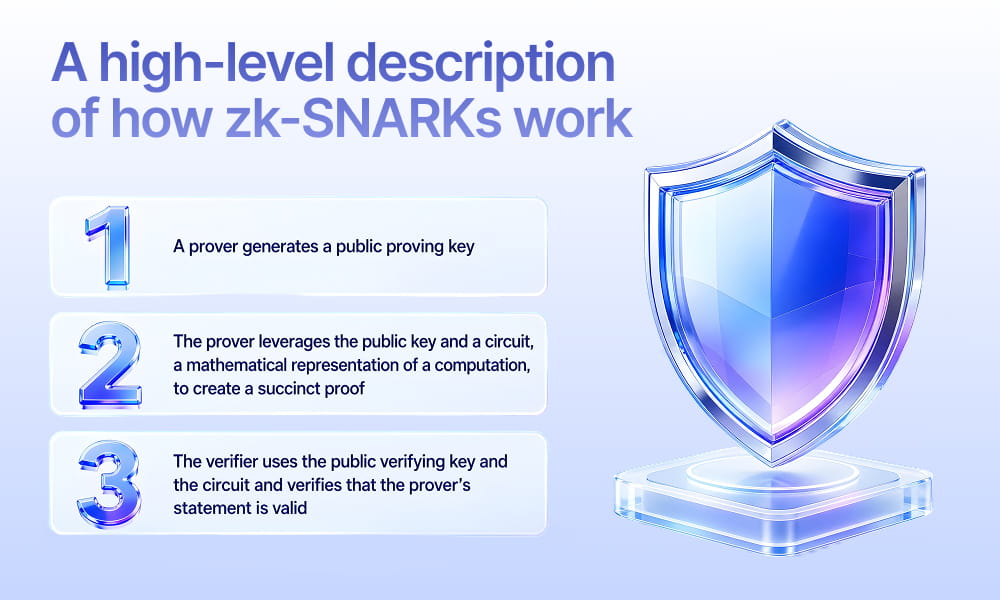
At a high level, a zk-SNARK involves three ingredients and three steps. The system is first set up to produce a pair of keys (a proving key and a verifying key) tied to a circuit, which is a mathematical description of the computation being proved.
The flow then looks like this:
- The prover takes the proving key, the circuit, and their private input (the “witness”) and generates a short proof.
- The proof travels to the verifier as a single message.
- The verifier uses the verifying key and the circuit to check the proof, confirming the statement is true without ever seeing the witness.
A password analogy makes the payoff concrete. Normally, logging in means sending your password so a server can compare it against a stored copy, which means the server holds something worth stealing. With a zero-knowledge approach, you instead prove mathematically that you know the correct password. The server verifies the proof and stores no password, so there is nothing to leak in a breach.
The deeper point is that a zk-SNARK proves not just that some information exists, but that the prover actually knows it. That distinction is what makes the technique useful for authentication, compliance, and any setting where trust has to be established without exposing the sensitive input.
What are Zero-Knowledge Rollups?
What Are Zero-Knowledge Proofs? Making Private Transactions Possible
What are the benefits of zk-SNARKs?
Privacy by default. Zk-SNARKs let individuals and organizations transact and share information while keeping the underlying details confidential. A party can prove a fact that a payment is within limits or that a user is over 18 without revealing the data behind it.
Succinct, cheap verification. Proofs are tiny and can be checked in milliseconds regardless of how complex the original computation was. On a blockchain, that means a network can confirm a large batch of work with one small on-chain check, which is the mechanism behind ZK rollups and their low per-transaction costs.
A single round of communication. Because verification is non-interactive, there is no repeated exchange between prover and verifier. One message settles it, which simplifies system design and keeps operating costs predictable.
Compression of computation. Succinctness compresses work on its own terms: a heavy off-chain computation becomes a small proof that anyone can verify quickly. This is why zk-SNARKs have become core scaling infrastructure for Ethereum rather than a niche privacy tool.
The limits and criticisms of zk-SNARKs
The most cited concern is the trusted setup. Many zk-SNARK schemes begin by generating a Common Reference String (CRS). The secret randomness used to create it (sometimes called “toxic waste”) must be destroyed, because anyone who retained it could forge proofs that still look valid to verifiers.
This risk is real, but it is far more manageable than it once was. Projects mitigate it in three ways: multi-party ceremonies in which no single participant ever holds the full secret (so the setup is safe as long as one participant is honest); universal and updatable setups such as PLONK, where a single ceremony can serve many applications; and setup-free systems such as Halo 2, which remove the trusted setup entirely. Zcash itself moved to a trusted-setup-free design with its Halo 2 upgrade.
Other trade-offs remain live considerations. Proving is expensive: generating a zk-SNARK is computationally heavy, which adds latency and pushes teams toward GPUs and specialized hardware for high volumes. Quantum exposure is a factor too: most zk-SNARKs rely on elliptic-curve cryptography and are not quantum-resistant, unlike hash-based approaches. And circuits are hard to build and audit; a subtle error in a circuit can be difficult to detect and expensive if it reaches production, which raises the value of rigorous review and dedicated smart contract audit services.
The State of Crypto Regulations and Laws in 2026
The US Cryptocurrency Taxes Guide: What Gets Taxed
How zk-SNARK proving systems have evolved
“Zk-SNARK” is not a single algorithm but a family that has advanced quickly, and the choice of proving system is now a real engineering decision with consequences for setup requirements, proof size, and proving speed.
| Proving system | Trusted setup | Notable for |
| Groth16 (2016) | Yes, circuit-specific | Extremely small, cheap-to-verify proofs; still widely used in production |
| PLONK (2019) | Universal and updatable | One setup reusable across many circuits; a common base for newer systems |
| Halo 2 (2020–2021) | None | Recursive proofs with no trusted setup; adopted by Zcash |
| Plonky2 (2022) | None | Fast recursive proving that blends PLONK and STARK techniques; used by Polygon |
| zkVMs (e.g. RISC Zero, SP1) | Varies | Prove ordinary programs (often RISC-V), lowering the barrier for developers |
The trend line is clear: away from rigid, setup-dependent constructions and toward flexible, recursive, and increasingly setup-free systems. The arrival of general-purpose zkVMs is especially significant for business, because it lets teams prove the execution of normal code without hand-writing bespoke circuits, shortening development time and widening the pool of engineers who can build with the technology.
Check out top cybersecurity trends that your business should be aware of
Zk-SNARKs vs zk-STARKs
Zk-SNARKs are frequently compared with zk-STARKs (Zero-Knowledge Scalable Transparent Arguments of Knowledge). STARKs rely on hash functions rather than elliptic curves, which makes them transparent and resistant to quantum attacks. The main cost is proof size.
| Dimension | zk-SNARK | zk-STARK |
| Proof size | Very small, roughly constant | Larger, often 10–100× a SNARK |
| Trusted setup | Often required (newer schemes avoid it) | None |
| Verification | Fast and cheap | More computationally intensive |
| Quantum resistance | Typically vulnerable (elliptic curves) | Resistant (hash-based) |
| Best-fit uses | Privacy coins, on-chain verification, identity | Large computations, high-throughput scaling |
In practice the two are converging rather than competing. Because STARK proofs are large and expensive to verify directly on Ethereum, several systems generate a STARK-style proof for speed and transparency, then wrap it in a small SNARK so the final proof settling on-chain stays cheap. That hybrid pattern is now common in high-performance ZK rollups.
Top 10 Blockchain Use Cases In 2026: How Your Business Can Ride the Wave
![Blockchain Statistics And Trends Across Industries in 2026 [With Infographic]](https://pixelplex.io/wp-content/uploads/2023/04/blockchain-statistics-and-trends-main-1600.jpg)
Blockchain Statistics And Trends Across Industries in 2026 [With Infographic]
Zk-SNARK use cases
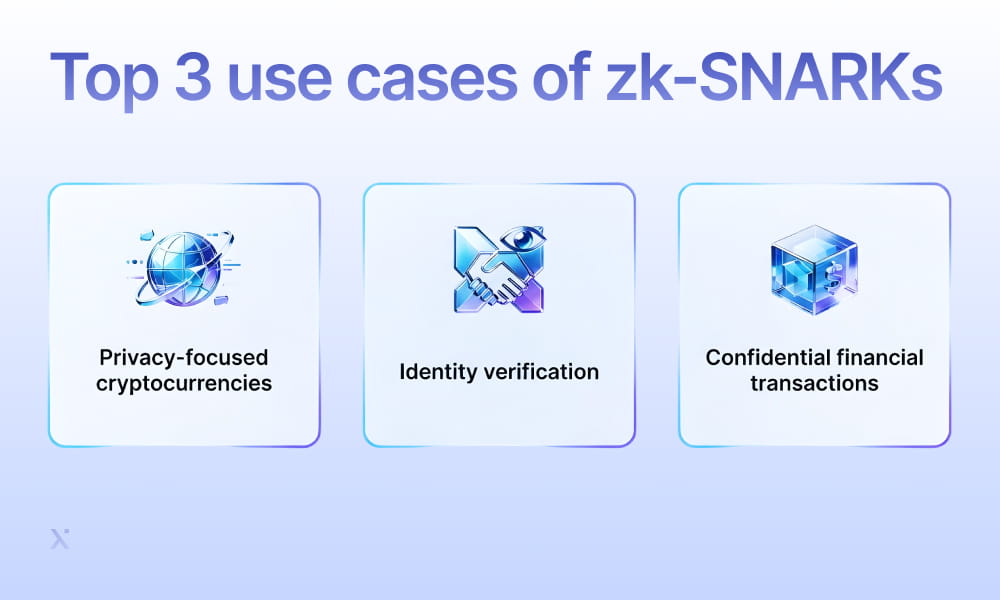
Blockchain scaling
This is the dominant use of zk-SNARKs today. ZK rollups execute thousands of transactions off-chain and post a single proof that Ethereum verifies cheaply, giving users lower fees and fast finality while inheriting Ethereum’s security. Leading rollups such as Polygon zkEVM, Linea, Scroll, and ZKsync Era all rely on SNARK proofs at settlement. These low-cost, high-throughput environments host much of today’s on-chain finance, making ZK rollups a common target for DeFi development services.
Privacy-preserving payments
The original application remains important. Zk-SNARKs let a network confirm that a transfer is valid (correct balances, no double-spend) without exposing the sender, recipient, or amount, keeping activity confidential while preserving on-chain integrity.
Digital identity and credentials
Users routinely prove who they are to access banking, travel, and other services, usually by over-sharing documents. Zk-SNARKs allow someone to prove a credential (e.g., that they hold a valid license or belong to an approved group) without revealing the document itself. Systems such as World ID (formerly Worldcoin) and Privado ID (formerly Polygon ID) apply this pattern. Privacy-preserving identity is also drawing concrete regulatory adoption: zero-knowledge proofs are a core technical requirement for the “selective disclosure” feature of the EU Digital Identity Wallet mandated by eIDAS 2.0, which lets someone prove they are over 18 without revealing their birthdate. That makes zk-SNARKs a natural fit for decentralized identity development.
Confidential and compliant finance
Demand here is rising across financial software development, with banking software development a particular hotspot. Zk-SNARKs let a bank prove a transfer meets anti-money-laundering rules or stays within limits without disclosing the amount or the parties, which is valuable for high-value corporate payments, cross-border settlement, and private banking. The same cryptography underpins proof-of-reserves and solvency proofs, which exchanges use to demonstrate they hold customer funds.
Emerging frontiers
Two newer categories are worth watching. Zero-knowledge machine learning proves that a specific model produced a given output, which supports verifiable and auditable AI. Web proofs (zkTLS) let a user prove that data genuinely came from a particular website or API, bringing off-chain facts on-chain in a trust-minimized way.
Have you heard of zkEVM? Check out how this cryptographic protocol helps enhance Ethereum blockchain’s scalability, security, and decentralization
Real-world examples of zk-SNARKs
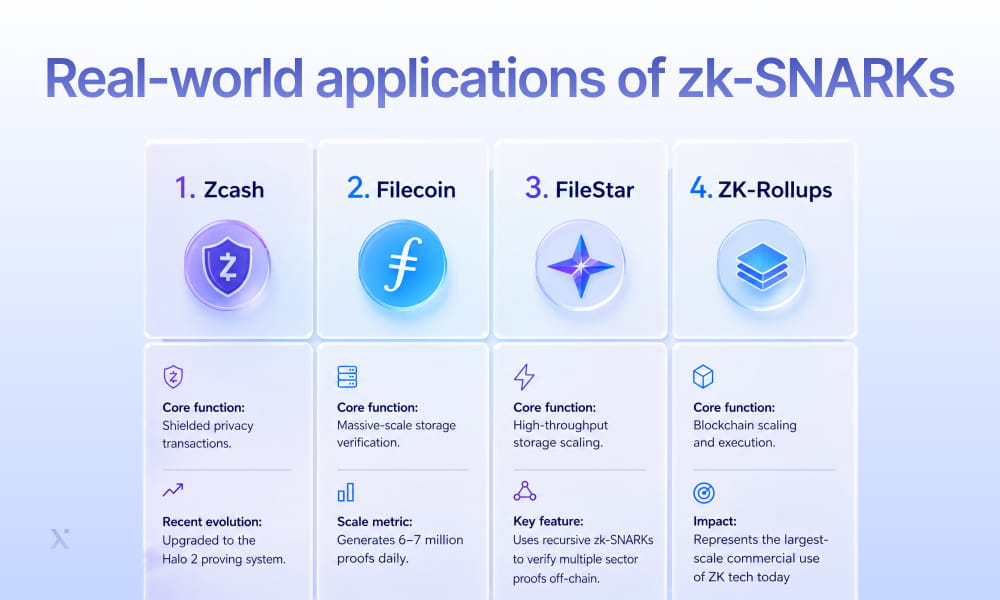
Zcash
It is the best-known example. It lets users choose between transparent and shielded addresses. When a shielded address is used, zk-SNARKs conceal who paid whom and how much while keeping the transaction verifiable. Zcash’s move to the Halo 2 proving system removed its dependence on a trusted setup, directly answering the criticism that dogged early zk-SNARK deployments.
Filecoin
It uses zk-SNARKs to prove that data is being stored correctly, compressing what would otherwise be enormous storage proofs into compact form. According to Protocol Labs, the network generates roughly 6 to 7 million zk-SNARK proofs per day, which makes Filecoin one of the largest deployments of zk-SNARKs anywhere. To keep that volume from clogging the chain, it uses aggregation techniques such as SnarkPack to bundle thousands of individual proofs into a single proof before submitting it on-chain.
FileStar
This is a decentralized storage network PixelPlex built on the Filecoin model, applying the same idea to a specific bottleneck. Because storage miners must submit frequent proofs, those messages can congest the chain at scale. FileStar uses recursive zk-SNARKs to verify many sector proofs off-chain and submit a single aggregate proof, which raises throughput and eases on-chain congestion, a concrete example of zk-SNARKs applied to Web3 development.
ZK rollups
ZK rollups represent the largest-scale deployment of the technology. Every proof that a rollup posts to Ethereum is a working example of zk-SNARKs verifying real economic activity — quietly, and at a scale far beyond the privacy coins where the technology began.
Conclusion
Zk-SNARKs have become core infrastructure for confidential computation and blockchain scaling, and the property that once seemed most interesting (hiding data) now shares the spotlight with the one that turned out to matter most at scale: compressing heavy computation into a proof anyone can verify in milliseconds. The old knock against them, the trusted setup, is increasingly a solved problem, leaving proving cost as the main constraint the industry is actively engineering away. The same properties are pulling the technology into regulated areas such as tokenization services and compliant finance.
PixelPlex is a blockchain development company that builds with zero-knowledge technology for privacy and blockchain scaling. If compliance is on your roadmap, our KYT solution adds real-time monitoring of on-chain activity to flag suspicious transactions and support AML requirements. Backed by 17+ years in blockchain and 450 completed projects, our team can help with enterprise blockchain consulting services, ZK integration, smart contract development services and audits, dApp development services, and full-cycle blockchain builds. Reach out to talk through your project.
FAQ
Zk-SNARK is short for Zero-Knowledge Succinct Non-interactive ARgument of Knowledge. It is a cryptographic proof that lets one party prove a statement is true without revealing the underlying data, using a small proof and a single message.
Zk-SNARKs produce smaller proofs that are cheaper to verify, but many require a trusted setup and are not quantum-resistant. Zk-STARKs need no trusted setup and are quantum-resistant, at the cost of larger proofs. Many production systems combine the two, generating a STARK-style proof and wrapping it in a SNARK for cheap on-chain settlement.
A trusted setup generates secret parameters that must be destroyed afterward, because anyone who kept them could forge valid-looking proofs. It is far less of a concern today: multi-party ceremonies remove single points of failure, universal setups such as PLONK can be reused across applications, and systems such as Halo 2 remove the trusted setup entirely.
The largest use is blockchain scaling: the ZK rollups that compress thousands of transactions into a single proof. They also power privacy-preserving payments, digital identity and credentials, and confidential, compliance-friendly financial transactions.
Usually not. Most zk-SNARKs rely on elliptic-curve cryptography, which quantum computers could eventually break. Hash-based approaches such as zk-STARKs are considered quantum-resistant, which is one reason some systems use STARK-based proving for the heavy computation.