Payment tokens and stablecoins move money, NFTs prove ownership of a unique asset, and tokenized real-world assets are now bringing traditional finance on-chain. Social tokens sit in a different lane: they tie value directly to a person, brand, or community.
Social tokens had their first big moment during the 2020–2021 creator economy boom, promising a direct financial link between creators, brands, and their audiences. The hype cycle that followed wiped out most of the early flagships — yet the underlying idea quietly matured. In 2026, top football clubs run fan token programs, restaurant groups settle loyalty rewards on-chain, and creator coins trade inside mainstream consumer apps.
What has changed is the framing: companies now treat tokens as programmable engagement infrastructure rather than a trend to ride. With the EU’s MiCA regulation in force and wallet UX that no longer looks like crypto, the groundwork is far more solid than it was in the first wave.
This updated guide explains what social tokens are today, which models businesses actually use, how these assets differ from NFTs and classic loyalty points, and what to weigh before launching your own token.
What are social tokens?
Social tokens are fungible cryptocurrency tokens issued by a person, brand, community, or platform, with value and utility tied to the issuer’s ecosystem. Holders typically receive access, rewards, recognition, or influence: exclusive content, merchandise, event tickets, voting rights, or revenue-linked perks.
“Fungible” is the key word. Every unit of a given social token is identical and interchangeable, like currency, which makes these tokens suitable for points-style rewards, tipping, and in-community payments. It is also what sets them apart from NFTs, in which each token is unique.
From social tokens to tokenized communities
“Social tokens” emerged as an umbrella label in 2020–2021. Since then, the industry has split it into more precise categories that reflect who issues the token and why:
- Creator economy tokens: issued by individual creators to monetize direct access and content;
- Fan tokens: issued for sports clubs and entertainment brands to activate global fanbases;
- Community tokens: issued by DAOs and interest groups for shared governance and treasuries;
- Loyalty and membership tokens: issued by brands as on-chain reward points and access passes.
The terminology evolved for a simple reason: the first wave tied the health of a community to the price of its token. When crypto prices collapsed in 2022, those communities collapsed with them. The models that survived (fan tokens with concrete perks, closed-loop loyalty points, contribution rewards) decoupled everyday utility from market speculation. ”Social tokens” remains a useful umbrella term, but in practice businesses now deploy one of these specialized models, often described simply as tokenized communities.
From Chaos to Compliance: How Cryptocurrency Regulation Is Shaping Up
The Real Price Tag of Launching a SafePal-Style Crypto Ecosystem
Why businesses use social tokens
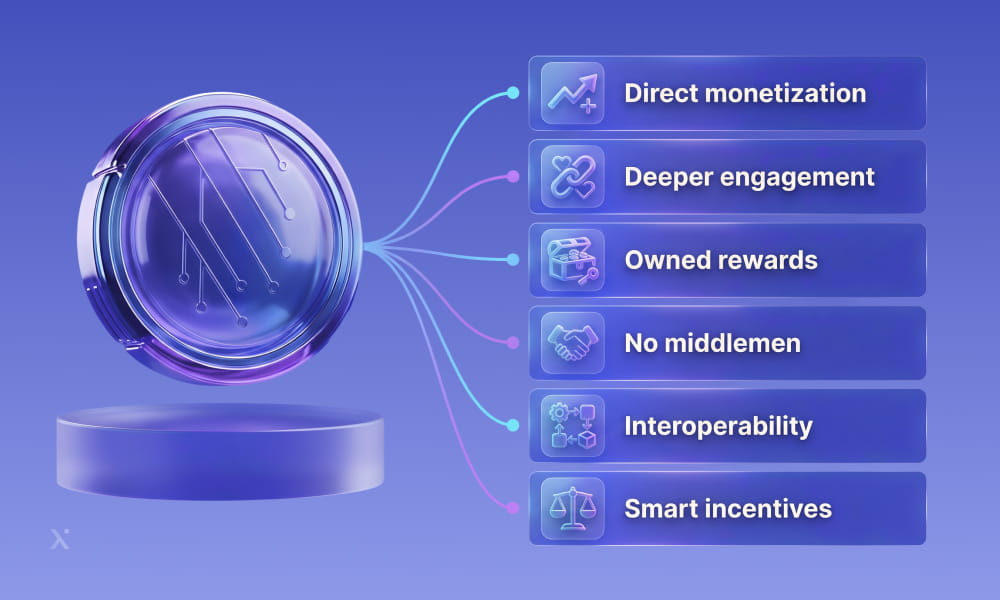
The benefits of social tokens for business come down to ownership, data, and programmability rather than quick fundraising:
- New monetization and funding rails. Established brands and creators sell token-gated access, products, and experiences directly, while early-stage projects can bootstrap through a community sale instead of relying solely on ads or platform revenue shares.
- Deeper, measurable engagement. Holding a token gives fans skin in the game, and on-chain activity shows exactly who your most loyal customers are, which is a verifiable, portable alternative to a CRM segment.
- Rewards customers actually own. Unlike miles locked inside one airline account, tokenized rewards sit in the user’s wallet and can be transferred or redeemed across venues, which raises their perceived value.
- Fewer intermediaries. Tokens create a direct economic relationship between a brand and its audience, reducing dependence on platforms whose take rates can reach 30–50%.
- Interoperability and partnerships. A single token can work across apps, venues, and partner brands, something siloed loyalty databases handle poorly.
- Programmable incentives and governance. Tiers, vesting, referral bonuses, and community votes are enforced by smart contracts instead of manual back-office processes.
One caveat: none of these benefits materialize without genuine utility behind the token. A social token is an engagement instrument, not a strategy in itself.
Types of social tokens
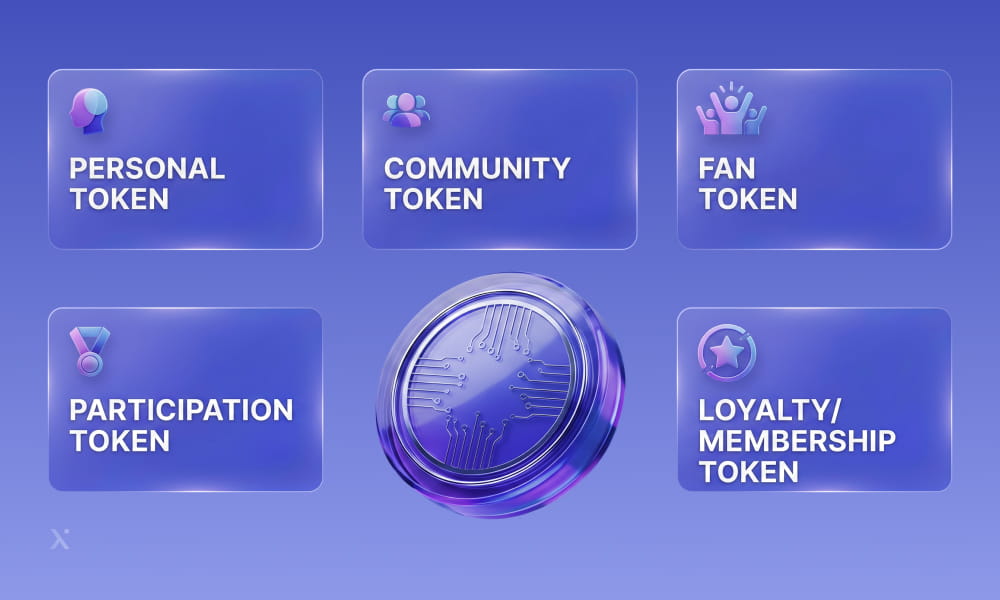
Most social and community tokens in 2026 fall into five types. The boundaries blur, as a fan token is arguably a community token with a sports brand behind it, but the issuer and purpose usually make classification straightforward.
Personal (creator) tokens
Personal tokens are issued by individuals to monetize direct access to themselves and their work. The category began as an experiment: back in 2020, blockchain entrepreneur Alex Masmej reportedly raised $20,000 in roughly 100 hours by selling $ALEX tokens that promised holders a share of his future income.
Today the model is more industrialized: Zora turns creator profiles (even individual posts) into tradable coins on Base, a mechanic Coinbase’s Base App adopted in 2025, while experiments such as Time.fun tokenize a creator’s time by the minute. The lesson of the last cycle still applies: tokens sold on personality alone behave like memecoins, so credible creators tie them to concrete deliverables.
Community tokens
Community tokens are launched by brands, companies, or groups of creators, and grant members shared benefits: exclusive products, event access, governance rights, and sometimes a say over a common treasury. They are typically managed by decentralized autonomous organizations, often built with a professional DAO development company.
Friends With Benefits ($FWB), a cultural community founded in 2020, remains the most cited example, though today it is best read as a landmark case rather than a thriving flagship. The DAO restructured and scaled back sharply after the 2022–2023 downturn; what sustained it at all was anchoring value in events, a members’ app, and curated content rather than token price.
Fan tokens
Fan tokens are the sports-and-entertainment branch of the concept, and the most commercially proven one. On Socios, built on Chiliz Chain, dozens of major clubs, including FC Barcelona, Paris Saint-Germain, and Manchester City, offer tokens whose holders vote in club polls, earn rewards, and unlock VIP experiences. Fan tokens succeeded where many social tokens failed because the perks are concrete, recurring, and aimed at fans rather than traders.
Participation and platform tokens
Participation tokens are earned by contributing to a platform or community: creating content, moderating, referring users, or shipping work. A representative modern example is $DEGEN, which started in early 2024 as a tipping token in the Farcaster social ecosystem and briefly grew into a small economy of its own, though both its price and on-platform tipping activity have cooled considerably since that peak. The design challenge is rewarding quality rather than volume, the play-to-earn and X-to-earn wave of 2021–2022 showed how quickly pure activity rewards get farmed into worthlessness.
Loyalty and membership tokens
For businesses, this is the fastest-growing category. Blackbird, founded by Resy co-founder Ben Leventhal and backed by a16z crypto, runs an on-chain loyalty network where diners earn $FLY across a growing set of restaurants in New York, San Francisco, and other US cities. Platforms like TYB let consumer brands (Rare Beauty was among the early adopters) reward community members with brand coins redeemable for products and early access.
The cautionary tales matter just as much: Starbucks discontinued its Odyssey program in March 2024, and Reddit sunset its Community Points in late 2023. The lesson is not that on-chain loyalty fails, but that it must either cut program costs or add utility users can feel, as a blockchain alone is not a value proposition.
| Token type | Who creates it | Main purpose | Example use case |
| Personal (creator) token | Individual creator | Monetize direct access and content | Creator coins on Zora and Base App |
| Community token | DAO, brand, or interest group | Shared perks, governance, treasury | $FWB membership community |
| Fan token | Sports club or entertainment brand | Fan engagement and monetization | FC Barcelona’s $BAR polls and rewards on Socios |
| Participation token | Platform or protocol | Reward contribution and activity | $DEGEN tipping in the Farcaster ecosystem |
| Loyalty / membership token | Consumer brand or venue network | Retention and cross-venue rewards | Blackbird’s $FLY restaurant points |
Ethereum DApp Development: How It Works and What You’ll Pay
The Real Cost of Stablecoin Development: What You Pay For and Why
Social tokens vs NFTs and other digital assets
Social tokens and NFTs are often mentioned in the same breath, but they solve different problems. Social tokens are fungible: any two units are identical, which suits points, tipping, and payments. Partnering with a jetton development company helps brands deploy these fungible reward tokens on TON. NFTs are unique, which suits identity, membership passes, and collectibles. In mature programs, the two are complementary: a common pattern pairs a membership NFT (who you are) with a fungible token (what you’ve earned).
The comparison with traditional loyalty points matters just as much for business readers. Classic points live in the issuer’s database, expire on the issuer’s terms, and rarely cross program borders. On-chain loyalty tokens are held by the customer, are auditable, and can move across a partner network without custom integrations.
| Asset type | Main purpose | Value driver | Typical use cases | Business benefits |
| Social / community tokens | Engagement, access, rewards | Utility and reputation of the issuer’s ecosystem | Creator coins, fan tokens, contribution rewards | Retention, direct monetization, verifiable fan data |
| NFTs | Unique ownership and identity | Rarity, provenance, unlockable perks | Membership passes, collectibles, certificates | Premium positioning, portable proof of membership |
| Loyalty tokens (on-chain points) | Retention and repeat purchases | Redemption value across a partner network | Restaurant, retail, and travel rewards | Lower breakage, partner interoperability, fraud resistance |
One more distinction matters in 2026: social tokens are not memecoins. The 2024–2025 launchpad wave, led by pump.fun and its clones, produced millions of tokens with no function beyond speculation. A business token that ships without clear perks will be read by users and regulators as exactly that. If the pitch for your token starts with price, you are not building a community asset; you are exposing your brand to casino dynamics.
Modern social token use cases in 2026
Creator economy
Creators depend on platforms that control distribution, take double-digit revenue cuts, and can demonetize accounts overnight. Creator coins give audiences a direct way to fund their favorite authors while showing creators exactly who their superfans are — in a creator economy that Goldman Sachs Research projected in 2023 could approach $480 billion by 2027. Blockchain fits because ownership and payouts settle instantly and globally, with no platform in the middle — a fit that blockchain development services are typically brought in to build correctly from the start.
Loyalty programs
Traditional loyalty suffers from siloed points, low perceived value, and breakage. Tokenized points are owned by the customer and redeemable across a partner network (Blackbird’s restaurant ecosystem is the most prominent example) while the shared ledger removes reconciliation between partners. The business case still has to beat the existing program on customer experience, which is where Starbucks Odyssey fell short.
Sports and fan engagement
Clubs monetize a global fanbase that mostly never buys a stadium ticket. Fan tokens create a paid engagement layer (polls, rewards, experiences) that stays active between match days and across borders. On-chain issuance keeps scarcity and voting verifiable, which is exactly what makes the perks feel legitimate to fans.
Gaming ecosystems
Studios use tokens to reward progression, user-generated content, and community participation, and to let players own tradable in-game assets. Telegram’s TON ecosystem showed the distribution power of this model when Notcoin onboarded tens of millions of players to a community token in 2024. The Axie Infinity cycle remains a warning: economies designed around earning rather than fun collapse once token emissions outpace demand.
Web3 communities and DAOs
Tokens give distributed communities a way to coordinate: weighted voting on proposals, funding from a shared treasury, and transparent contributor rewards. This model powers professional guilds, investment clubs, and open-source ecosystems, with tooling like Snapshot and Safe making governance and treasury management routine rather than experimental.
Digital memberships and tokenized access
Token-gating turns content libraries, communities, and even storefronts into verifiable memberships: hold the token, get the access via tools such as Guild.xyz, Collab.Land, and Unlock Protocol. Because membership is an asset the user controls, it can be resold rather than simply churned, and it works across platforms without separate accounts.
Brand communities and co-creation
Consumer brands reward reviews, user-generated content, and product feedback with coins redeemable for products, early drops, or experiences. The brand gets cheaper insight and an advocacy loop; the community gets tangible recognition. Blockchain adds portability and provable scarcity of rewards, while modern platforms keep the crypto mechanics invisible to shoppers.
Social token platforms and technologies in 2026
What happened to the first-wave platforms
The dedicated social token platforms of 2021 did not survive contact with the bear market. Rally shut down its creator sidechain in early 2023, leaving tokens and NFTs on it effectively worthless. Roll never regained momentum after a $5.7 million hot-wallet hack in 2021. BitClout evolved into the DeSo blockchain, but its founder was charged with fraud by the SEC and the Department of Justice in 2024, and the network never became a serious business venue. The takeaway shapes today’s best practice: issue your token as a standard contract on a public chain you don’t depend on, rather than inside someone else’s walled garden.
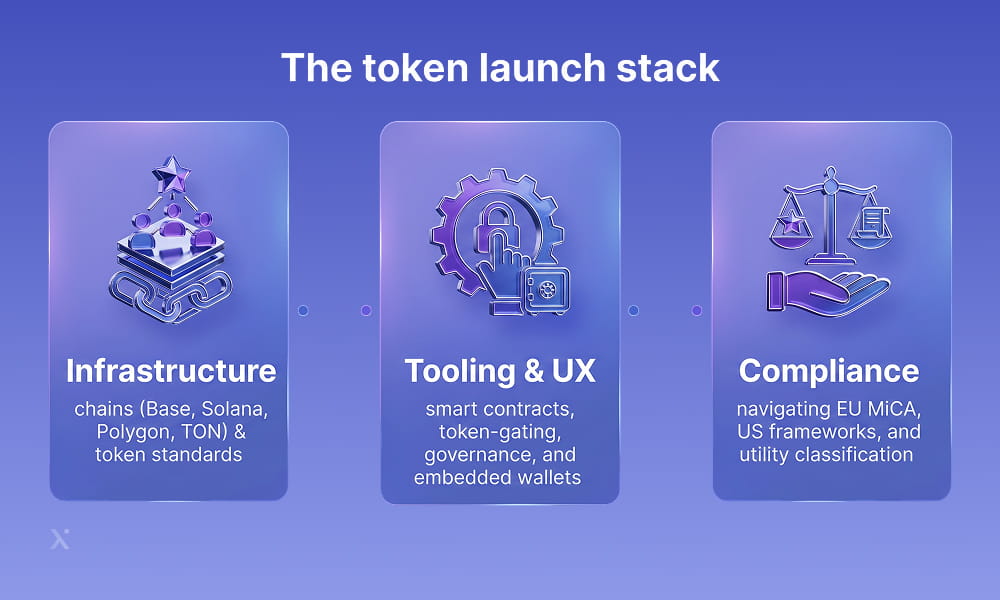
Blockchains and token standards
- Base: Coinbase’s Ethereum layer-2 and the center of creator-coin activity, with low fees and easy fiat onramps;
- Solana: a high-throughput home for consumer crypto apps and token launchpads;
- Polygon: a frequent choice for enterprise loyalty deployments;
- Chiliz Chain: purpose-built for sports and entertainment fan tokens;
- TON: distribution through Telegram’s massive user base via mini apps.
On the standards side, ERC-20 (and its equivalents on other chains) covers fungible tokens, ERC-721 and ERC-1155 cover membership passes and collectibles, and non-transferable (“soulbound”) tokens are increasingly used for reputation and loyalty tiers that shouldn’t be tradable.
Launch and community tooling
- Token creation: audited open-source contracts (OpenZeppelin) and development platforms such as thirdweb; consumer apps like Zora for creator coins. Solana launchpads like pump.fun exist, but their speculation-first design rarely fits business goals.
- Token-gating and community management: Guild.xyz, Collab.Land, Unlock Protocol.
- Governance and treasury: Snapshot for voting, Safe for multisig treasuries.
- Wallet UX: embedded wallets and passkeys built on account abstraction let users hold tokens behind an ordinary email or social login. Stripe’s 2025 acquisition of wallet-infrastructure provider Privy signaled how mainstream this layer has become.
Regulation and compliance
In the EU, the MiCA regulation has been fully applicable since the end of 2024: public offers of utility-type tokens generally require a published white paper and impose issuer obligations, with limited exemptions for small or free distributions. The first design question is classification: whether a given token qualifies as a utility token, an e-money or asset-referenced token, or a financial instrument, since that determines which obligations apply. In the US, the direction became clearer in 2025, when federal stablecoin legislation (the GENIUS Act) was signed into law in July 2025, and a broader market-structure bill, the CLARITY Act, passed the House that year and was still moving through the Senate as this article went to publication. Check the current status of any pending legislation before finalizing legal strategy. A practical pattern many corporate programs follow: start with non-transferable tokens to stay firmly on the utility side, and enable trading later only if the legal analysis supports it.
How to launch a social token
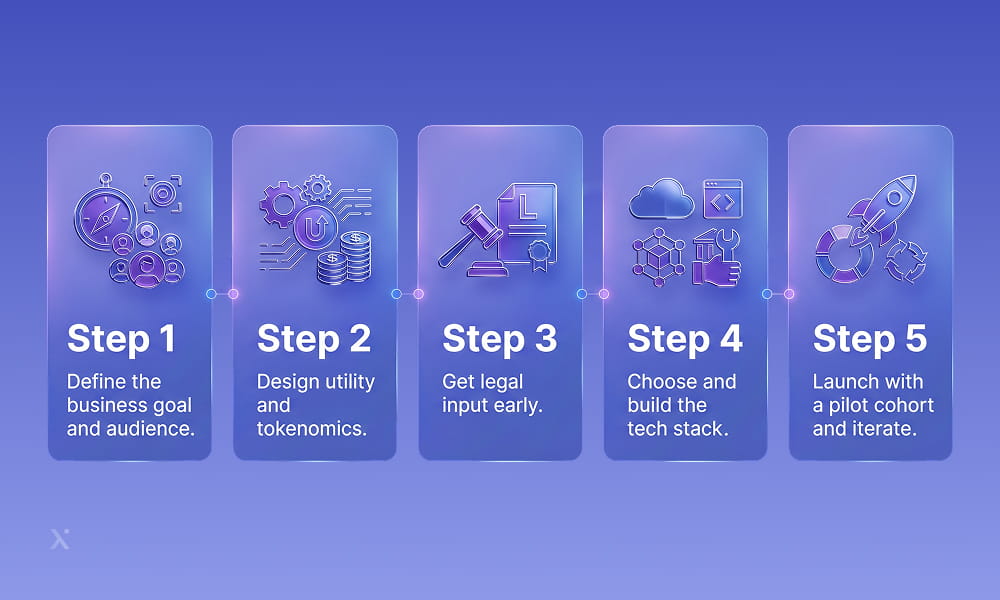
If you’re researching how to create a social token, treat it as product work rather than a token drop. Five steps cover the process:
Step 1. Define the business goal and audience. Retention, funding, community activation, or fan monetization lead to very different token designs. Pick the metric you want to move before anything else.
Step 2. Design utility and tokenomics. Decide on supply, how tokens are earned and spent (sinks matter more than emissions), whether the token is transferable or closed-loop, and vesting for the team and partners. Model demand pessimistically: the perks must be worth holding even if the token never trades.
Step 3. Get legal input early. Jurisdiction, MiCA white paper obligations, securities analysis, tax treatment, and program terms all shape the design. Launching a closed-loop project first is often the pragmatic opening phase.
Step 4. Choose and build the tech stack. Select the chain and token standard, custody and wallet UX, and integrations with your app or CRM. An independent smart contract audit is non-negotiable. You can assemble the stack from off-the-shelf tooling or engage a token development partner for a tailored build.
Step 5. Launch with a pilot cohort and iterate. Distribute to a core segment, watch redemption and retention data, and expand utility gradually. Plan communications for every scenario, including a responsible wind-down. Starbucks and Reddit showed that programs end; how you end them is part of the brand experience.
Business considerations before launch
- Regulatory exposure. A transferable token marketed with profit expectations invites securities scrutiny in most jurisdictions. Design and messaging are as important as code.
- Speculation management. Token price is not community health. Volatile price action attracts mercenary capital and headlines you don’t control; closed-loop or slow-transfer designs reduce that surface.
- Security. Smart contract audits, key management, and a multisig treasury are baseline hygiene, as the 2021 Roll hack remains the canonical warning.
- Reputation coupling. The token is tied to your brand, and the link cuts both ways: a brand crisis hits the token, and token drama hits the brand.
- Cost and ROI horizon. Pilot before scaling, and measure retention, redemption rates, and customer lifetime value.
- Exit planning. Define upfront how holders keep or convert value if you ever sunset the program. Users forgive endings; they don’t forgive rug pulls.
Conclusion
Social tokens have outgrown their hype phase and settled into a set of working models: fan tokens in sports, on-chain loyalty in consumer businesses, creator coins in the media economy, and governance tokens in digital communities. For a business in 2026, the question is no longer whether the technology works, but it’s whether a token genuinely strengthens your community and revenue model.
That answer depends on utility design, tokenomics, and compliance far more than on the choice of blockchain. PixelPlex’s tokenomics consulting and development services help companies stress-test these assumptions and build tokens tailored to their audience and jurisdiction.
Let’s design your tokenized community together — drop us a line.
FAQ
Social tokens are fungible blockchain tokens issued by a creator, brand, or community that give holders access, rewards, or governance rights within the issuer’s ecosystem — from exclusive content and events to a vote on decisions.
The umbrella term is used less often, but the models behind it are more active than ever: fan tokens on Chiliz, creator coins on Base, loyalty tokens in consumer apps, and community tokens in DAOs.
Social tokens are fungible, as every unit is identical, while each NFT is unique. In practice, the two are often combined: an NFT (commonly built with dedicated NFT development services) proves membership, while a fungible token tracks earned rewards.
Utility. A social token grants access, rewards, or governance tied to a real ecosystem; a memecoin’s only function is speculation. Business tokens launched without utility inherit memecoin risks, including regulatory attention.
Define the goal, design utility and tokenomics, clear the legal framework, build on a suitable chain with audited contracts, and launch with a pilot cohort. Most companies combine standard tooling with experienced tokenization services.
It depends on jurisdiction and design. In the EU, public token offers generally fall under MiCA disclosure rules, while non-transferable, closed-loop programs carry lighter obligations. A legal review before launch is essential.
Disclaimer: The information provided in this article is for educational purposes only. It does not constitute advice or a recommendation to issue or invest in social tokens or any other digital assets. Please seek professional advice before taking financial or legal risks.