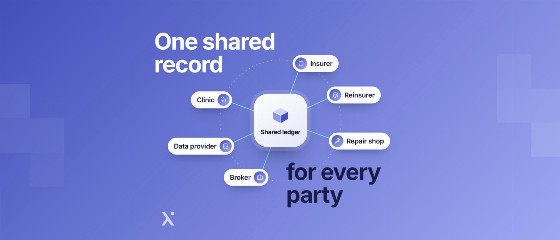
When several organizations touch the same claim, keeping everyone aligned becomes part of the problem.
Many insurance processes depend on several organizations working from the same facts: who is insured, what happened, whether it complies with the policy terms, what data can be trusted, and how much to pay. The problem is that this data is stored in different places — on insurance company platforms, in brokerage systems, at medical facilities, in repair networks, at reinsurers, in various external data sources — each organization or system maintains its own version. This leads to reconciliation delays, duplicate checks, and disputes over whose data is correct.
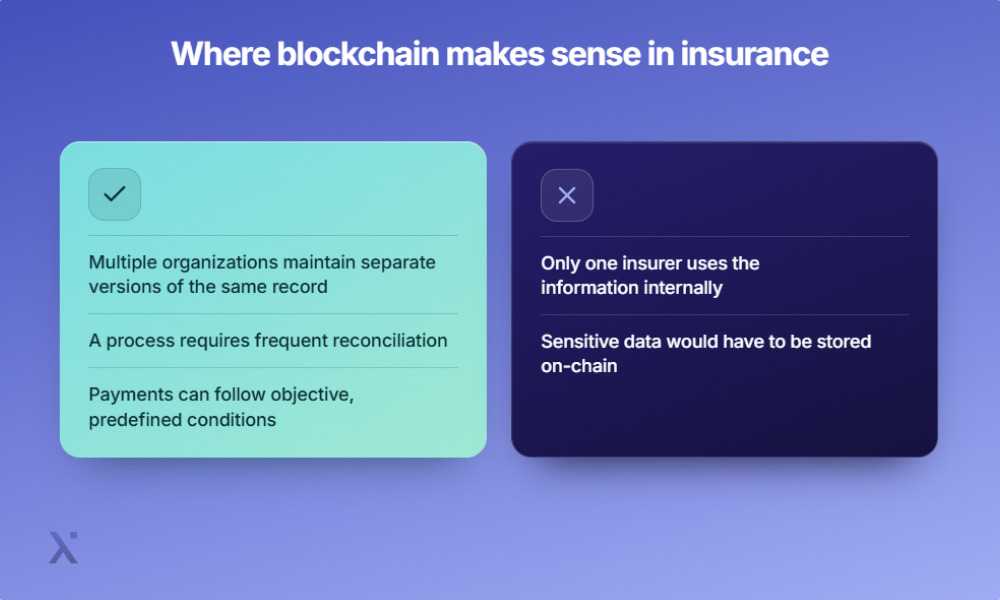
Blockchain can help when several companies need to work with the same transaction or claim data. An insurer, broker, healthcare provider, or reinsurer can reduce the need to reconcile separately maintained records for the events placed on the shared ledger. The existing claims, policy administration, CRM, and analytics systems continue to perform their usual functions. Blockchain for insurance is most useful in the gaps between those systems, where records must move from one organization to another and be rechecked along the way.
This article takes a practical look at blockchain insurance from that perspective. We will examine where it works, where it adds unnecessary complexity, which use cases are increasing in popularity, how the market is developing, what implementation entails, how much solutions cost, when they can pay off, and what real projects reveal about the technology’s strengths and limits.
What is blockchain in insurance?
A claim may pass through an insurer, broker, clinic, repair shop, or reinsurer before it is closed. Each company records its part of the process in its own system. Blockchain can be used to record selected events on the chain, so participants can verify when a particular event or assertion was recorded and whether that record was subsequently altered.
The underlying business data does not have to be stored on-chain. A medical file, claims document, or other source record can remain in the insurer’s or service provider’s controlled system, while the blockchain records only the events or proofs needed for cross-party verification, such as a timestamp, transaction state, or cryptographic proof.
| Architecture element | Existing insurance systems | Role of a shared ledger |
| Core records | Store policies, claims, customer data, billing, and operational records | Records selected events that multiple parties need to verify |
| Data ownership | Remains with the insurer or other responsible organization | Does not require transferring ownership of the underlying business data |
| Cross-party verification | Relies on APIs, EDI, documents, portals, or reconciliation | Provides participating organizations with a common record of agreed events |
| Sensitive data | Stored and managed in controlled systems | Usually keeps underlying personal and business data off-chain |
| Automation | Uses workflow engines, rules, and APIs | Can execute agreed rules through smart contracts where appropriate |
| Integration | Connects internal and external applications | Adds a shared transaction layer that still depends on integrations with source systems |
The shared ledger operates alongside existing insurance systems, rather than replacing them. Applications for policy processing, claims, billing, customer service, and analytics continue to handle day-to-day operations, while the ledger stores only those events or confirmations required for verification by other participants.

Top 10 Blockchain Use Cases Across Different Industries and Domains to Explore in 2026 and Beyond

Best Smart Contract Use Cases Across Industries to Explore in 2026 and Beyond
How is blockchain used in insurance?
There isn’t one standard way insurers use blockchain. In claims, it may give several parties the same record to work from. Elsewhere, it can support settlement, reusable credentials, or rules that run automatically once the required conditions are met.
Claims processing and automated payouts
In some cases, the blockchain provides all participants with access to the same fixed stages. A smart contract can then advance the process when a clearly defined condition is met.
Take flight-delay insurance. An approved flight feed confirms how long the delay lasted, and payment can be released automatically once it crosses the limit stated in the policy. Blockchain is optional here. Its role is to preserve a shared record of the trigger and payout. Property and liability claims are different because they usually require investigation and judgment.
Note that a smart contract is code that executes predefined instructions. It does not automatically replace the legal insurance contract, policy wording, or claims rules behind it.
Fraud detection and duplicate claim prevention
A shared record can give fraud-detection systems a more consistent history against which duplicate or altered submissions can be checked.
This can help with cases such as:
- Repeated claims for the same insured asset
- Duplicate medical billing
- The same accident reported to several insurers
- Documents changed after submission
Blockchain itself does not detect fraud. Fraud assessment is still based on rules, analytics, or artificial intelligence. Blockchain, however, provides a more consistent record of what was sent, when it was sent, and whether it has changed.
Reinsurance
Reinsurance involves numerous interactions between insurers and reinsurers. Each party may maintain its own data on transferred risks, premiums, losses, balances, and settlements, and then spend time reconciling this data.
The value here lies not so much in automation alone, but in reducing the need for repeated reconciliations among cedants, reinsurers, brokers, and other parties to the reinsurance process.
Identity, KYC, and counterparty verification
Insurance companies conduct numerous checks on clients, commercial partners, brokers, and other counterparties. Blockchain can support architectures in which verified identity attributes are represented as reusable digital credentials, so that previously verified facts don’t need to be re-verified.
The identity data itself doesn’t have to sit on the blockchain. Credentials or well-constructed cryptographic proofs can handle verification while the actual information stays in a controlled system. That said, whatever identifiers do end up on-chain still need to be checked against data protection law.
Blockchain for health insurance
Blockchain for health insurance can support provider verification, coverage checks, consent records, claim status checks, and duplicate-billing controls. For example, an insurer can confirm that a provider submitted a claim and that participating organizations use consistent identifiers and shared validation rules.
The practical value is in verifying coverage, consent, billing, and claim events across participating organizations. Clinical record management remains a separate healthcare system responsibility.
If a project combines insurance workflows with provider, patient, and clinical systems, that’s healthcare software development territory more broadly than an insurance-specific build.

Healthy Data, Happy Patients: A Masterclass in Blockchain Healthcare App Development

Exploring 6 Blockchain Use Cases in Healthcare: A Detailed Overview with Examples
Peer-to-peer and decentralized insurance
In blockchain-based decentralized insurance models, smart contracts may manage the shared risk pools, premiums, voting rules, and payouts.
Smart contracts enforce the pool rules and log fund movements, which can cut administrative overhead. But regulation, governance, liquidity, and claims processing don’t get any simpler just because the pool is on-chain — those still need real design work.

Peer-to-Peer Insurance: An Overview and Guide to Building Your Own P2P Insurance App

Blockchain in Insurance: What to Expect?
Blockchain in insurance use cases
The table below shows where blockchain may add value and where a simpler alternative may be enough.
| Use case | Need for independent-party coordination | Suitability for objective rules | What may be recorded on-chain | Non-blockchain alternative |
| Claims | Medium to high, depending on the number of insurers, providers, brokers, or other parties involved | Medium: many claims still require investigation and judgment | Selected claim events, timestamps, document proofs, and settlement states | Shared claims platform, API hub, EDI, or bilateral integrations |
| Parametric insurance | Medium: insurer, customer, and external data provider may rely on the same trigger | High when payout conditions are predefined and measurable | Trigger confirmation, policy state, payout, or settlement event | Conventional rules engine connected to trusted external APIs |
| Fraud and duplicate-claim controls | High when several insurers or providers need to compare events | Low to medium; detection still depends on matching rules, analytics, or AI | Event identifiers, document proofs, submission history | Shared fraud database, consortium platform, or data exchange |
| Reinsurance | High; cedants, reinsurers, and brokers may maintain separate records | Medium: some calculations and settlements can be standardized | Contract states, premium or loss events, and settlement confirmations | Reinsurance platform, EDI, API-based exchange, or shared industry service |
| Health insurance | High where insurers and healthcare providers exchange eligibility, billing, consent, or claim information | Medium: verification can be standardized, while clinical and claims decisions may still require judgment | Coverage confirmations, consent events, billing, or claim proofs | Healthcare data exchange, shared platform, or API network |
| Identity and KYC | Medium to high when verified attributes need to be reused across organizations | High for defined verification checks | Credential status, verification proof, or revocation event | Centralized identity platform or verifiable-credential system without blockchain |
| P2P or decentralized insurance | High when participants rely on shared pool rules and transparent fund movements | High for clearly defined pool and payout rules | Pool transactions, governance actions, policy states, and payouts | Centralized mutual or P2P insurance platform |
Blockchain insurance vs traditional insurance systems
Cross-company coordination can be handled in several ways. Insurers may use bilateral integrations, a shared platform or industry exchange, or a blockchain-enabled ledger.
The table below compares three coordination models on the criteria that actually differ.
| Criterion | Separate enterprise systems with bilateral integrations | Shared platform or industry exchange | Blockchain-enabled shared ledger |
| Internal processing | Strong fit | Usually not the primary purpose | Usually not the primary purpose |
| Cross-party data exchange | APIs, EDI, files, or portals connect individual parties | Participants connect through a common platform | Participants can use a shared transaction record |
| Reconciliation | Often required when parties retain separate records | Can be reduced through centralized shared data | Can be reduced for events recorded on the ledger |
| Infrastructure control | Each organization controls its own systems; interfaces are governed bilaterally | Controlled by a platform operator or industry body | May be distributed among participating organizations |
| Auditability | Depends on the system and logging design | Depends on platform design | Typically provides a tamper-evident transaction history |
| Data updates and deletion | Relatively straightforward | Governed by the platform and applicable rules | Requires careful on-chain/off-chain design |
| Automation | Workflow engines, APIs, and rules | Platform workflows and APIs | Smart contracts plus conventional integration logic |
| Privacy | Mature access-control patterns | Depends on platform architecture | Requires deliberate permission and data architecture |
| Integration complexity | Established bilateral integration patterns | Requires connection to the shared platform | Adds ledger, smart-contract, governance, and integration requirements |
| Best fit | Internal workflows and stable bilateral relationships | Ecosystems that can rely on a trusted platform operator | Multi-party processes where no single participant should control the shared record |
Where the trade-offs appear
Blockchain adds another moving part to an already complex insurance stack. Existing platforms still need to feed data into the network, privacy rules limit what can be shared, and smart contracts create new security concerns that have to be managed from the start.
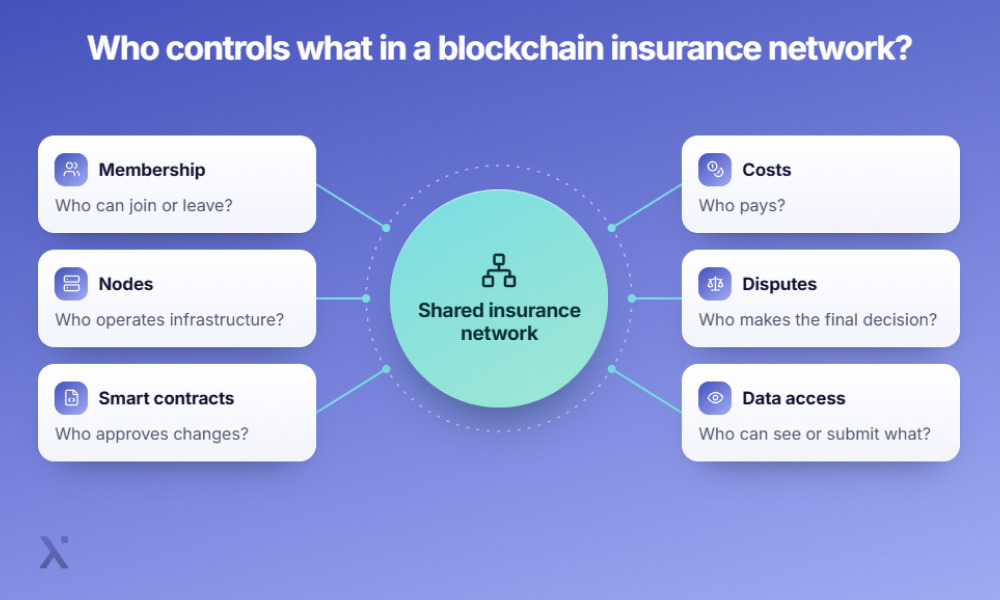
Multi-party networks also come with governance challenges. Someone has to decide who is allowed access, who actually manages the nodes, how updates are approved, and who pays for their operation. Then, scalability and regulatory requirements add more constraints, which can rule out some processes altogether.
The business case becomes much weaker when one insurer already controls the full workflow, and there is little reconciliation between independent parties. In that situation, a conventional database and well-designed APIs will usually solve the problem with less complexity.
Where several independent organizations work with the same data, blockchain can improve how they coordinate and verify shared events. The main benefits are greater confidence in transaction history, fewer inconsistencies between participant records, clearer accountability across organizations, and the ability to automate agreed-upon rules where the process is suitable.

Blockchain and KYC: Expert Interview on Navigating Security and Compliance Challenges

The Role of Blockchain in Strengthening Your Cybersecurity: Key Use Cases
Blockchain in the insurance market: size and regional outlook
Forecasts for the blockchain in the insurance market are aggressive. Fortune Business Insights values the market at $2.96 billion in 2025 and $4.74 billion in 2026, projecting $95.97 billion by 2034. This works out to a 45.6% CAGR for 2026–2034. Claims management alone is expected to account for 21.58% of the market in 2026. This trajectory assumes adoption accelerates sharply from a low base — EIOPA’s survey found only 15% of insurers had even one live use case as of its most recent count, and half of those were still proofs of concept. Vendor forecasts and insurer adoption data are telling different stories right now, and the gap is worth watching rather than resolving in advance.
North America
North America remains the largest regional market, accounting for 34.2% of global revenue in 2025, or approximately $1.01 billion, and is projected to reach $1.63 billion by 2026. The US alone is expected to account for $1.16 billion.
North America has been an early adopter of emerging technologies in insurance and is home to several companies developing blockchain-based insurance solutions. Fortune Business Insights associates the region’s leading market position with early adoption, the presence of established technology providers, and ongoing product development. Blockchain initiatives in the region span areas such as claims, identity, fraud prevention, and cross-company transactions.
Europe
The European blockchain insurance market was valued at roughly $840 million in 2025 and is on track to reach $1.34 billion in 2026. Adoption isn’t moving fast, though. GDPR alone brings a long list of constraints: data processing, cross-border transfers, minimization, the right to rectification and deletion, plus DORA and whatever else applies in a given sector.
France is part of the broader European blockchain insurance market and is already showing early insurer experiments. For example, AXA launched Fizzy, a blockchain-based parametric product that compensated travelers for qualifying flight delays, though the product was discontinued in 2021 — a reminder that early proof-of-concept traction doesn’t guarantee commercial longevity. Estimates of the French blockchain insurance market also vary depending on the source and methodology, so a direct comparison with the regional data cited above may be misleading.
Asia-Pacific
Asia-Pacific’s blockchain insurance market reached about $760 million in 2025 and is expected to grow to $1.25 billion in 2026. Fortune Business Insights links the region’s growth outlook to continued technological development among insurers and experimentation with emerging technologies, including blockchain and smart contracts. Adoption still varies considerably across individual markets and insurers.
China is one of the markets to watch. The Chinese blockchain insurance market is projected to be approximately $290 million in 2026, according to the same Fortune Business Insights dataset. Its large insurance sector, established digital financial ecosystem, and ongoing enterprise blockchain activity create a substantial foundation for claims, smart contracts, fraud prevention, and policy management applications.
Canada
Canada’s regulatory environment becomes particularly relevant when blockchain projects involve crypto-assets or tokenized financial instruments. OSFI’s Capital Treatment of Crypto-asset Exposures guideline, effective in 2026, sets out how federally regulated insurers should treat certain crypto-asset exposures — including some tokenized traditional assets issued using distributed ledger technology — for capital purposes.
Its scope is narrow, though. The guideline addresses crypto-asset exposures specifically, not how insurers use blockchain day-to-day. Claims coordination, policy administration, reinsurance settlement, and partner data exchange still fall under the rules that already govern insurance operations more broadly: data protection, cybersecurity, outsourcing, and operational risk. For the Canadian blockchain insurance market, that means most current use cases sit outside this framework entirely — the regulatory conversation and the operational one are, for now, largely separate.
Blockchain insurance market by geography
| Geography | Adoption context | Where blockchain may fit | Main constraints |
| United States | Early enterprise technology adoption and an active insurtech ecosystem | Claims coordination, fraud controls, health insurance data exchange, cross-company settlement | Privacy, legacy integration, and fragmented regulatory requirements |
| Canada | Digital insurance modernization with a strong focus on operational and regulatory controls | Claims, identity verification, partner data exchange | Data protection, operational risk, sector-specific regulation |
| France | Insurer experimentation with DLT within the broader European market | Parametric insurance, claims, reinsurance, and identity | GDPR, governance, integration with existing insurance systems |
| Broader Europe | Cross-border insurance activity and a strong focus on privacy and data governance | Reinsurance, claims coordination, digital identity, policy verification | GDPR, interoperability, cross-border data requirements, governance |
| China | Large insurance market, digital finance ecosystem, and enterprise blockchain activity | Claims, fraud controls, policy administration, smart-contract applications | Regulatory requirements, ecosystem governance, interoperability |
| Asia-Pacific | Adoption varies widely by market, with insurers continuing to test blockchain and smart-contract use cases | Claims, payments, parametric insurance, partner coordination | Different regulatory regimes, uneven ecosystem maturity, and integration complexity |
What blockchain insurance architecture looks like
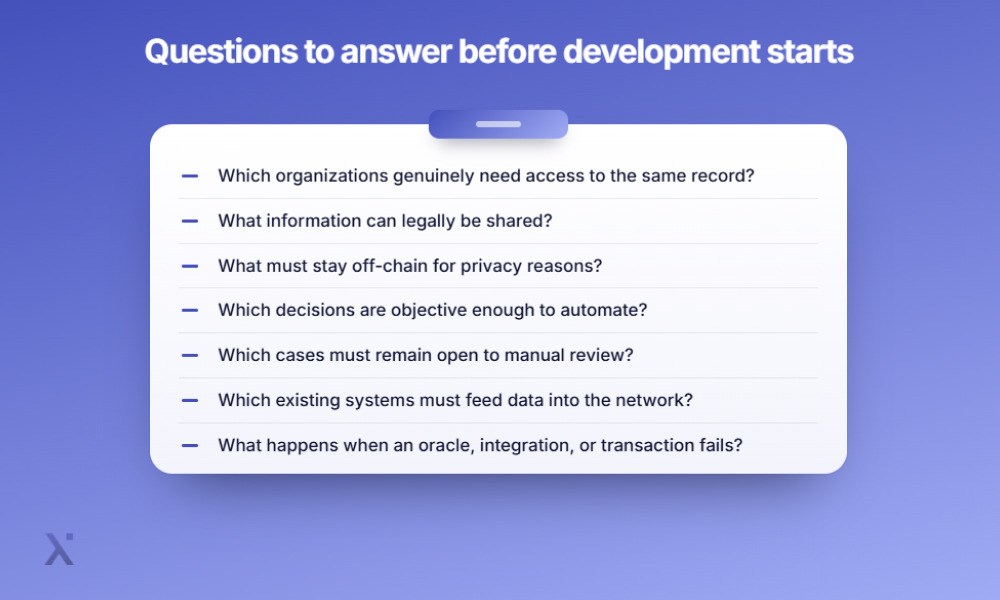
The choice of blockchain architecture matters as much as the decision to use blockchain at all. An insurer building a customer-facing Web3 product has very different requirements from a group of insurers, brokers, and reinsurers sharing claims data.
Rather than treating public, permissioned, private, and hybrid as mutually exclusive architecture types, it is more useful to separate several design decisions. These include who can access and validate the network, who governs it, and which data and processes stay on-chain or off-chain.
Public blockchain
Public blockchains are a better fit when the product depends on open access or public visibility. You see this most often in decentralized insurance, peer-to-peer (P2P) risk pools, and other Web3 products where users need to verify policies, reserves, or payouts directly on-chain.
For products built around wallets, tokenized assets, decentralized governance, or other on-chain functionality, the work can also extend into Web3 development services.
Permissioned blockchain
Permissioned networks restrict participation to approved organizations or users. This model can suit insurer and partner ecosystems where access, transaction rights, and validation responsibilities need to be controlled.
An insurer, reinsurer, broker, and claims provider, for example, can share the same network without exposing it publicly. Hyperledger Fabric is one of the platforms built for this kind of setup.
Hybrid architecture
A hybrid architecture combines blockchain with existing enterprise systems and off-chain data stores. It works with either public or permissioned networks — the choice follows from the governance and access model, not from the hybrid design itself.
Only selected events or proofs need to be recorded on-chain. The rest of the workflow remains connected through APIs, external data services, and, where needed, blockchain oracles. Smart contracts then handle the parts of the process where the rule is deterministic and the inputs are reliable.
Public vs permissioned vs hybrid blockchain for insurance
| Design dimension | Main options | What it determines |
| Network access | Public/permissioned | Who can join the network, submit transactions, and validate activity |
| Governance | Network-governed / single-organization / consortium | Who controls membership, upgrades, operating rules, and dispute resolution |
| Infrastructure | Public network / privately operated network | Who operates the underlying blockchain infrastructure |
| Data architecture | Primarily on-chain / hybrid on-chain and off-chain | Which records are written to the ledger, and which remain in existing systems |
| Integration model | Blockchain-native / integrated with enterprise systems | How strongly the solution depends on claims, policy, payment, identity, and other existing platforms |

How Permissioned Blockchains Transform Business: A Detailed Overview

Private Blockchain Development in 2026: A Step-by-Step Guide
How blockchain insurance solutions are developed
Strong blockchain insurance solutions development starts by looking at the process itself. The team needs to see where information moves between companies, who checks it, and where separate records create extra work, delays, or cost.
- Check whether the process justifies using a shared ledger. Assess where time and money are currently wasted, such as due to reconciliations, manual verification, disputed entries, or settlement delays. Compare blockchain with simpler alternatives before deciding on this architecture.
- Work out who is involved. Define who can access the network, what each participant is allowed to do, and who has the final say on changes.
- Define the ledger data model. Decide which events, proofs, and state changes participants actually need to share or verify, and which information should remain in the connected source systems.
- Define the architecture across several dimensions. Decide whether network participation is public or permissioned, how governance is organized, who operates the infrastructure, and which data and processes stay on-chain or off-chain.
- Turn the business rules into code. Smart contracts handle tasks such as eligibility checks, claim status changes, parametric triggers, and settlement rules — but only where the business rule is deterministic enough to code without judgment calls.
- Connect the systems insurers already use. That may include policy administration, claims platforms, CRM, payment services, identity tools, healthcare systems, telematics, and external data feeds.
- Build the interfaces people will use. Customers, brokers, claims teams, and partners still need portals, dashboards, apps, or dApps to interact with the solution.
- Test the entire system. Test smart contracts, permissions, integrations, external-data inputs, transaction loads, failure scenarios, and recovery procedures, not just the application code.
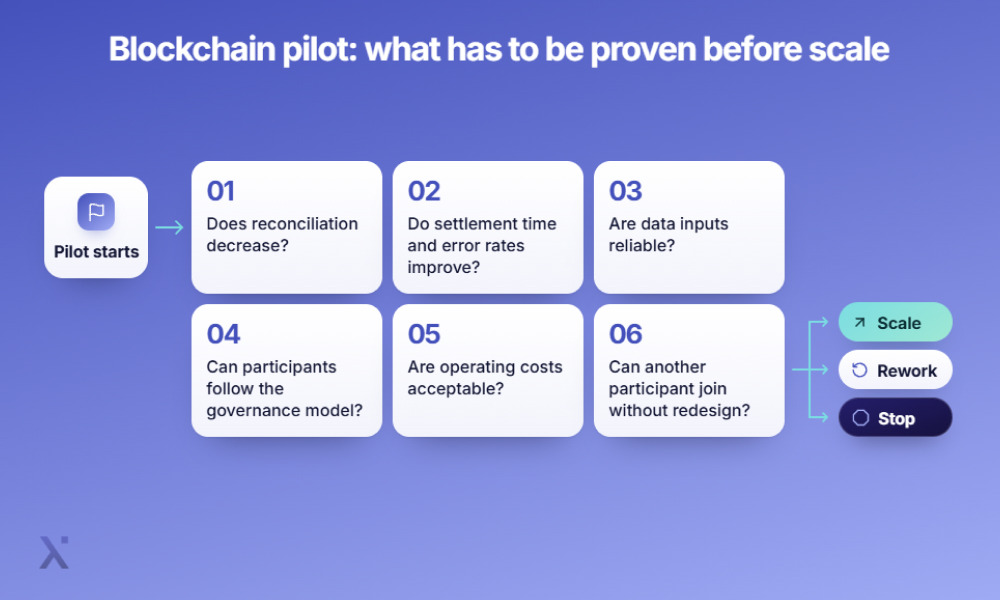
- Start small, then expand. Roll out one process with a limited group of participants and see whether it actually reduces processing time, reconciliation work, or settlement delays.
What to validate during blockchain insurance development
| Decision | Acceptance criterion | Evidence required before moving forward |
| Use-case selection | The process has a measurable coordination or verification problem that blockchain could address better than simpler alternatives | Baseline data on reconciliation effort, processing delays, manual checks, disputes, or settlement time |
| Participant model | The organizations that need to participate are identified and are willing to use the network | Confirmed participant roles, responsibilities, access requirements, and initial governance agreement |
| Architecture | Network access, governance, infrastructure, and on-chain/off-chain boundaries are defined | Approved architecture design showing data flows, system boundaries, and participant responsibilities |
| Smart-contract scope | Only rules that are sufficiently clear and deterministic are selected for automation | Documented business rules, exception scenarios, approval logic, and escalation paths |
| Data and integration | Required source systems and external data services can provide the necessary information reliably | Integration specifications, data-quality checks, interface tests, and source-system ownership |
| Security | Identity, permissions, keys, contracts, and administrative access can be protected to the required level | Threat model, security requirements, contract test results, and planned audit controls |
| Pilot | The limited rollout produces measurable improvement over the current process | Pilot results against predefined KPIs such as processing time, reconciliation effort, error rates, or settlement time |
| Scale | Additional participants and transaction volumes can be supported without disproportionate cost or redesign | Load-test results, onboarding model, operating-cost estimates, and governance plan for expansion |

DApp Development: How It Works and What It Costs
A Comprehensive Guide to Blockchain Application Development
Main challenges of blockchain insurance development
Most problems in blockchain insurance solutions development appear outside the ledger itself. The difficult part is getting blockchain, legacy insurance software, external data, security rules, and several organizations to behave as one working system.
Legacy system integration
Many insurers are still running core systems that were built long before real-time integration became standard. Claims, billing, CRM, and partner tools have usually been added around them over time. Bringing blockchain into that mix can quickly expose gaps in APIs, data access, and system compatibility.
Privacy versus immutability
Insurance data changes. Records may need to be corrected, restricted, or deleted, while blockchain is designed to preserve what has already been written.
That makes data design especially important. Insurers need to be selective about what goes on-chain and keep personal or sensitive information in controlled systems. Even hashes or references can fall under data protection law, so keeping the original record off-chain does not solve every privacy issue.
Oracle reliability
An oracle is only as useful as the data behind it. A flight-delay policy, for example, might rely on an airport or flight-status feed. Weather cover could use data from a meteorological service.
If that feed is late or wrong, the contract may execute exactly as coded and still produce the wrong result. Insurers need to decide which sources they trust and what the system should do when the data is missing or conflicting.
Smart contract risk
Once the code starts transferring funds or changing a request’s status, even a small error can have real consequences. A contract deployed to production is also harder to change than ordinary software — fixing a flawed rule may mean migrating state to a new contract rather than patching the old one, and by then it may have already executed against real claims.
Testing has to include those awkward cases, not only the standard workflow. There should also be a clear point at which automation stops, and the claim goes back to a person.
Consortium governance
Shared infrastructure only works if the companies behind it agree on the practical details. Who runs the nodes? Who pays for them? Who can approve a contract change or bring a new participant into the network?
Those questions are easy to postpone during a pilot. They become much harder to settle once more companies depend on the network.
Scalability and transaction economics
There’s no need to store all operational details on the blockchain. Notes, regular status updates, documents, and approval records can remain in the systems teams already use.
The ledger should be reserved for information that another participant actually needs to verify. Otherwise, the network becomes more expensive and complicated without adding much value.
Regulation across markets
What passes regulatory review in one market may need to be reworked for another. A cross-border rollout can change how data is handled, which automated decisions are allowed, and what requirements apply to third-party providers. Crypto-assets and tokenized instruments bring their own regulatory questions.

Ethereum Smart Contracts: The Hard Parts Made Clear

Ethereum DApp Development: How It Works and What You’ll Pay
How much does a blockchain insurance solution cost?
There is no useful single price for a blockchain insurance project. A small proof of concept may only test one claims workflow, while a production network could involve several insurers, smart contracts, legacy integrations, external data feeds, audits, and strict access controls.
Indicative blockchain development costs by project size
PixelPlex’s 2026 blockchain development cost guide provides the following indicative ranges by project size. Insurance projects can fall within or above these ranges depending on integrations, regulatory requirements, security, and the number of participating organizations.
| Project | Typical scope | Indicative development budget |
| Proof of concept | One workflow, limited integrations | $10K+ |
| MVP | Core smart contracts, UI, and several integrations | $40K+ |
| Production platform | Multiple workflows, integrations, and stronger security | $150K+ |
| Enterprise or multi-party network | Complex governance, compliance, integrations, and audits | $300K+ |
The biggest cost drivers usually sit around the ledger: integrations, security, compliance, external data, and partner onboarding. And development is only a portion of the cost. Infrastructure, security, monitoring, contract updates, integrations, audits, and after-sales support continue even after the project launches.

The Price of Intelligence: AI Game Development Costs Uncovered

Web3 Development Cost: Breaking Down What Really Drives the Price
When does blockchain for insurance pay off?
Start with the current process. Measure what reconciliation, manual checks, partner coordination, delays, and fraud-related losses cost today. Then compare the savings a new setup could create with the cost of integration, infrastructure, security, and ongoing support.
The business case is generally stronger when the process is data-intensive and already expensive or slow to manage. If one insurance company controls most of the workflow and the existing system is efficient, it is much more difficult to prove its value.
| Value area | Baseline metric | What to measure after implementation | Potential financial effect |
| Reconciliation | Staff hours spent matching records across organizations | Reduction in reconciliation time per transaction or claim | Lower processing cost |
| Claims verification | Average time required to verify shared claim information | Change in verification time | Faster claims handling, lower labor costs |
| Settlement | Average time from approved claim or balance to settlement | Reduction in settlement cycle time | Lower administrative cost, improved cash flow |
| Duplicate or altered claims | Number and value of duplicate or inconsistent submissions identified | Change in duplicate-processing or fraud-related losses | Lower loss exposure |
| Audit and investigation | Time required to reconstruct transaction history | Reduction in audit or investigation effort | Lower compliance and operational cost |
| Partner processing | Time and cost required to exchange and validate data with participating organizations | Reduction in repeated checks or manual exchanges | Lower partner-coordination cost |
| Reinsurance | Time spent reconciling premiums, losses, balances, and settlements | Reduction in reconciliation effort and settlement delays | Lower operating costs and faster settlement |

Blockchain as a Service (BaaS) vs Custom Blockchain Development: Which Option Will Suit You Best?
Crypto Payment Gateway: Costs, Benefits, Implementation
Real-world blockchain insurance projects and what they teach us
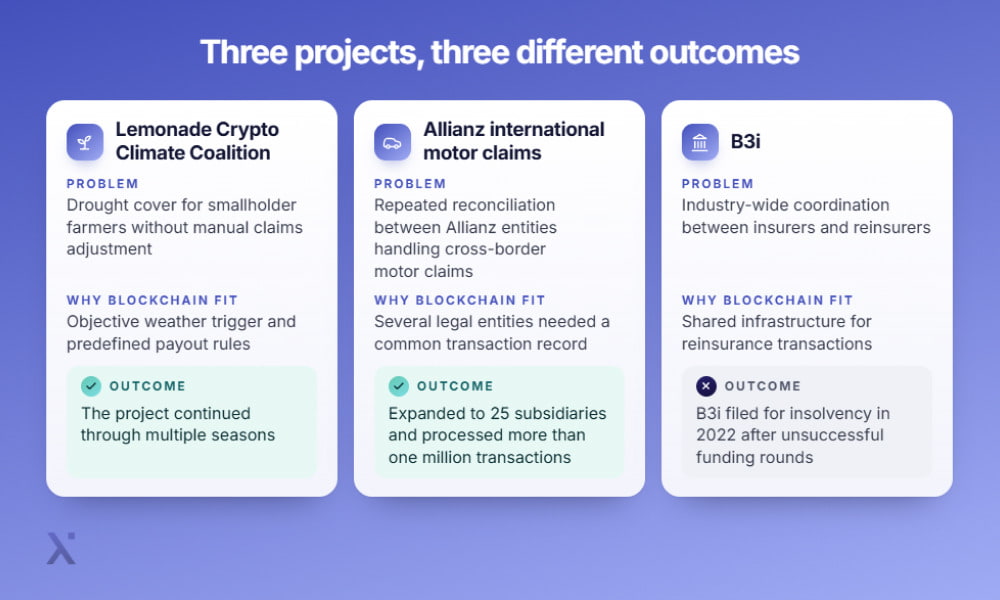
There is enough history now to judge blockchain insurance by more than pilots and press releases. Some projects made it into production and kept growing. Others changed direction or shut down. Both outcomes are useful because they show where the technology holds up in practice and where the business case falls apart.
Lemonade Crypto Climate Coalition
The Lemonade Foundation launched the Crypto Climate Coalition with partners including Etherisc, Avalanche, Chainlink, Hannover Re, Pula, and DAOstack. The first product focused on smallholder farmers in Kenya and offered parametric crop protection.
During the coalition’s first Kenya pilot, covering the October 2022 to January 2023 growing season, nearly 7,000 farmers purchased insurance. Weather data determined whether drought conditions met the payout threshold, and eligible farmers received payments without filing a traditional claim or waiting for manual claims adjustment. In May 2025, Etherisc announced that the coalition had reached its fifth season.
The project makes a good case for blockchain, where the event is measurable, and the payout rule is simple. It says much less about property, liability, or health claims, where determining the loss still requires judgment.
Allianz international motor claims
Allianz took a different route. Rather than building a decentralized insurance product for consumers, it used enterprise blockchain to deal with international motor claims between its European subsidiaries.
The platform went into production in 2021 across 23 subsidiaries. During its first six weeks, Allianz employees processed roughly 145,000 blockchain transactions covering more than 10,000 international accident claims. The process had previously relied heavily on communication between separate Allianz legal entities when, for example, a customer insured in one country had an accident in another.
By February 2022, the platform had expanded to 25 subsidiaries and processed more than one million transactions. The interesting part here is the problem Allianz chose to solve. Blockchain was applied to a process with repeated cross-entity settlement and reconciliation, rather than being added to ordinary claims processing simply because the technology was available.
B3i
B3i offers the other side of the reality check. The Blockchain Insurance Industry Initiative brought together some of the world’s largest insurers and reinsurers to build a shared DLT infrastructure for the industry. By 2020, it had backing from 20 major re/insurer investors and had developed products for reinsurance.
The company filed for insolvency in July 2022 after unsuccessful funding rounds. Swiss Re CFO John Dacey said at the time that the volumes in demand did not justify continued investment in the platform.
B3i reminds us that technical progress and strong industry backing do not guarantee sufficient network adoption or a viable commercial model. A successful shared insurance platform requires a sufficient number of participants who will use it frequently enough to justify the cost of funding, operating, governing, maintaining, and expanding the network.
Why choose PixelPlex for blockchain insurance development?
Working with blockchain in insurance requires more than just knowledge of protocols. Claims processing, policy administration, sensitive customer data, partner integration, and regulatory constraints all shape the architecture. PixelPlex combines its insurance expertise with the development of blockchain technologies, smart contracts, Web3, healthcare software, and security.
From business case to production
PixelPlex can cover the full blockchain insurance solutions development cycle: use-case validation, architecture, proof of concept (PoC), smart contract development, integrations, testing, deployment, and post-launch support. The same team can also handle insurance software development services, blockchain development services, and Web3 components where the product calls for them.
Enterprise blockchain experience
Our company currently reports 13 years of core-team blockchain experience and 450+ completed projects across its broader blockchain practice.
Security starts with the architecture
For insurance, security cannot be left until the audit stage. Threat modeling, permission design, key management, contract testing, vulnerability analysis, formal verification for critical logic, audits, and production monitoring all need to be considered before launch. PixelPlex’s smart contract practice combines automated testing with manual review and formal verification, where the risk justifies it.
That broader experience also matters when blockchain touches healthcare data or other sensitive systems, where the design has to cover both the on-chain logic and the software around it.
Top 10 Machine Learning Development Companies

Top 10 AI Development Companies in 2026
Conclusion
The strongest blockchain for insurance business cases usually start with a coordination problem, not with a decision to decentralize. The same claim may be checked more than once, insurers and reinsurers may work from different records, providers may wait for coverage confirmation, and settlements may depend on data held across several systems.
What tips a use case from interesting to “worth building” is usually external, not technical: a regulator standardizing a data-sharing format, a reinsurance treaty that starts requiring shared audit trails, or enough insurers in one market agreeing to a common network that the coordination cost of not joining exceeds the cost of joining. B3i shows what happens when that critical mass doesn’t materialize; Allianz shows what happens when it does, inside a single organization’s control. Most insurers evaluating blockchain today are really asking whether their market is closer to one condition or the other.
If you are evaluating where blockchain could fit into your insurance operations, PixelPlex can help assess the use case, design the architecture, and build the solution around the systems you already use.
FAQ
Usually not. In most corporate systems, policyholders never interact directly with the blockchain, and premiums and claims run on regular banking and payment rails. They use the same web or mobile interface as they would for any other insurance product.
Wallets and tokens are more likely to come into play in decentralized products, where users sign transactions, hold tokens, or manage assets on-chain — for example, to pay public-chain fees or take part in an on-chain pool. That is where DApp development services may also come into the picture, particularly for wallet integration and the customer-facing app.
Usually, there is little reason to move the entire archive. A project can start from a defined date or migrate only the records that will be needed in the new workflow. Older policies and claims can remain in existing databases, with references or proofs added to the blockchain where later verification is needed.
People need to know how their day-to-day work changes, not how blockchain works under the hood. Claims teams, brokers, providers, and administrators should be clear on new responsibilities, approval steps, and what happens when something goes wrong.
With a larger rollout, that training can be harder to manage across different roles and external partners. Custom portals or learning platforms, built through broader education software development services, can give each group the right guidance and make onboarding easier to repeat as new users join.
Yes. An insurer can switch platforms later, but the move gets harder when too much of the solution is built around one network. Keeping core business data separate from the ledger and avoiding unnecessary platform-specific dependencies gives the insurer more flexibility if the technology or business requirements change.
Blockchain technology is most useful when multiple independent organizations need to verify the same events or transactions without relying on a single party to control the shared record. If a single organization can manage a reliable platform for all participants, a shared SaaS solution, API hub, or industry exchange may prove simpler and more cost-effective.
The decision should come down to the coordination problem, the governance model, the verification requirements, and the expected value, rather than the technology itself.
Responsibility depends on the network’s governance model and should be agreed before launch. In a permissioned consortium, participant agreements can define who may authorize corrections or compensating transactions and how losses are allocated. The ledger helps establish what happened, but liability remains a contractual and regulatory matter. Smart contracts should be limited to well-defined rules, with a clear route to human review when something goes wrong.