FinTech has spent years chasing faster transactions and lower costs. Blockchain promises both, but the real question is whether the savings justify the complexity that comes with it.
Blockchain has been part of the finance conversation for well over a decade. Long enough that most of the exaggerated claims from the early 2010s have quietly faded, while a narrower set of use cases has held up under scrutiny. Today, banks and FinTech companies use blockchain for cross-border payments, trade settlement, tokenized assets, and automated financial agreements. It also gives companies working on the same transaction a shared record, which can save them from constantly checking one database against another.
Going on-chain doesn’t make the hard parts of FinTech go away. You still have legacy systems to connect, regulators to satisfy, and a new set of security risks to deal with, from smart contract bugs to compromised keys. Make the wrong technical choices early on, and the savings you were chasing can get swallowed by development and maintenance costs.
This article examines the areas where blockchain in FinTech is truly beneficial for businesses. We’ll look at the processes where it can cut costs, the FinTech products already proving the case, the trade-offs teams need to account for, and what a sensible development roadmap looks like when there is real business value to capture.
What problems does blockchain solve in FinTech?
FinTech has made financial services easier to access, but much of the machinery underneath hasn’t changed nearly as much. Payments still pass through several intermediaries. Institutions keep separate versions of the same records. Settlement can take days. Compliance teams pull data from systems that were never designed to talk to each other.
This is the gap blockchain is meant to close. Its value lies in providing a common transaction processing layer for multiple parties, especially when the alternative requires multiple verifications, reconciliations, and data transfers.
High transaction costs
More parties in a transaction usually mean more cost. Cross-border payments are an obvious example: correspondent banks, FX providers, payment processors, and local clearing systems can all sit between sender and receiver.
Blockchain can cut out some middlemen and allow value to move more directly between participants. Smart contracts can handle routine checks and trigger transactions when the agreed-upon conditions are met. At scale, shaving even a little off each transaction can make a noticeable difference to the bottom line.
The important word here is some. Network fees, liquidity costs, custody, compliance, and infrastructure still cost money. A solid blockchain development services strategy starts by determining whether removing existing friction saves more than the new infrastructure costs to operate.
Slow settlements
Sending a message that says money has moved and actually settling that money are two different things. Traditional finance often separates the two, which is why a payment can appear almost instantly while final settlement happens much later.
Blockchain networks can bring execution and settlement closer together. They also operate outside conventional banking hours, making 24/7 settlement possible.
That has a knock-on effect on liquidity. Capital that would otherwise remain tied up while institutions wait for settlement can be put back to work sooner. This is one reason blockchain has attracted serious attention in payments, treasury operations, and securities markets.
Fraud and reconciliation
A distributed ledger provides participants with an agreed-upon history of events, which can reduce reconciliation work and make unauthorized changes easier to detect. It does not eliminate fraud, but it can make transaction records more consistent and easier to audit.
Data silos
Modern FinTech products depend on APIs, but APIs alone don’t solve the ownership problem. A bank has its own database, a payment provider has another, and a trading partner may keep a third. Each organization trusts its own records and needs a way to verify everyone else’s.
A blockchain can act as the shared layer between them. Participants see the same agreed transaction state without one company having to own the master database.
That model makes the most sense when several independent organizations need to coordinate. There is little reason to introduce a distributed ledger into a process managed entirely by one company. Even in a good blockchain use case, conventional software remains part of the stack. Financial software development services still encompass applications, APIs, databases, identity systems, analytics, and legacy integrations alongside and around the blockchain layer.
Compliance traceability and controls
Blockchain can make some compliance and audit processes easier to manage when multiple organizations need to verify the same transaction history. Timestamped records, traceable transaction data, and permissioned access can give authorized participants a consistent source of information, while smart contracts can enforce predefined, machine-verifiable controls before certain transactions are executed.
That doesn’t make regulatory complexity go away, though. KYC, AML, sanctions screening, privacy, data hosting, reporting obligations — all of it still applies, and some of it doesn’t sit comfortably with blockchain architecture. Immutable records, for instance, need careful design when personal data has to be corrected or deleted down the line.
FinTech blockchain technology works best when the problem actually calls for shared infrastructure. The table below helps draw that line.
| Fintech challenge | Where the pain is greatest | What blockchain changes | Strong-fit applications |
| High transaction costs | Multi-party and cross-border transactions | Removes some intermediary and reconciliation steps | Remittances, B2B payments, asset transfers |
| Slow settlements | Payments and markets where funds remain in transit | Supports continuous execution and faster final settlement | Cross-border payments, securities, treasury |
| Fraud and reconciliation | Workflows where organizations maintain separate records | Creates a shared, tamper-resistant transaction history | Trade finance, lending, and clearing |
| Data silos | Processes spanning several independent institutions | Gives participants an agreed transaction state | Syndicated lending, KYC, interbank workflows |
| Fragmented compliance and audit processes | Auditing, reporting, and transaction monitoring across disconnected systems | Provides traceable records and programmable controls | Audit trails, transaction monitoring, and regulatory reporting |
The pattern is fairly clear. Blockchain in the FinTech industry has the strongest case when several parties need to exchange value, verify the same information, and keep their records synchronized. The next question is more interesting from a business perspective: where does this actually deliver measurable benefit today?

Building Strategic Value with Blockchain FinTech App Development
A Comprehensive Guide to Blockchain Application Development
Blockchain in the FinTech industry: where it delivers the greatest business value
The strongest use cases for blockchain tend to appear where money or data has to move between several parties. The more intermediaries, reconciliation, and waiting involved, the easier it is to build a business case for changing the underlying rails.
Today, blockchain in the FinTech industry is finding practical applications across several areas:
- Digital payments and cross-border transfers
- Lending
- Digital banking
- Wealth management and capital markets
- Embedded finance
- Insurtech, and more
Targeted projects may offer a clearer path to measurable returns rather than attempts to move an entire financial operation on-chain. Cross-border payments, settlement, tokenized assets, and multi-party workflows are good candidates because the existing cost or delay is relatively easy to identify. The next step is putting a number on it.

Fintech’s New Brain: Why Machine Learning is the Real Reason Your Bank Suddenly Understands You

The Intelligent Bank: Moving Beyond Automation to Strategic AI
How blockchain reduces costs across financial operations
The cost argument for blockchain needs some context. There’s no standard blockchain-saves-X% figure that applies across the FinTech industry. A payment company processing millions of cross-border transactions has a very different cost structure from a digital lender or an investment platform.
The savings usually come from a handful of places.
Faster settlement and better use of liquidity
Traditional settlement can leave cash or collateral tied up while institutions wait for clearing and final confirmation. Blockchain can shorten that window and, in some cases, settle both sides of a transaction at the same time. J.P. Morgan’s Digital Financing, for example, uses blockchain for intraday repo transactions. In one client case, the blockchain-based financing solution was associated with a 56% decrease in the borrowing rate compared with the institution’s traditional intraday credit solution.
Less reconciliation work
Every institution keeping its own version of a transaction creates another opportunity for records to disagree. A shared ledger reduces that duplication. J.P. Morgan lists automatic reconciliation through shared ledgers among the ways Kinexys reduces disputes and manual steps. The platform has now processed more than $4 trillion in transaction volume, with average daily volume above $7 billion.
A more accessible audit trail
Auditors and operations teams often have to pull approvals, transaction records, ownership changes, and settlement data from different systems. Keeping relevant events on a shared ledger gives them a chronological record to work from. Smart contracts can take over some of the routine steps as well, such as settlement instructions, collateral transfers, or lifecycle events.
Lower investigation overhead
When transaction data is shared across participants, investigators have fewer disconnected records to reconcile. This can reduce the time spent reconstructing transaction histories, especially in workflows involving several institutions.
More automation around compliance and documentation
Rules that can be expressed in code can sometimes be checked before a transaction goes through. The BIS Project Agorá prototype, for example, showed how smart contracts could embed compliance requirements, workflow logic, and conditional payment triggers directly into wholesale cross-border transactions. The BIS says this approach could reduce reconciliation work, manual intervention, and other operational friction.
Fewer costs in the correspondent banking chain
Cross-border payments remain one of the clearest targets. The Bank for International Settlements notes that they’re still more expensive, slower, less accessible, and less transparent than domestic payments, with limited interoperability as a major sticking point. Blockchain-based settlement can shorten parts of that chain, cutting the need to push information and value sequentially through several intermediaries.
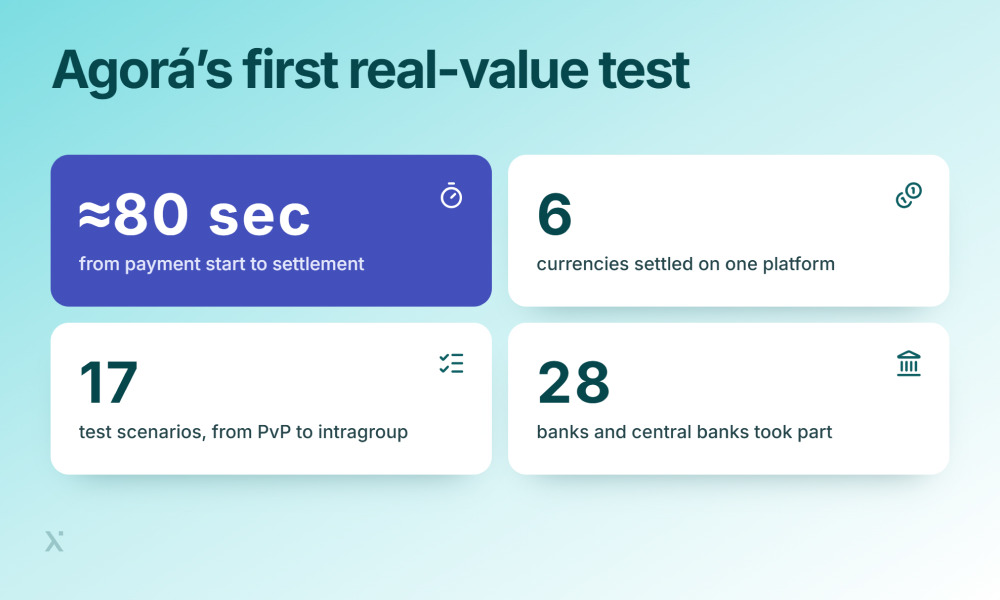
Project Agorá tested this at institutional scale: with central banks and more than 40 financial institutions, it demonstrated atomic multi-currency settlement, using tokenized commercial bank deposits and central bank reserves. In practical terms, all parts of a transaction can settle together rather than moving through a chain of separate settlement steps.
Before writing code for payment software development, identify the main cost drivers, such as reconciliation, settlement delays, intermediaries, and manual processing. If these materially affect operating costs, blockchain may be worth evaluating.

Planning Web3 App Development Cost: Team, Timeline, And Hidden Expenses

Blockchain Development Cost in 2026: What Goes Into the Price Tag
Blockchain for cross-border payments and remittances
Cross-border payments have an odd problem: the payment message travels much faster than the money itself. SWIFT reports that 90% of payments sent over its network reach the receiving bank within an hour. Reaching the bank isn’t the same as reaching the recipient, though — compliance checks, local payment infrastructure, FX conversion, and correspondent banking still stand between the two.
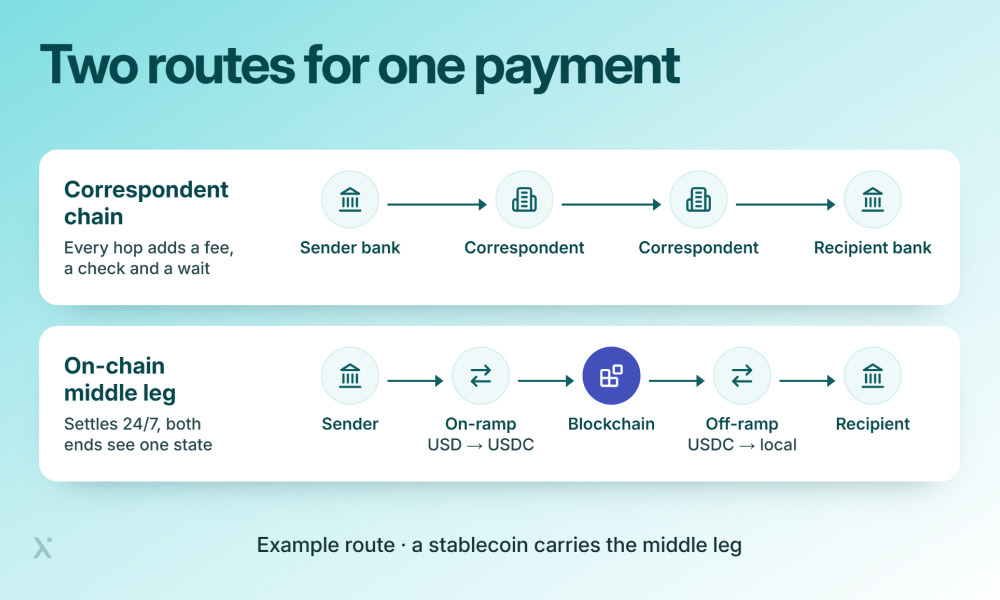
Correspondent banking brings its own challenges. Banks require accounts and liquidity in multiple markets to process payments, so a transfer often passes through several institutions before reaching the recipient. Each step entails additional fees, an additional reconciliation point, and additional funds locked in pre-funded accounts. Blockchain technology offers a different approach.
From payment chains to on-chain settlement
Instead of moving value through a series of correspondent accounts, a payment provider can settle part of the transaction on-chain. Blockchain networks run 24/7, so transfers aren’t tied to banking hours or local cut-off times. The sender and recipient can also see the same transaction state, rather than waiting for several institutions to update their separate ledgers.
Stablecoins have made this model considerably more useful. A provider can convert fiat into a dollar-denominated token such as USDC, transfer it over a blockchain, and exchange it for the destination currency at the other end. The blockchain handles the middle leg, while local banking and payment networks take care of the on- and off-ramps.
That setup can also change liquidity management. Instead of maintaining large balances across numerous correspondent accounts, payment companies can move liquidity when and where needed. The benefit becomes particularly relevant for businesses serving many currencies and payment corridors.
The payment giants are already testing the model
Stablecoin settlement is no longer limited to crypto-native companies. Payment networks, blockchain providers, and banks are all experimenting with ways to move money on-chain, although the underlying models differ. In most cases, blockchain sits in the settlement layer rather than replacing the customer-facing payment experience.
There are still limits. Currency conversion, AML and sanctions checks, licensing, and fiat on- and off-ramps remain part of the process. In practice, this gives FinTech companies another settlement option alongside existing payment infrastructure, rather than a replacement for Swift.
Blockchain’s role in global FinTech has settled into something narrower and more practical. Instead of replacing banks or payment networks, it is being used to improve specific parts of the financial stack, from cross-border settlement and tokenized assets to shared records and programmable transactions. Most real-world systems are hybrid, with blockchain handling the parts where shared infrastructure or faster settlement adds value.
Stablecoins, tokenized deposits, and CBDCs
As blockchain becomes part of the payment infrastructure, the value moving across it looks less like BTC or ETH and more like digital versions of familiar money.
Stablecoins, tokenized deposits, and central bank digital currencies (CBDCs) all represent fiat value digitally, but they are not built the same way. The main differences are who issues them, what claim the holder has, and whether the underlying infrastructure uses blockchain, DLT, or a centralized system.
| Technology | Issuer | Backing | Primary use | Examples |
| Stablecoins | Private regulated or commercial issuer | Cash, Treasuries, and other reserve assets, depending on the coin | Payments, transfers, trading, on-chain settlement | USDC, USDT, RLUSD, PYUSD |
| Tokenized deposits | Commercial banks | Deposit liability of the issuing bank | Institutional payments, settlement, collateral | JPM Coin, bank deposit-token projects |
| CBDCs | Central banks | Direct liability of the central bank | Retail or wholesale payments and settlement | Digital euro, wholesale CBDC initiatives |
Stablecoins bring fiat onto public blockchains
Stablecoins are the most established of the three in blockchain payments. Coins such as USDC, USDT, RLUSD, and PYUSD aim to maintain a stable value while retaining the speed and programmability of blockchain-based assets. Their issuers, reserves, supported networks, and regulatory frameworks differ, so those details matter when choosing one for a payment product.
For FinTech companies, stablecoins offer a relatively straightforward way to add on-chain dollars to a payment product. A crypto payment solutions development project might use them for international payouts, merchant settlement, treasury transfers, or other transactions where conventional banking rails create unnecessary delays.

Introduction to Stablecoins. Use Cases and Examples
The Real Cost of Stablecoin Development: What You Pay For and Why
Tokenized deposits keep banks in the loop
Tokenized deposits are commercial bank money represented on programmable infrastructure. Unlike stablecoins, they remain a liability of the issuing bank rather than a claim on assets held by a separate issuer.
JPM Coin is one live example. The broader appeal for banks is that tokenized deposits can add programmability and faster settlement while keeping commercial bank money at the center of the transaction.
CBDCs put central bank money on digital rails
CBDCs are digital liabilities of central banks. Retail CBDCs are designed for consumers and businesses, while wholesale CBDCs focus on settlement between financial institutions. They do not necessarily use blockchain or DLT.
The digital euro makes that distinction clear: the ECB plans to use a centralized settlement platform rather than blockchain. A pilot is planned for the second half of 2027, with any future issuance still dependent on EU legislation. The United States, meanwhile, has not approved a digital dollar and is currently taking a more restrictive policy approach to CBDCs.
Stablecoins, tokenized deposits, and CBDCs solve different problems and rely on different infrastructure. For FinTech companies, the practical question is which form of digital money fits the product, payment flow, and regulatory environment.

Blockchain in Payment Services: Trends, Technologies, and Development Best Practices

How to Build a Crypto Wallet: a Complete Guide
Real companies already using blockchain in FinTech
Production rollouts are now taking place alongside complex pilot projects and prototypes. Payment networks are using stablecoins for settlements, asset managers are migrating investment products to the blockchain, and financial institutions are testing blockchain for collateral and securities transactions.
Payments are gaining scale: Visa’s stablecoin settlement reached a $7 billion annualized run rate in April 2026 and expanded to nine blockchains. Circle reported $21.5 trillion in total USDC on-chain transaction volume in Q1 2026, while its Circle Payments Network reached an $8.3 billion annualized transaction volume as of March 31.
Tokenized investments are attracting real capital: BlackRock’s BUIDL passed $1 billion in AUM within a year of launch, while Franklin Templeton’s BENJI suite reached $1.98 billion in AUM by April 2026.
Banks and market infrastructure providers are using blockchain for settlement. J.P. Morgan’s Kinexys has processed more than $4 trillion since launch, while DTCC has tested tokenized securities across collateral, repo, lending, and equities workflows. In one collateral project, settlement went from hours to seconds.
The pattern across these examples is consistent: payments, tokenized assets, settlement, and collateral. Most established financial institutions are adopting it selectively rather than replacing their existing infrastructure.

Top 10 Blockchain Development Companies in 2026

Top Blockchain Companies Revealed: How to Choose the Right Development Partner
Blockchain transparency and security in financial services
Financial security often comes down to the quality of the record — who approved a transaction, whether anything changed afterward, and where the funds ultimately went. In systems spread across several institutions, answering those questions can mean pulling data from multiple databases and hoping the records line up.
Blockchain provides participants with a shared transaction history. Once a transaction is confirmed, it is difficult to change it retroactively, and subsequent on-chain transactions remain traceable, creating a useful audit trail for payments, asset transfers, collateral, and other financial transactions.
This also changes the approach to fraud investigation. Blockchain transactions can be tracked as funds move from one address to another, and monitoring tools can flag potentially suspicious transaction patterns in near real time. Permissioned networks add another layer: access control determines who can send transactions or see certain data.
The catch is that blockchain protects the integrity of information after it reaches the ledger — it cannot guarantee that the information was correct in the first place, and it cannot protect a transaction authorized with stolen credentials.
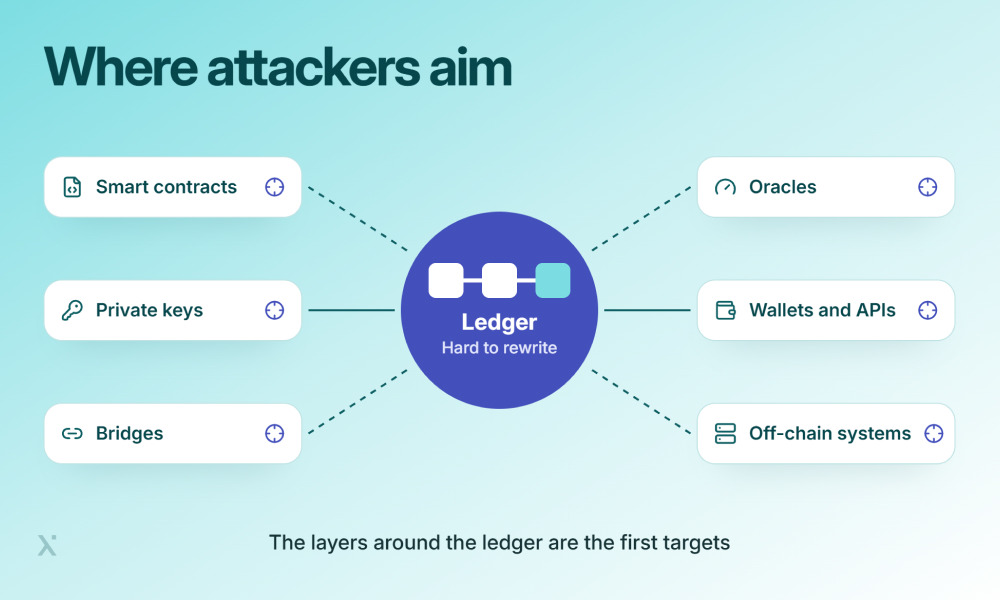
Blockchain introduces its own attack surface
Smart contracts are a prime example: an error in contract logic can put funds at risk, and sometimes there’s no easy way to fix it, so testing, formal verification when necessary, and independent audits are fundamental aspects of smart contract development.
Private keys create another weak point, as losing a private key can result in loss of access to assets. If an attacker gets the key, the blockchain may treat their transactions as perfectly valid. For FinTech products handling customer assets, crypto wallet development has to account for custody models, key recovery, access policies, and secure signing from the start.
Other risks sit between blockchain and the outside world:
- Bridge exploits. Cross-chain bridges hold or control assets while moving value between networks, making them attractive targets for attackers.
- Oracle manipulation. Smart contracts that depend on prices, exchange rates, or other external information are only as reliable as the data feeding them.
- Protocol and smart contract bugs. A small error in code can have direct financial consequences once contracts control real assets.
- Key theft and poor access controls. Phishing, compromised devices, and weak custody procedures can bypass the protections of the ledger itself.
For a FinTech company, good blockchain security means much more than just protecting the network itself. Audits should cover smart contracts, wallets, APIs, bridges, oracles, permission systems, and any off-chain systems connected to them. Critical contracts should undergo independent, risk-based security audits before deployment to production. Keys should be protected using MPC, multisig, or another approach appropriate to the system architecture, and transaction monitoring should continue after launch.
Blockchain technology can make it more difficult to falsify financial records and easier to trace, but it also expands the security boundaries that need protecting. Directly attacking the ledger itself can be difficult, while applications, keys, contracts, and integrations around it become the first targets for attackers.

Best Smart Contract Use Cases Across Industries to Explore in 2026 and Beyond

Smart Contract Development Cost Demystified: What Every Business Should Know
Smart contracts in modern financial products
Many rules-based financial workflows contain steps that can be expressed as predefined conditions and actions — releasing funds, calculating interest, paying claims, distributing income, and issuing assets. Smart contracts translate this logic into code and run it on the blockchain.
Escrow is a simple example: funds stay locked until the agreed conditions are met, then the smart contract releases them automatically. The same idea can work for parametric insurance or trade finance, as long as the contract has a reliable source for whatever happens off-chain. That could be an oracle providing weather data or a trusted system confirming shipment or document status.
Lending shows this at scale: Aave operates by supplying liquidity, enabling collateralized borrowing, and running other lending operations through self-executing smart contracts. Compound handles supplying, borrowing, repayment, and interest accrual the same way, through its own protocol contracts. Sky, the ecosystem formerly known as MakerDAO, built a different model: lock crypto collateral in smart contracts, generate DAI.
Smart contracts are useful for smaller, repeatable payment tasks, too. They can handle recurring subscription charges, divide revenue between several parties, schedule payroll in crypto or stablecoins, and control how tokens are issued and transferred.
| Financial product | Manual workflow | Smart contract automation | Business benefit |
| Escrow | Third party holds and releases funds | Funds unlock when agreed conditions are met | Fewer intermediaries and faster settlement |
| Lending | Staff manage collateral, interest, and repayments | Contract applies lending and collateral rules | Less operational work |
| Insurance | Claim review followed by manual payout | Verified event triggers contract execution | Faster claims processing |
| Trade finance | Parties exchange and verify documents | Payment follows predefined transaction conditions | Fewer handoffs and delays |
| Subscriptions & payroll | Payments are initiated on a schedule | Contract executes programmed transfers | More predictable payment flows |
| Revenue sharing | Income is calculated and distributed manually | Funds are split automatically by preset percentages | Faster, transparent distribution |
| Token issuance | Ownership and transfer records require separate infrastructure | Contract creates and manages digital assets | Programmable issuance and transfers |
For FinTech companies, building smart contracts becomes useful when a workflow contains enough repeatable rules to justify putting them on-chain. Combined with DApp development, those contracts can sit behind a familiar interface, so users don’t need to interact with contract addresses or understand the underlying blockchain.
Automation also comes with a trade-off: once financial logic controls real money, a coding mistake becomes a financial risk. Compound, for example, documents the use of third-party audits and formal verification alongside its smart contract development. The more responsibility a smart contract takes away from people, the more carefully that contract needs to be designed, tested, audited, and monitored.
Comparing DApps Across Protocols: Why Your Blockchain Choice Can Break Everything

DApp Development: How It Works and What It Costs
Blockchain for KYC, AML, and digital identity
Blockchain can support identity and compliance workflows by helping different parties verify credentials, check their status, and rely on the same trust framework. The identity data itself does not have to live on-chain, and tools such as verifiable credentials can work without blockchain.
In practice, blockchain can support several parts of the compliance stack:
- Self-sovereign identity. Users can hold digital credentials and choose what information to share. Blockchain can support parts of the trust infrastructure, but it is not required for this model.
- Travel Rule compliance. Blockchain can provide a traceable record of on-chain transactions, while the required sender and recipient information is exchanged separately through appropriate compliance channels.
- Verifiable credentials. Banks and FinTech platforms can cryptographically verify that credentials came from trusted issuers and have not been altered.
- Anti-money laundering monitoring. Blockchain analytics can trace on-chain fund movements, assess wallet activity, and flag potentially suspicious transaction patterns.
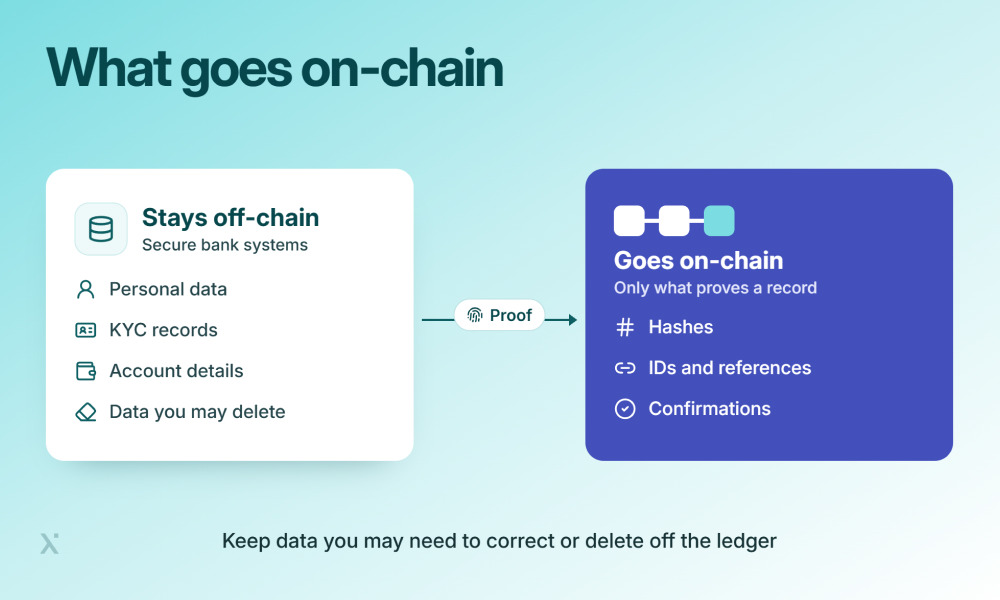
Privacy requirements are a key reason to keep most customer data off-chain — personal information may need to be corrected or deleted, which does not fit well with an immutable ledger. A more practical approach is to store sensitive data elsewhere and use blockchain only for the pieces that benefit from shared verification.
For blockchain in the FinTech industry, that is a much stronger use case than trying to put entire customer identities on a ledger.
Asset tokenization is reshaping investment products
Tokenization turns ownership rights in an asset into digital tokens that can be issued, transferred, and managed on a blockchain. The model is already being applied to real estate, private equity, bonds, U.S. Treasuries, commodities, carbon credits, funds, and money market products.
The appeal comes from what happens after an asset goes on-chain:
- Fractional ownership can enable smaller investment units for assets that are difficult to divide.
- 24/7 markets allow eligible investors to transfer certain tokenized assets outside traditional market hours.
- Programmability puts rules for ownership, transfers, distributions, and compliance into smart contracts.
- Faster settlement reduces the gap between a trade and the final transfer of cash and ownership.
Institutional products demonstrate where this is all heading: BlackRock’s BUIDL tokenizes access to a money market fund containing cash, US Treasury bills, and repurchase agreements. Franklin Templeton uses blockchain infrastructure for its tokenized BENJI fund ecosystem, and Ondo Finance has developed tokenized treasury products that bring government securities to the blockchain.
For blockchain in the FinTech industry, tokenization matters because it changes more than the format of an asset. It can change how that asset is distributed, traded, settled, and used as collateral, opening the door to investment products that would be difficult or expensive to run on conventional infrastructure.
Choosing a blockchain network model
Choosing a network for blockchain FinTech app development involves several dimensions of control. Teams need to consider who can access the network, submit or validate transactions, view data, and participate in governance.
Public permissionless blockchains such as Ethereum, Polygon, and Solana support open participation and connect to well-developed ecosystems of wallets, tokens, and DeFi services. FinTech companies can use this existing infrastructure for stablecoin payments, tokenized assets, and customer-facing applications.
Private permissioned networks restrict access to approved organizations or participants. This model gives operators greater control over identity, data visibility, governance, and network configuration. Hyperledger Fabric, for example, is an enterprise-grade permissioned DLT platform, while Corda is designed as a private, permissioned DLT platform.
Public networks with permission and privacy controls combine open network infrastructure with more granular control at the application or transaction level. Canton Network follows this model as a public Layer 1 blockchain with built-in privacy and selective data disclosure. Besu also supports both public Ethereum and private permissioned networks, allowing it to serve different enterprise and consortium architectures.
| Network model | Access and data visibility | Performance | Compliance | Best FinTech use cases |
| Public permissionless | Transactions broadly visible | Varies by network; high scalability available on some chains and L2s | Requires additional identity and compliance layers | Stablecoin payments, DeFi, tokenization, consumer apps |
| Private or consortium permissioned | Limited to one organization or closed environment | Potentially higher/configurable, depending on architecture | Strong control over access and data | Internal settlement, treasury, recordkeeping |
| Public with privacy and permission controls | Visible only to approved participants | Designed for controlled enterprise workloads | Identity and access rules can be built into the network | Interbank settlement, trade finance, institutional assets |
The right choice comes down to the product: a stablecoin payment app and an interbank settlement platform have very different requirements, and forcing both onto the same type of network rarely makes sense.

How Permissioned Blockchains Transform Business: A Detailed Overview

Private Blockchain Development in 2026: A Step-by-Step Guide
Blockchain development roadmap for FinTech companies
A blockchain-based FinTech project shouldn’t begin with choosing a network or writing smart contracts. It begins with a solid justification for placing part of the product on the blockchain. A practical roadmap looks like this:
- Assess the business problem. Map the current process, its costs, bottlenecks, intermediaries, and technical limitations.
- Select a use case. Identify where blockchain can provide measurable improvements — faster settlements, reduced reconciliation costs, improved asset traceability.
- Conduct a regulatory review. Consider licensing, KYC/AML, privacy, custody, securities regulations, and jurisdiction-specific requirements before defining the architecture.
- Compare network models. Compare public, private, and permissioned networks in terms of transaction volume, fees, privacy, compatibility, and governance.
- Design the architecture. Determine what should be on-chain, what remains off-chain, and how the blockchain interacts with existing payment, banking, identity, and information systems.
- Create and test smart contracts. Develop and test on-chain logic or smart contracts, if required.
- Conduct a security audit. Review contracts, wallets, key management, APIs, permissions, and external dependencies.
- Launch an MVP. Develop only what is necessary to validate the core workflow and business feasibility.
- Run a pilot with real users. Test under realistic transaction volumes, compliance procedures, and operating conditions.
- Move to production. Scale gradually, with established monitoring and incident response systems in place.
- Track KPIs. Compare actual transaction costs, settlement times, failure rates, adoption rates, and operational savings with the initial business case.
Order matters here: a technically sound blockchain product can still fail if it solves a low-cost problem with expensive infrastructure. The business case must survive the MVP and pilot stages before you commit to full-scale production.
Typical blockchain FinTech app development timeline
Timelines vary significantly depending on the product, architecture, integrations, security requirements, and regulatory scope. As a rough planning estimate, a blockchain MVP for a FinTech product may take 3–6 months to build, while production readiness can extend the timeline to 6–12 months or more. Projects built on an existing network are often faster to deliver than solutions that require custom infrastructure.
Timelines vary significantly depending on the product, architecture, integrations, security requirements, and regulatory scope. As a rough planning estimate, a blockchain MVP for a FinTech product may take 3–6 months to build, while production readiness can extend the timeline to 6–12 months or more. Projects built on an existing network are often faster to deliver than solutions that require custom infrastructure.
How to Build a Crypto Wallet: a Complete Guide

Blockchain Analysis Explained: Use Cases & Data Insights
Metrics that measure blockchain success
A blockchain product can work perfectly from a technical standpoint and still make little financial sense. The KPIs chosen before the pilot should show whether the new infrastructure actually improves on the process it replaces.
For most FinTech projects, the useful metrics fall into three groups:
- Cost and efficiency: cost per transaction, settlement time, reconciliation time, compliance costs, operational savings, and liquidity efficiency.
- Risk and reliability: fraud losses, failed transactions, security incidents, and network uptime.
- Adoption and financial return: number of active users, transaction volume, customer retention, ROI, and, for relevant DeFi products, total value locked (TVL).
Speed isn’t everything: reducing settlement time from two days to five minutes means little if it dramatically increases operating costs. Automation is no exception: reducing reconciliation work is only worthwhile when the savings outweigh the costs of development, infrastructure, security, and regulatory compliance.
This focus on measurable returns also represents broader blockchain FinTech trends. As production deployments increase, FinTech companies are placing greater emphasis on measurable business outcomes rather than experimentation alone.
Challenges every FinTech company should consider
The economics may look good on paper, but blockchain adds constraints that conventional FinTech teams don’t always deal with. These need to be factored into the architecture and budget early.
- Regulation. Rules governing digital assets, stablecoins, custody, and tokenized securities vary by market and continue to evolve.
- Scalability. Transaction throughput, confirmation times, and network fees can become a problem as volumes grow.
- Interoperability. Moving data and assets between blockchains, banks, payment networks, and other systems is still difficult.
- Privacy. Financial data cannot simply be exposed on a public ledger. Products need a clear split between what goes on-chain and what stays private.
- Legacy integration. Core banking systems and existing payment infrastructure weren’t built with blockchain connectivity in mind. Integration can become one of the largest parts of the project.
- Specialized skills. FinTech blockchain technology requires expertise across distributed systems, smart contracts, cybersecurity, and financial regulation, a combination that isn’t easy to hire for.
- Governance. Someone needs to decide how protocols are upgraded, permissions are changed, disputes are handled, and responsibilities are divided between network participants.
- Vendor lock-in. Building too closely around one network, custody provider, or infrastructure vendor can make future migration expensive.
None of these challenges rules blockchain out, but they do change the calculation. A project makes sense when the problem it removes is expensive enough to outweigh the complexity it introduces.
So, is blockchain worth the complexity?
Sometimes — and that is probably a healthier answer than the sweeping promises blockchain came with a decade ago.
The technology has reached a point where simply putting finance on-chain isn’t much of an achievement. The harder test is whether doing so leaves the business with a better system than the one it had before. If a blockchain product cuts an expensive intermediary, frees up liquidity, or removes enough operational work to justify its cost, the added complexity has a purpose. If the same result could be achieved with a database and a good API, blockchain is an expensive detour.
A practical approach is to start with the economics, not the technology. Identify costly friction points, then validate whether the proposed blockchain solution addresses them. That’s the point where blockchain stops being an experiment and starts being part of the financial system.
FAQ
Connecting a blockchain network to existing banking systems involves more than adding an API. Teams may need to align data models, transaction states, identity and access controls, settlement logic, compliance workflows, and accounting records across systems built on very different architectures. This is why blockchain initiatives in financial institutions often become part of broader banking software development rather than standalone Web3 projects.
Not necessarily. ISO 20022 is a financial messaging standard, not a blockchain protocol, so blockchain itself cannot be ISO 20022 compliant. However, FinTech platforms exchanging data with banks and payment networks may need to support ISO 20022 messages at the integration level.
Blockchain transactions generally cannot be reversed at the ledger level once completed. However, a FinTech product may still include mechanisms for refunds, dispute resolution, escrow, or compensation transactions. The choice of the appropriate model depends on who controls the product and the consumer protection regulations in place in its market.
Yes. A company can keep its existing FinTech interface and connect the trading capabilities it needs through external infrastructure providers. Liquidity, custody, market data, and execution do not all have to be built in-house, and white-label or hybrid models can further reduce development effort. For products that require custom order matching, wallet logic, fee models, liquidity management, or broader asset support, cryptocurrency exchange development offers greater flexibility to customize the underlying architecture.
Financial and customer data don’t always need to be stored on the blockchain. Sensitive information, including personal data, KYC records, account information, and anything that might require correction or deletion, is generally best stored in secure off-chain systems. Blockchain can only store elements necessary for verification, such as hashes, identifiers, references, or confirmations. The right balance between storing data on and off-chain depends on privacy obligations, access control, and the amount of data participants actually need to transmit.
Start with the current cost of the process you want to improve. Measure transaction fees, reconciliation work, settlement delays, liquidity tied up in transit, compliance overhead, and exception handling. Then compare those costs with the expected expense of blockchain development, infrastructure, security, integration, and ongoing maintenance.