
No, blockchain will not replace teachers or do your homework — at least, not by itself. What it can do is change how educational records and learning ecosystems are created, stored, and verified.
Blockchain is making its way into education. In 2025, the global blockchain in education market was worth around $1.8 billion and is expected to reach $12.4 billion by 2034, with a CAGR of 23.8% between 2026 and 2034.
One of the main drivers is the growing need for secure, easy-to-verify educational records. This is especially relevant given that nearly 30% of U.S. workers admit to lying about their college degree on a resume. Blockchain can help schools issue digital diplomas and certificates that are difficult to fake and easy for employers to verify.
But credential verification is just one of the possible use cases. So, what else can blockchain bring to education?
We at PixelPlex have all the answers. With our blockchain development services, we know the ins and outs of blockchain in higher education and other levels of learning — and we’re ready to spill the tea. Let’s start!
Education + blockchain: what’s the formula for?
Blockchain is a shared digital record that stores information across a network instead of keeping it in one central place. Once information is added, it is difficult to change or delete without leaving a trace, which makes blockchain useful for keeping records secure and trustworthy.
So, what does this have to do with education? Blockchain in education can:
- Help secure student records
- Simplify data sharing between institutions
- Improve transparency around payments and funding
- Create new ways to manage learning and educational content
The technology can also help different parties work with the same trusted information without relying on a single central database. In other words, blockchain can become part of the infrastructure behind a more connected and transparent education system.

Beyond Traditional LMSs: The Rise of Web3 Learning Apps

From Certificates to Credentials: Why eLearning Needs Blockchain
Blockchain vs. traditional education: what’s the difference?
Traditional education systems usually rely on centralized databases and institutions to store, manage, and verify information. Blockchain in education takes a different approach: it creates a shared, tamper-resistant record that authorized parties can access and verify. This can change how educational data is managed and how students, institutions, and employers interact with it.
Blockchain in education vs. traditional education system
| Aspect | Traditional education system | Blockchain in education |
| Data storage | Information is usually stored in centralized databases managed by individual institutions | Information can be stored on a distributed network and shared between authorized participants |
| Record security | Security depends on the institution’s databases, access controls, and cybersecurity measures | Cryptographic protection and a tamper-resistant record make unauthorized changes more difficult |
| Credential verification | Employers and other institutions may need to contact the issuing institution to verify credentials | Digital credentials can be verified through the blockchain without lengthy manual checks |
| Data sharing | Institutions may use different systems, which can make data sharing slower and more complicated | A shared infrastructure can make it easier for authorized parties to access and verify the same information |
| Transparency | Data and processes are mainly controlled by individual institutions | Blockchain can provide greater visibility into records and transactions while keeping access controlled |
| Control | Educational institutions usually have primary control over student records | Students can potentially have more control over how and where their verified credentials are shared |
| Automation | Many administrative processes still require manual work and verification | Smart contracts can automate certain processes based on predefined rules |
| Interoperability | Different institutions may use systems that do not easily communicate with each other | Blockchain can provide a common infrastructure for connecting different participants and systems |
It’s important for us to add that blockchain in education is not about replacing everything that already works. It is about using this technology where it can solve specific problems better. In education, this can mean adding a new layer of security, transparency, and automation where traditional systems may fall short.

DApp Development: How It Works and What It Costs
Comparing DApps Across Protocols: Why Your Blockchain Choice Can Break Everything
Use cases of blockchain in education: what exactly can you build?
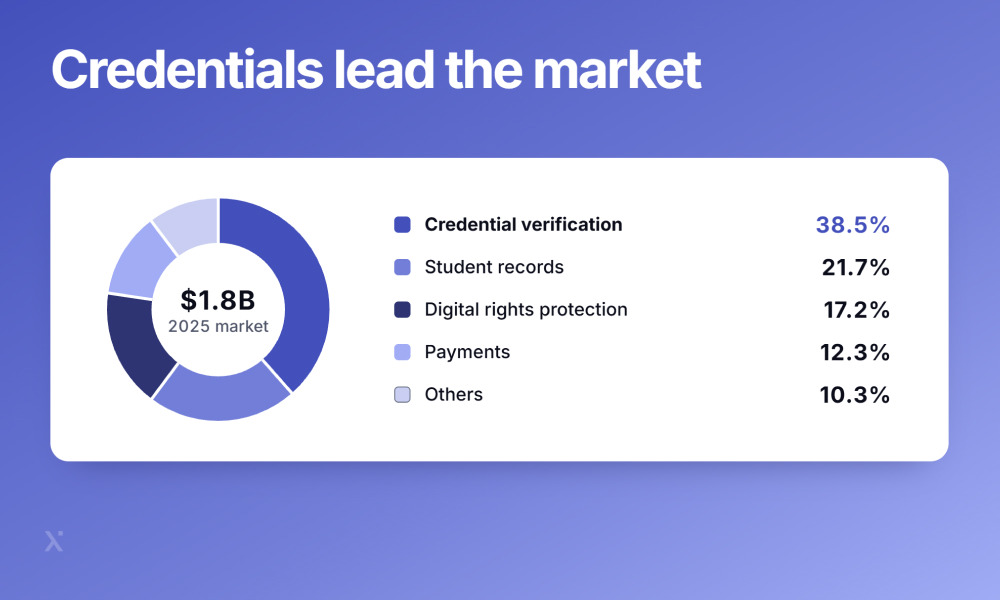
There are many ways to apply blockchain to education, from improving existing processes to creating entirely new digital learning solutions. The most relevant use cases include:
- Digital credentials and certificates
- Student records and identity management
- Academic credit and achievement tracking
- Secure data sharing between institutions
- Blockchain-based payments
- Intellectual property and educational content management
- Learning and training platforms
- Funding, scholarships, and donations
- NFT-based educational assets
- Decentralized education platforms
These use cases of blockchain in education can apply to schools, universities, online learning providers, and professional training organizations. Here is a closer look at them.
Blockchain for education: use cases
| Use case | What you can build |
| Digital credentials | Platforms for issuing, storing, and verifying diplomas, certificates, badges, and other academic achievements |
| Student records | Secure systems for managing academic records and giving students more control over how their information is shared |
| Credit and achievement tracking | Solutions that record academic credits, skills, and achievements and make them easier to transfer between institutions |
| Blockchain payments | Systems with blockchain payments for education sector that automate tuition fee collection, scholarships, grants, and other transactions with the help of smart contracts |
| Data sharing | Blockchain-based infrastructure that allows authorized schools, universities, employers, and students to share and verify trusted information |
| Intellectual property | Platforms that help educational institutions and creators record ownership and manage rights to research, courses, and other educational content |
| Learning platforms | Decentralized learning environments where students and educators can interact, share content, and track learning activities |
| Funding and donations | Transparent systems for managing scholarships, grants, donations, and other education funding |
| NFTs for education | NFT-based solutions for representing certificates, digital achievements, memberships, or educational assets. NFT development services can help bring these solutions to life. |
| Identity management | Blockchain-based identity solutions that help students securely prove who they are and access educational services |
These are only some of the possibilities. The right solution depends on the problem you want to solve, the users involved, and how blockchain can add value compared with a traditional system.
At PixelPlex, we can help you choose the right approach and build the solution around your goals. If you are looking to create a decentralized learning platform or another blockchain-powered education product, our dApp development services can help turn your idea into a secure, scalable, and user-friendly solution.
Tell us what you want to create, and we’ll help you find where blockchain fits and how to make it work.
Blockchain education solution development: step by step
Building a blockchain solution for education doesn’t need to be complicated. You can start with a clear problem, choose the right technology, and gradually turn your idea into a working product. Here is what the process may look like.
1. Define your goals
Start by deciding what you want your solution to achieve. Then, answer the following questions:
- What problem are you trying to solve?
- Who will use your future product?
- How should it improve on the current system?
A clear goal will help you choose the right features and avoid adding blockchain where it’s not really needed.
2. Choose the blockchain
Next, you should choose a blockchain that fits your project. There is no one-size-fits-all option here. Your choice will depend on factors such as transaction speed, fees, scalability, security, ecosystem, and the type of solution you want to build.
For example:
- Ethereum — choose it when you need a mature ecosystem, strong security, and access to a wide range of smart contract tools and integrations.
- Polygon — choose it when you want to build on the Ethereum ecosystem while keeping transaction costs lower and improving scalability.
- Solana — choose it when your solution needs high transaction throughput and low fees, especially if you expect a large number of transactions.
- BNB Chain — choose it when you need relatively low transaction fees and want access to an established smart contract ecosystem.
- Hyperledger Fabric — choose it when you need a permissioned network with strict control over who can access and manage educational data, such as in collaboration between universities, government bodies, or other institutions.
You should also think about where your data will live. Sensitive student information does not necessarily need to be stored directly on the blockchain. In many cases, only a hash, proof, or other reference is stored on-chain, while the actual data remains in a secure off-chain system.

Ethereum Development from A to Z: Features, Use Cases, and Costs

Exploring Solana Development: Core Features, Industry Use Cases, and Future Trends
3. Plan the solution
Now you can define how the product will work. Decide which features you need, how users will interact with the platform, what data will go on-chain, and what will stay off-chain.
At this stage, you should also plan integrations with existing education systems, payment providers, identity solutions, or other tools your users already rely on.
4. Design the user experience
Blockchain may be behind the scenes, but your users should not need to understand how exactly it works. Create a simple interface that makes it easy for students, teachers, administrators, or employers to use the platform.
The goal is to make blockchain-powered features feel as straightforward as any other digital service.
5. Develop smart contracts and core features
Once the solution is planned, the actual development process can begin. Your team can build the platform, smart contracts, user accounts, integrations, and other required features.
Smart contracts can also automate specific processes and reduce the need for extra manual actions.
6. Test everything
Before launch, you should test the solution from both technical and user perspectives. Check smart contracts, transactions, integrations, permissions, and overall platform performance.
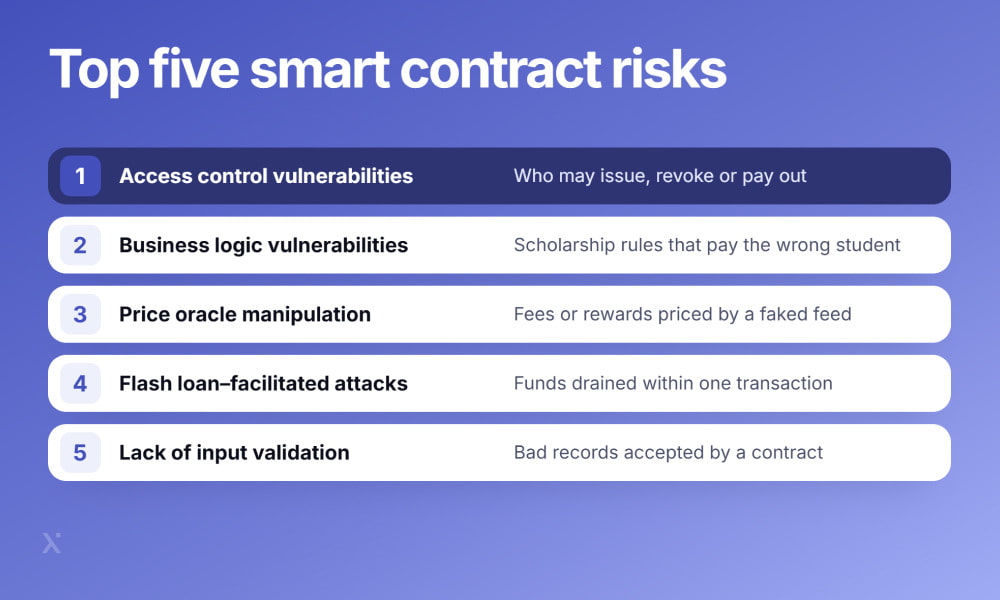
Security testing is especially important when the solution handles sensitive educational records, payments, or digital assets.
Smart contracts automate critical processes and transactions, so even a small vulnerability can cause major problems. Prioritizing their security helps protect your users, data, and assets from the start.

From Code to Confidence: Inside Smart Contract Audit Pricing

Web3 Smart Contract Development: Building the ‘Brain’ of Your Web3 Project
7. Deploy and launch
Once everything works as expected, you can deploy the solution and make it available to users. But the work shouldn’t just stop here.
You should monitor the platform, fix issues, collect user feedback, and improve the product as your needs evolve.
8. Scale when you’re ready
As more users and institutions join the platform, you may need to add new features, integrations, or blockchain networks. Plan for scalability from the very beginning so that this process is much easier later on.
Blockchain technology in education: how much does it cost?
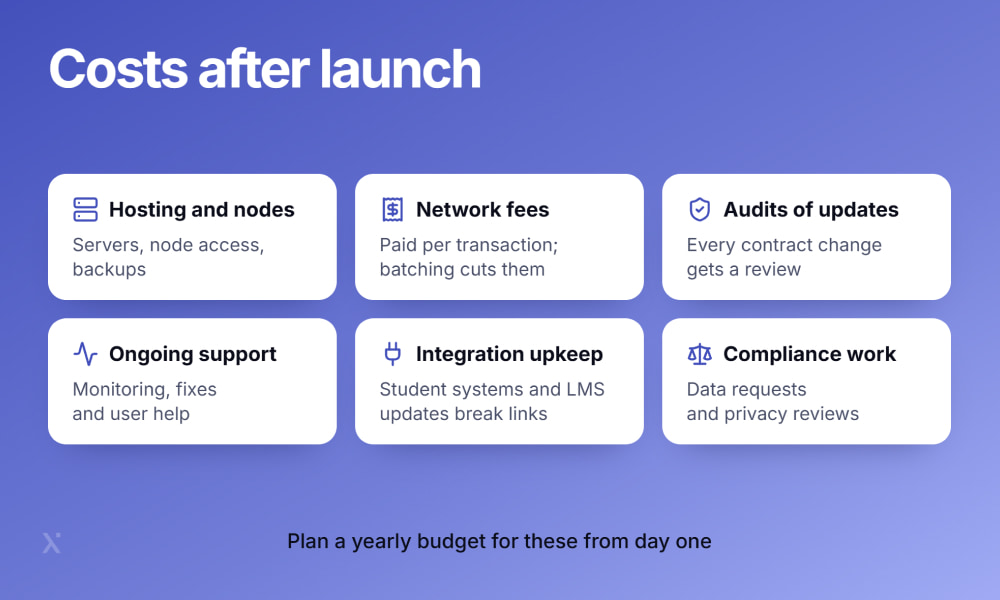
The cost of blockchain in education depends on what you want to build, how complex the features are, and how many integrations the solution needs. A simple MVP can start at around $50,000, while a more advanced platform can require $180,000 and much more.
Here is a rough estimate to help you understand what different project sizes may look like.
MVP
An MVP is a good starting point if you want to test an idea with a limited set of features and users.
| Estimated cost | Timeline | Scope |
| $50,000–$80,000 | 3–5 months | Basic blockchain integration, user accounts, one core use case, simple smart contracts, basic admin panel, and essential security testing |
Mid-size education solution
A mid-size solution is suitable when you need more features, integrations, and a more polished user experience.
| Estimated cost | Timeline | Scope |
| $80,000–$180,000 | 5–8 months | Multiple blockchain features, smart contracts, custom UI/UX, several integrations, user roles, admin tools, API integration, and comprehensive security testing |
Advanced platform for education
Advanced solutions are designed for larger organizations or platforms that need complex functionality, high scalability, and multiple integrations.
| Estimated cost | Timeline | Scope |
| $180,000–$500,000+ | 9–15 months | Complex smart contracts, multiple integrations, advanced user management, custom blockchain infrastructure, high scalability, sophisticated security, analytics, and ongoing optimization |
If you want to build a blockchain-powered education platform, our Web3 development services can help you choose the right architecture, build the core product, and prepare it for real-world use. We can also help you integrate blockchain with your existing education systems, prioritize security, and scale the solution as your user base grows.

Blockchain for Business: Beyond Cryptocurrency to Real-World Value

Top Blockchain Companies Revealed: How to Choose the Right Development Partner
Blockchain in education: real-world success stories
Universities around the world have already experimented with blockchain for education: they have used the technology to issue digital credentials, verify academic records, and build blockchain-focused programs.
Here are three examples that show how these blockchain education initiatives work.
| Institution | What they use blockchain for | What makes it interesting |
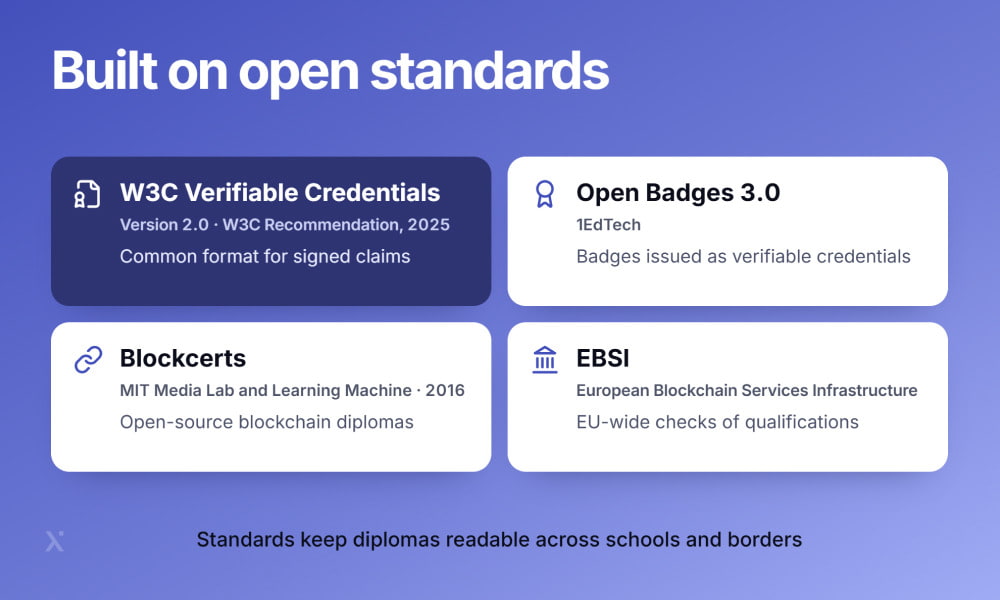
| MIT (US) | Digital diplomas | MIT introduced blockchain-based digital diplomas through a pilot project. Graduates could receive a digital version of their diploma that uses Blockcerts to protect and verify the credential. Employers and other institutions could verify the diploma without contacting MIT directly. |
| University of Melbourne (Australia) | Blockchain-based credentials | It became the first university in the Asia-Pacific region to issue recipient-owned blockchain credentials. Its Melbourne Teaching Certificate used the Blockcerts standard that allows recipients to own, share, and independently verify their credentials. |
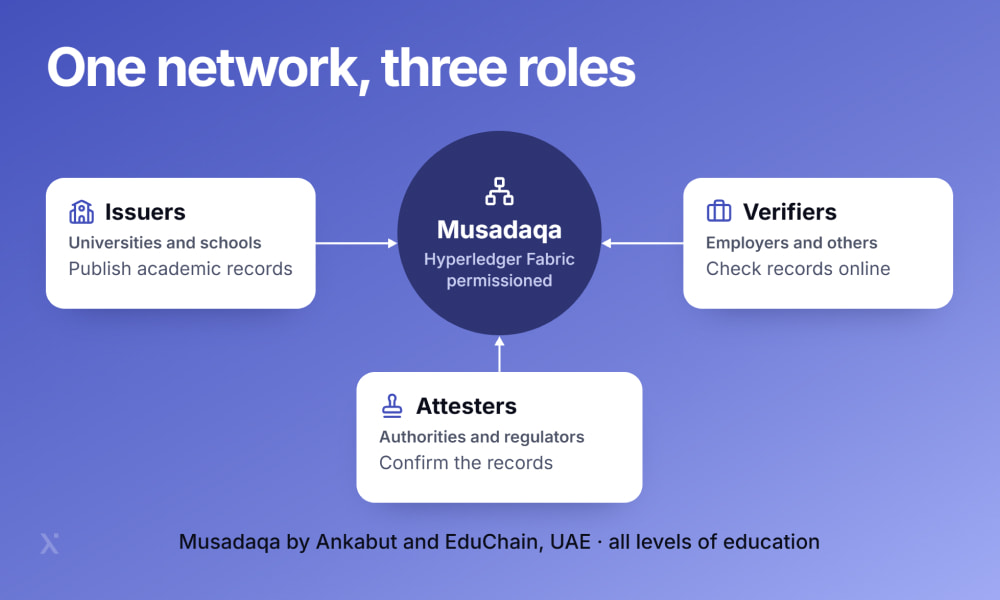
| Ankabut (UAE) | Digital academic records | A case study of Musadaqa shows how Ankabut and EduChain applied blockchain to academic credential management. The organizations launched a platform for issuing, attesting, and verifying digital academic records across all levels of education. Built on Hyperledger Fabric, the permissioned blockchain allows educational institutions to issue credentials and authorized parties, such as employers, to verify them. |
These examples may focus on credentials and academic records, but they also show that every blockchain solution requires a tailored approach. Blockchain consulting can help you find the right technology, architecture, and development strategy for your project before you start investing in the build.
Why partner with PixelPlex for your blockchain-based education project?
Building blockchain in education requires more than blockchain expertise alone. You also need a strong understanding of education products, user experience, integrations, security, and the technology already used by your organization.
That is where PixelPlex can help. We combine blockchain expertise with our education software development services, so you can build the blockchain layer while also creating the rest of the product around it.
Our education app development team works on custom e-learning platforms, mobile apps, legacy system modernization, gamification, and AR/VR learning environments as well.
Reasons to choose PixelPlex
| Why PixelPlex? | |
| 13 years in blockchain | 47+ blockchain projects launched |
| 1 million+ audited smart contract calls | $1.2 billion generated by projects PixelPlex engineered |
You don’t have to force blockchain into every part of your project. We can help you figure out where blockchain makes sense and where another technology would work better, then bring everything together into one solution. Besides blockchain, we work with AI, data, mobile technologies, and AR/VR, so you can use more than one technology to build your solution.
Whether you are starting a new education platform or modernizing an existing one, we can help you choose the right technology mix and take the product from idea to launch.
FAQ
The tech stack depends on the project, but it can include Solidity for smart contracts, JavaScript or TypeScript for application development, Node.js for backend services, and frameworks such as React for the frontend. The solution may also use blockchain APIs, cloud infrastructure, databases, wallets, and identity management tools.
Blockchain in education can provide strong security through cryptography, decentralized storage, and tamper-resistant records. However, sensitive student data should not automatically be stored directly on-chain, and the overall solution still needs proper access controls, encryption, and security testing.
You should consider smart contract vulnerabilities, private key management, access control, data privacy, wallet security, and vulnerabilities in third-party integrations. A security audit and thorough testing should be part of the development process.
Yes, it surely can. Automated verification, smart contracts, and shared records can reduce some repetitive manual processes and make collaboration between institutions more efficient.
They can, but scalability needs to be considered during architecture design. The choice of blockchain, transaction model, off-chain infrastructure, and data storage approach can all affect how well the solution handles a growing user base.
A typical team can include a business analyst or product manager, UX/UI designer, blockchain developer, backend developer, frontend developer, QA engineer, and DevOps engineer. You may also need a security specialist or smart contract auditor for solutions that handle sensitive data or digital assets.