Keeping your valuable digital assets safe takes more than a wallet and a password. As institutions move deeper into crypto and tokenized assets, secure custody is becoming a must-have, not a nice-to-have.
Keeping your valuable digital assets safe takes more than a wallet and a password. As institutions move deeper into crypto and tokenized assets, secure custody is becoming a must-have, not a nice-to-have.
The market reflects this shift. The global digital asset custody market was valued at $683.4 billion in 2024 and is expected to reach $4.38 trillion by 2033. North America led the market in 2024, accounting for 39.5% of revenue.
But custody is about more than simply storing digital assets. Businesses need to manage private keys, control access, monitor transactions, reduce security risks, and meet compliance requirements — all without making the user experience unnecessarily complicated.
So, what does a digital asset custody platform actually need? In this article, we’ll break it down for you. We will also cover how these platforms work, what features they include, and how to build one with security in mind.
What is a digital asset custody platform?
Digital asset custody means securely safeguarding and managing cryptocurrencies, tokens, and other digital assets on behalf of clients. At a basic level, this means protecting the private keys that provide access to those assets.
For institutions, however, digital asset custody platform development is about much more than storing private keys. A bank, exchange, or investment firm may hold assets on behalf of many different clients. It needs to know who owns what, who can move funds, who approved a transaction, and how to track everything that happens.
This is where a digital asset custody platform comes in. It combines key management with the tools needed to safeguard client assets and maintain accurate records.
An institutional crypto custody solution typically includes:
- Client asset segregation: Keeps each client’s assets separate and makes it clear who owns what.
- Omnibus and segregated accounts: Supports different ways of holding and accounting for client assets. Assets can be held in separate wallets for individual clients or together in omnibus wallets while the platform tracks each client’s balance internally.
- Internal ledger: Keeps a record of client balances and transactions alongside the data recorded on the blockchain.
- Transaction policies: Sets rules for how and when funds can be moved.
- Approval workflows: Requires one or more people to approve certain transactions before they are sent.
- Compliance checks: Supports KYC, AML, sanctions screening, transaction monitoring, and other compliance requirements.
- Reporting: Gives clients and internal teams access to balances, transactions, and other reports.
- Audit trails: Records important actions so they can be reviewed later.
- Reconciliation: Compares internal records with blockchain data to make sure balances and transactions match.
- Disaster recovery: Helps keep the platform running and restore operations if something goes wrong. This includes RTO (how quickly systems should be restored) and RPO (the maximum amount of data loss considered acceptable).
- Proof of reserves: Shows that the custodian has enough on-chain assets to cover the assets it holds for customers.
- Sub-custody: Allows the institution to work with other custodians to hold certain assets or support specific networks.
A crypto wallet or an institutional custody platform: what’s the difference?
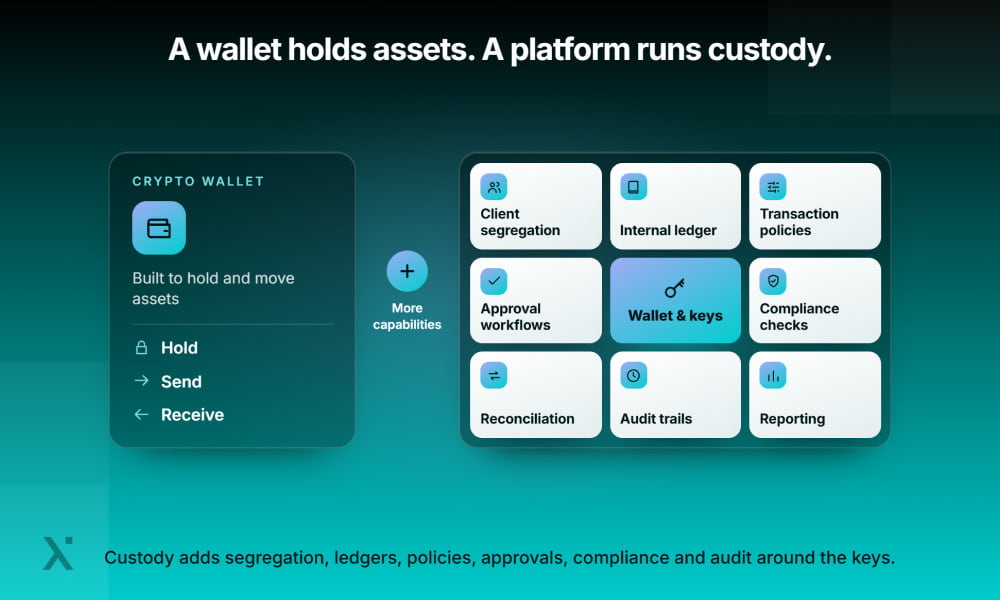
A wallet is mainly designed to hold, send, and receive digital assets. An institutional crypto custody solution, on the other hand, has to manage the wider operational, accounting, and compliance processes around those assets. It needs to keep client balances organized, control who can move funds, support compliance processes, and provide a clear record of every transaction and approval.
This means that building an institutional custody platform is not simply a matter of adding more wallets. The platform needs extra layers around its wallet and key management infrastructure.
The table below shows what sets an institutional custody platform apart from a standard crypto wallet.
Crypto wallet vs. digital asset custody platform
| Capability | Crypto wallet | Institutional custody platform |
| Key management | ✓ | ✓ |
| Client asset segregation | Limited | ✓ |
| Internal ledger | Basic | ✓ |
| Transaction policies | Limited | Advanced |
| Approval workflows | Limited | ✓ |
| Compliance | External integrations | Built-in workflows + integrations |
| Reconciliation | Basic/none | ✓ |
| Audit trails | Limited | ✓ |
| Reporting | Limited | ✓ |
| Proof of reserves | Not typical | ✓ |
| Sub-custody | Not typical | ✓ |
| HA/DR (High availability and disaster recovery) | Basic | Enterprise-grade |
Even though an institutional custody platform requires a broader infrastructure than a standard wallet, the wallet and key management layer remains at its core. Choosing the right architecture, security model, and blockchain integrations is therefore essential when building custody solutions.
If you need a secure and scalable wallet infrastructure to support your custody platform or digital asset product, PixelPlex provides crypto wallet development services tailored to your business and technical requirements.

How to Build a Crypto Wallet: a Complete Guide
Zero-Leakage Vaults: Building High-Stakes Canton Network Wallets
Digital asset custody architecture: what are the key layers?
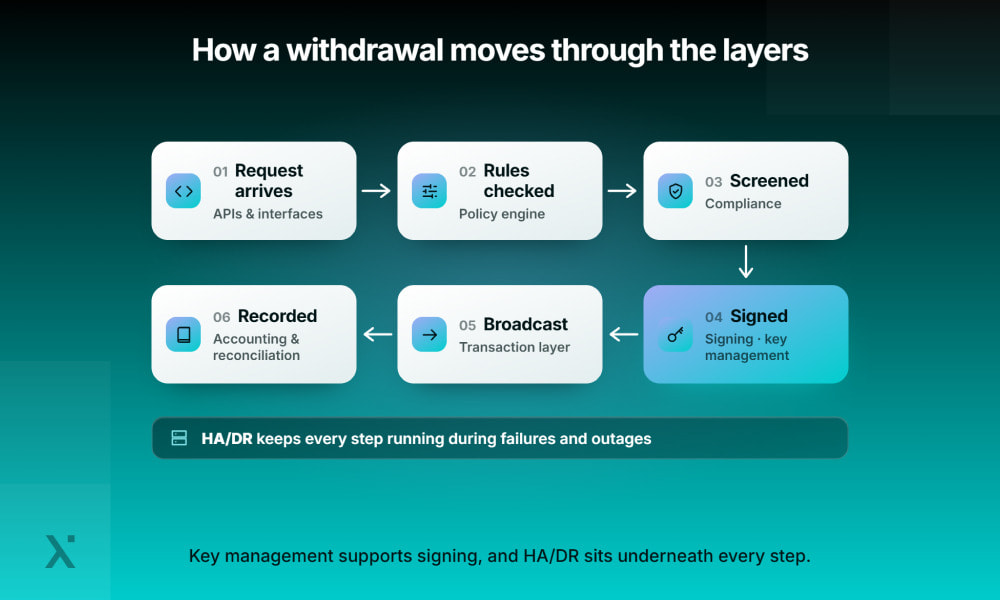
Behind the user interface, a custody platform has several layers that work together to protect private keys, approve transactions, track assets, enforce compliance, and keep the platform running if something goes wrong.
A typical digital asset custody architecture can be divided into eight key layers:
| Layer | Its responsibility |
| Key management | Generates, stores, protects, and manages cryptographic keys throughout their lifecycle |
| Signing | Authorizes blockchain transactions using secure signing mechanisms such as multi-party computation (MPC custody), hardware security modules (HSMs), or multi-signature schemes |
| Policy engine | Defines and enforces rules for transaction limits, approvals, user permissions, and other security controls |
| Transaction layer | Creates, validates, submits, and monitors transactions across supported blockchain networks |
| Accounting & reconciliation | Tracks asset balances, transaction records, fees, and ensures internal records match on-chain data |
| Compliance | Supports KYC/AML checks, transaction monitoring, risk screening, and other regulatory requirements |
| APIs & interfaces | Connects the custody platform with wallets, exchanges, financial systems, internal tools, and user-facing applications |
| HA/DR | Provides high availability and disaster recovery to keep critical custody operations running during failures or outages |
Together, these layers create the foundation for a custody platform that is secure, auditable, compliant, and reliable enough to handle institutional digital assets. Transaction monitoring software can further strengthen this architecture by continuously observing transactions, identifying suspicious activity, and supporting regulatory compliance.
Various key management approaches and how to choose the right one
Key management is at the heart of digital asset custody platform development. It determines how private keys are protected, how transactions are approved, and what happens if a device, employee, or part of the infrastructure is compromised.
There is no single approach that works best for every custody platform. MPC/TSS, HSMs, and on-chain multisig protect assets in different ways, so the right choice depends on your threat model, supported networks, transaction volume, and recovery requirements. In practice, institutional platforms may also combine these approaches rather than rely on just one.
MPC/TSS
Multi-party computation (MPC) and threshold signature schemes (TSS) distribute key control across multiple parties or devices. A complete private key does not need to exist in one place, while the parties can jointly produce a valid transaction signature.
This makes MPC custody and TSS particularly useful when you need strong security without slowing down everyday operations.
Advantages:
- No complete private key needs to exist in one location
- Strong protection against a single compromised device or server
- Fast signing for frequent transactions
- Works well across many blockchain networks
- Fits automated custody workflows and institutional operations
Trade-offs:
- More complex to design and operate
- Recovery depends on the MPC/TSS implementation and backup strategy
- Requires careful coordination between key shares and signing parties
- Security depends heavily on the quality of the underlying protocol and implementation
If MPC fits your custody model, MPC wallet development can be used to build distributed key management into the wallet and custody infrastructure.

MPC Wallet Development Cost: Pay Now or Pay After a Breach

Custodial vs. Non-Custodial Wallet: Everything You Need To Know
HSM
Hardware security modules (HSMs) keep cryptographic keys inside dedicated, tamper-resistant hardware. The key stays within the device while cryptographic operations, such as signing, are performed there. HSMs are often used where strong hardware isolation and controlled key ceremonies are important.
Advantages:
- Keys remain inside dedicated secure hardware
- Strong protection against unauthorized physical access
- Well suited to controlled, high-security environments
- Can support formal security certifications and audit requirements
- Useful for offline or cold custody setups
Trade-offs:
- Hardware adds cost and operational overhead
- Scaling and coordinating multiple devices can be complex
- Less flexible for some blockchain and smart contract workflows
- Recovery requires carefully designed backup and key ceremony procedures
On-chain multisig
Multisig requires multiple private keys to approve a transaction before it can be executed. For example, a 2-of-3 wallet can require two of three authorized signers. Unlike MPC custody, the approval logic is visible and enforced on-chain, which makes the authorization model easy to verify.
Advantages:
- No single signer can move funds alone
- Approval rules are visible and auditable on-chain
- Straightforward to understand and govern
- Useful for treasury management and shared control
- Recovery can be designed around replacing individual signers
Trade-offs:
- Each signer usually has a separate private key to protect
- On-chain implementation varies between networks
- Transactions can require multiple signatures and additional coordination
- Smart contract multisig introduces smart contract risk on supported networks
The choice becomes easier when you compare the three approaches against the risks and operational requirements of your custody platform.
MPC/TSS vs. HSM vs. on-chain multisig
| Factor | MPC/TSS | HSM | On-chain multisig |
| Threat model | Protects against compromise of individual key shares or signing parties | Protects keys through hardware isolation and tamper resistance | Protects against a single compromised signer |
| Secret storage | Distributed cryptographic shares | Keys stored inside secure hardware | Multiple separate private keys |
| Signing speed | Fast, suitable for frequent transactions | Fast within the HSM environment, but operational controls may add delays | Depends on the network and number of required signatures |
| Network coverage | Broad, depending on protocol and implementation | Depends on HSM and blockchain integration | Depends on native or smart contract multisig support |
| Operational complexity | High | High, especially at scale | Moderate to high |
| Recovery | Requires robust share backup and recovery procedures | Requires secure hardware backups and recovery ceremonies | Can replace or rotate individual signers, depending on implementation |
| Best fit | Institutional, high-volume, multi-chain custody | High-security and cold custody | Shared treasury control and transparent on-chain governance |
There is also no rule saying you must choose only one. A custody platform can use MPC for active wallets, HSMs for high-value reserves, and multisig for specific governance or treasury workflows. The important part is matching each technology to the risk and operational needs of the asset pool.
Hot, warm, and cold custody tiers
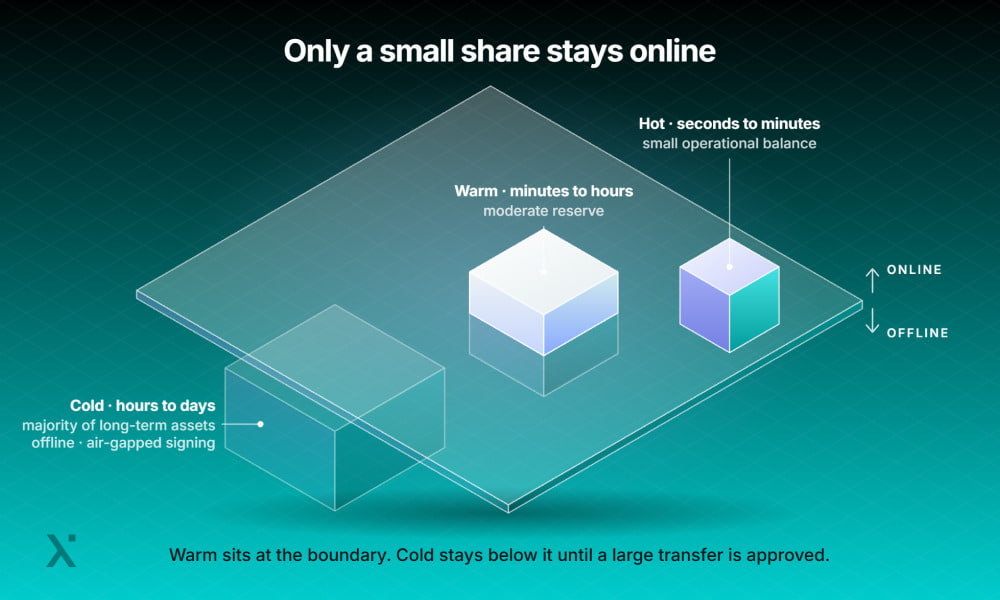
Key management technology is only one part of the picture. A digital asset custody platform also needs to decide where different portions of assets are kept and how quickly they should be accessible.
This is where hot, warm, and cold custody tiers are useful. Instead of keeping all assets in one wallet, a custody platform can divide them into operational tiers based on liquidity needs and risk. Most institutional setups keep a smaller operational balance readily available while moving larger reserves into more isolated storage.
Hot vs. warm vs. cold custody tiers: the comparison
| Custody tier | How it works | Best for | Security and access |
| Hot | Assets are held in wallets connected to online systems, allowing transactions to be signed and processed immediately | Customer withdrawals, payments, settlements, trading, and market-making | Small operational balance; MPC/TSS, transaction limits, allowlists, and monitoring; access in seconds to minutes |
| Warm | Assets are kept in a more controlled environment and moved to hot wallets when additional funds are needed | Operational reserves, treasury management, hot wallet replenishment, and larger withdrawals | Moderate reserve; MPC, HSMs, multisig, manual approvals, and time delays; access in minutes to hours |
| Cold | Assets are kept offline or isolated from online systems and brought online only when a large transfer is approved and required | Long-term reserves, high-value holdings, and disaster recovery | Majority of long-term assets; offline HSMs, air-gapped signing, multisig, and strict approvals; access in hours to days |
Security and compliance: what your digital asset custody platform needs
When you build a digital asset custody platform, security and compliance should be planned together. Strong key management protects assets from theft, while regulatory controls help you operate legally and meet the expectations of institutional clients.
Crypto custody platform development and regulations
The exact requirements depend on where you operate, which assets you custody, and what other services your platform provides.
For example, the EU’s Markets in Crypto-Assets Regulation (MiCA) sets out specific requirements under Article 75 for crypto-asset service providers offering custody and administration services, such as custody policies, client asset records, security systems, and safeguards against cyber threats and misuse of client assets.
In Dubai, the VARA Custody Services Rulebook covers areas such as asset segregation, wallet management, safekeeping, and custody procedures.
Compliance needs to shape your custody platform from the start — from its architecture and access controls to transaction workflows and security processes. Building it in early is much easier than trying to fix compliance gaps after launch.
There is no single global rulebook for digital asset custody. However, regulators and institutional customers generally expect a few core safeguards, such as clear ownership records, controlled access to assets, strong risk management, reliable transaction records, and evidence that security controls actually work.
The specific requirements vary by region, so here’s a quick overview of what to consider in the main markets:
Regulatory and institutional requirements by region
| Region | Regulations/frameworks | Requirements to consider | Nuances |
| US | Bank Secrecy Act (BSA), FinCEN rules, applicable SEC rules, and state money-transmitter laws | AML/KYC, MSB registration where applicable, transaction monitoring, recordkeeping, sanctions screening, custody controls, and applicable state licensing | There is no single federal crypto custody law. Requirements depend on the services you provide and whether your business falls under FinCEN, the SEC, state regulators, or other authorities |
| EU | MiCA, particularly Article 75 for custody | Authorization, custody policies, client asset records, security systems, asset protection, risk management, and operational safeguards | MiCA provides a relatively unified framework across the EU. Article 75 specifically addresses custody and administration services |
| APAC | Hong Kong — the Securities and Futures Ordinance (SFO), the Anti-Money Laundering and Counter-Terrorist Financing Ordinance (AMLO); Singapore — the Payment Services Act (PSA); plus local regimes in other markets |
VASP/DPT licensing, AML/CFT, custody controls, technology risk management, client asset protection, and reporting | APAC does not have one regional framework. Requirements vary significantly between markets, so the target countries should be defined before designing the compliance architecture |
| MEA | UAE Virtual Assets Law / VARA Regulations (Dubai), including the VARA Custody Services Rulebook | Licensing, asset segregation, key management, custody procedures, AML/CFT, cybersecurity, and operational controls | MEA is similarly fragmented, with requirements varying by country |
The main takeaway is simple: your custody platform needs to prove not only that assets are secure, but also who controls them, how they are protected, and what happens when something goes wrong.
If you need to build compliance controls into the product from the beginning, crypto compliance solutions can help align the technical architecture with the relevant regulatory requirements.

MiCA Regulation Explained: New Framework for Regulating Crypto Assets

Blockchain and KYC: Expert Interview on Navigating Security and Compliance Challenges
Security engineering
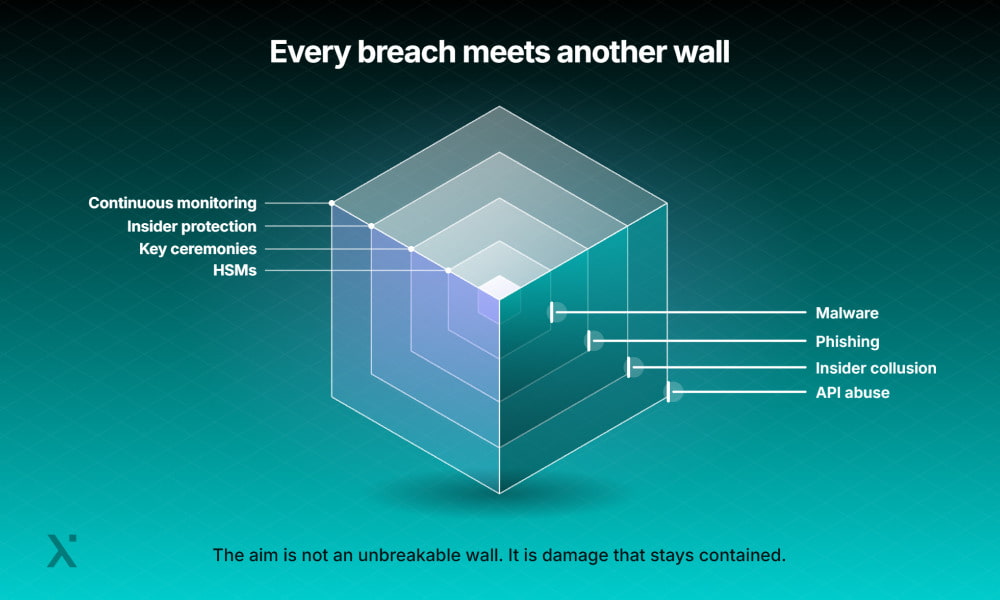
A digital asset custody platform can be targeted in many ways. Private key theft is an obvious risk, but attackers may also go after employee accounts, APIs, cloud infrastructure, backup systems, or even the people operating the platform.
Your security model should account for threats such as:
- Private key theft
- Compromised employee accounts
- Insider collusion
- Unauthorized transaction signing
- Phishing and social engineering
- Malware and endpoint compromise
- Cloud infrastructure attacks
- API abuse
- Supply-chain attacks
- Physical attacks
- Blockchain and smart contract vulnerabilities
Once you understand the attack surface, the next step is to build multiple layers of protection. The following measures help protect the platform at different points, from key generation and transaction signing to access management, monitoring, and recovery:
- Key ceremonies and shard management. Generate and distribute keys or key shares through a controlled, documented process. Separate signing authority so that no single person or system can move assets alone.
- HSMs. Use hardware security modules to protect cryptographic material and control sensitive signing operations.
- Insider protection. Apply role-based access, separation of duties, multi-person approvals, MFA, and privileged-access monitoring.
- Recovery. Keep encrypted backups and establish recovery procedures that do not create another single point of failure. Test these procedures regularly.
- Continuous monitoring. Monitor transactions, privileged activity, authentication events, API calls, and other unusual behavior so potential attacks can be detected early.
- Post-quantum planning. Keep the cryptographic architecture flexible enough to replace algorithms and security components as post-quantum standards evolve.
The goal is not to make the platform impossible to attack. Let’s face it, that is unrealistic. Instead, the security architecture should make unauthorized access difficult, limit the damage if something is compromised, and provide a reliable way to recover.

A Deep Dive into Post-Quantum Cryptography: The Next Security Frontier
The Role of Blockchain in Strengthening Your Cybersecurity: Key Use Cases
Certifications and audits
Security controls also need independent validation. Institutional customers may want more than a description of your security architecture — they may want evidence that your controls are properly designed, implemented, and tested.
Common requirements include SOC 2 Type II, ISO 27001, penetration testing, signing-service audits, and appropriate insurance coverage.
| Certification/audit | What it checks | Typical timeline | Who is needed |
| SOC 2 Type II | Security controls and how consistently they operate | Several months or longer | Internal security/compliance team + external auditor |
| ISO 27001 | Information security management, risk management, and controls | Several months | Security team + certification body |
| Penetration testing | Vulnerabilities across applications, APIs, infrastructure, and networks | Several weeks | Independent security testers |
| Signing-service audit | Key management, signing workflows, approvals, and operational controls | Several weeks to months | Security team + specialist auditors |
| Insurance assessment | Security posture, operational risks, incident response, and controls | Varies | Insurance provider + security/compliance teams |
These certifications do not replace good security engineering. Instead, they give customers and regulators additional evidence that your processes are documented and consistently followed.
A structured security audit and risk management process can help turn these findings into practical technical and operational improvements.
Regular penetration tests, access reviews, key-ceremony reviews, recovery exercises, and risk assessments help you find weaknesses before attackers do.
Custody for tokenized assets and RWAs: what changes?
Tokenized assets and real-world assets (RWAs) require more than standard BTC/ETH custody. Along with protecting private keys, the platform for tokenized asset custody may need to manage asset-specific permissions, off-chain records, transfer restrictions, and corporate actions.
Here’s how the custody architecture differs:
Custody for BTC/ETH vs. for tokenized assets
| Aspects | BTC/ETH custody | Custody for tokenized assets and RWAs |
| What is held | Native crypto assets | Tokens representing securities, funds, real estate, commodities, or other assets |
| Ownership | Mainly based on control of blockchain addresses and private keys | May depend on the token, legal agreements, issuer records, and underlying asset |
| Key management | Protect private keys and transaction signing | Protect keys + manage token-specific permissions and transfer rules |
| Transfers | Primarily controlled by blockchain transactions | May also require KYC, investor eligibility, jurisdiction, or other restrictions |
| Off-chain data | Usually limited | May require connections to issuers, banks, registries, brokers, and other systems |
| Smart contracts | Used for applications such as DeFi and staking | Often manage issuance, transfers, compliance rules, redemptions, and corporate actions |
| Asset servicing | Mainly blockchain transactions | May include dividends, interest, voting, redemptions, and maturity events |
So, custody for tokenized assets means protecting the token and maintaining the link between that token and the asset or rights it represents. This makes digital asset custody platform development more integration-heavy.
For projects involving tokenized assets, tokenization platform development can help build the infrastructure for issuing, managing, transferring, and securing these assets.

Real-World Asset Tokenization: Key Benefits and Opportunities Explained

Tokenizing Gilts, Eurobonds and Gold: Default-Tested Mobile Collateral on Canton
Digital asset custody platform development cost and timeline: what to expect?
The crypto custody development cost depends on how many assets you need to support, how the platform manages keys, how much compliance automation you need, and how deeply you want to integrate with existing financial infrastructure.
Here are the main cost drivers:
- Supported networks. Each additional blockchain can require separate node infrastructure, transaction logic, signing support, monitoring, and testing.
- Key management architecture. MPC/TSS, HSM-based custody, multisig, or a combination of approaches can have very different implementation and infrastructure requirements.
- Compliance integrations. KYC/KYB, AML screening, transaction monitoring, sanctions screening, and travel rule tools add both development and ongoing integration costs.
- High availability and disaster recovery. Institutional platforms need redundancy, failover, backups, and recovery environments to keep custody operations running during infrastructure failures.
- Security audits. Penetration testing, code reviews, signing-service audits, and other assessments add to the project budget but are essential for a custody product.
- Tokenized-asset functionality. Supporting tokenized securities or RWAs can require smart contracts, transfer restrictions, asset registries, corporate actions, and connections to traditional financial systems.
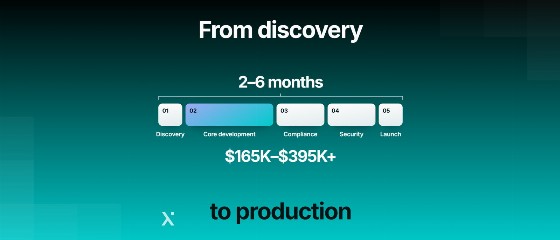
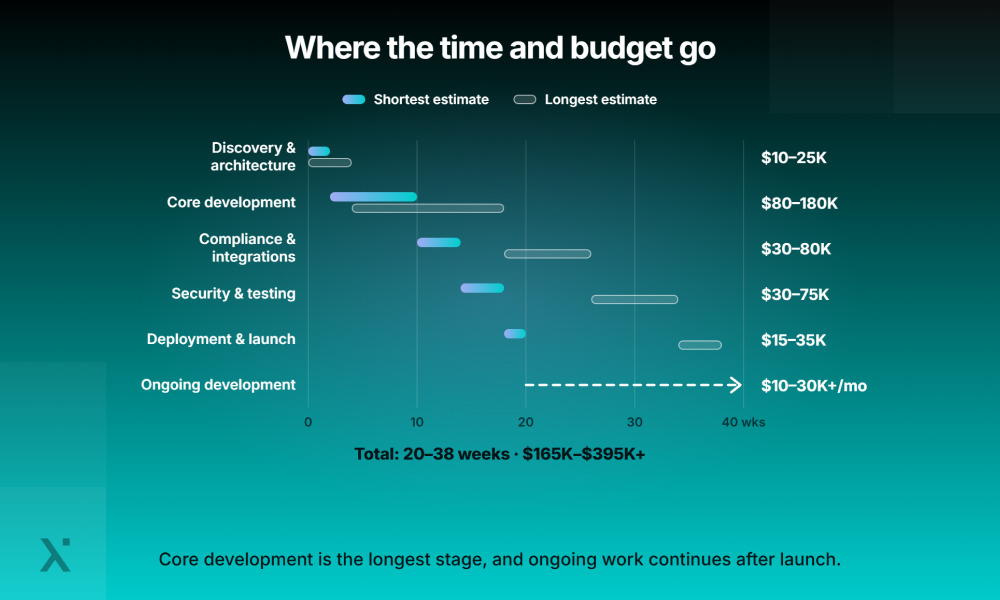
As for the development budget, it is usually spread across several stages, from initial architecture to deployment and ongoing improvements. The table below gives a general estimate for each stage of a production-ready crypto custody platform.
These figures are intended as a planning guide rather than a fixed quote. The actual crypto custody development cost can be higher or lower depending on the platform’s scope, technical architecture, and regulatory requirements.
Digital asset custody platform development cost by stage
| Development stage | Activities | Estimated timeline | Estimated cost |
| Discovery and architecture | Requirements, custody model, regulatory analysis, technology stack, architecture | 2–4 weeks | $10,000–$25,000 |
| Core development | Wallet infrastructure, key management, blockchain integrations, transaction workflows | 8–14 weeks | $80,000–$180,000 |
| Compliance and integrations | KYC/AML, sanctions screening, monitoring, banking or payment integrations | 4–8 weeks | $30,000–$80,000 |
| Security and testing | Functional testing, penetration testing, key management testing, disaster recovery testing | 4–8 weeks | $30,000–$75,000 |
| Deployment and launch | Infrastructure setup, production deployment, monitoring, documentation, team training | 2–4 weeks | $15,000–$35,000 |
| Ongoing development | New networks, features, security improvements, compliance updates, maintenance | Ongoing | $10,000–$30,000+/month |
| Total estimated cost | Production-ready crypto custody platform | 20–38 weeks (about 5–9 months) | $165,000-395,000+ |
The timeline above assumes stages run largely in sequence and excludes ongoing development. Regulatory approvals, audit cycles, and a wider set of supported networks push it further: independent estimates for in-house custody builds range from six to eighteen months.
Build vs. buy vs. white-label
When you decide to build a crypto custody platform, you don’t necessarily have to develop every component from scratch. You can choose between building your own infrastructure, buying existing custody technology, or using a white-label solution.
| Approach | What it means | Best suited for | Main trade-off |
| Build | Develop custody infrastructure and workflows from the ground up | Businesses that need full control and custom functionality | Highest cost and longest timeline |
| Buy | Integrate existing custody infrastructure from a technology provider | Businesses that want to launch faster using proven infrastructure | Less control over the underlying technology |
| White-label | Customize an existing custody solution with your branding, features, and workflows | Businesses looking for a faster route to market | Customization may be more limited than with a fully custom build |
For businesses building broader financial products around digital assets, custody can also become part of a larger infrastructure stack. Crypto banking solutions can help connect custody with services such as payments, accounts, and other crypto-financial operations.
Why build your digital asset custody platform with PixelPlex?
Digital asset custody platform development has its own set of technical and operational challenges. Assets need to remain accessible when required, while keys, transactions, user permissions, and compliance processes all need to be tightly controlled. That’s why a custody platform needs a broader architecture than a typical crypto wallet.
PixelPlex covers this broader scope through crypto custody platform development that combines blockchain engineering, wallet development, key management, compliance, security, and tokenized asset expertise. Whether you need a ready-to-customize solution or a fully custom platform, we can handle the blockchain technology behind it.
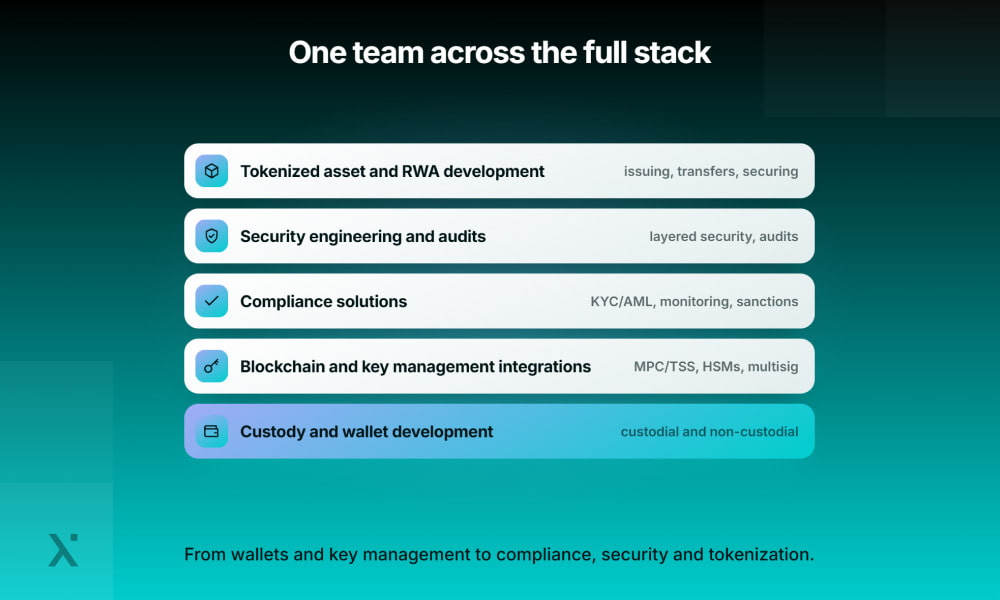
What exactly PixelPlex can help with:
- Custody and wallet development — we build custodial and non-custodial solutions, including white label crypto wallet development.
- Blockchain and key management integrations — we connect multiple networks and integrate MPC/TSS, HSMs, multisig, and other custody technologies.
- Compliance solutions — we implement KYC/AML, transaction monitoring, sanctions screening, and other compliance controls.
- Security engineering and audits — we design layered security and assess smart contracts, infrastructure, and key management systems.
- Tokenized asset and RWA development — we create infrastructure for issuing, managing, transferring, and securing tokenized assets.
From wallets and custody infrastructure to tokenization and custom blockchain solutions, PixelPlex can support projects across the full digital asset technology stack.
FAQ
Crypto exchanges, fintech companies, banks, asset managers, payment providers, and Web3 businesses can use custody infrastructure when they need to manage digital assets securely at scale.
Yes. During digital asset custody platform development, custody infrastructure can be connected to trading platforms, payment systems, banking infrastructure, portfolio applications, and internal systems through APIs and other integration layers.
The response depends on the custody architecture. A properly designed platform should limit the impact of a compromised component, detect suspicious activity, restrict affected access, and support controlled recovery procedures.
Yes. A crypto custody platform can support stablecoins across the networks where they are issued. It can also include tools for monitoring token contracts and managing deposits and withdrawals across different networks.
There is no fixed schedule. Updates may be needed when new networks or assets are added, vulnerabilities are discovered, regulations change, or infrastructure requirements evolve. Regular security reviews and maintenance help keep the platform reliable over time.
Look for a development partner with proven blockchain expertise and experience in wallet infrastructure, key management, security, and compliance. They should also understand institutional custody requirements and be able to work with different blockchain networks and digital asset technologies.