Most employees now know that AI can do a lot, but it still needs guidance because bringing it into the workplace also comes with risks. AI governance gives companies a clear way to manage those risks and use AI responsibly.
According to a 2026 survey by McKinsey & Company, AI is becoming a regular part of business operations. Nearly nine in ten respondents say their organizations use AI in at least one business function, and 44% report that AI is now being scaled across the enterprise, up from 38% in 2025.
The survey also shows that AI is spreading across different departments. In fact, 56% of organizations now use AI in at least three business functions. Larger companies are moving faster, too. Among businesses with annual revenue of $1 billion or more, 54% are scaling AI across their operations, compared with just one-third of smaller companies.
As more businesses bring AI into their daily work, they also need to think about how to manage it. This means protecting sensitive data, checking AI-generated results, and setting limits on what automated systems can do.
At PixelPlex, we help businesses adopt AI and deal with the challenges that come with it. As an AI deployment company, we know that choosing the right tools is only part of the job. Companies also need practical rules and proper oversight to make AI work safely.
In this article, we’ll look at what AI governance means, why businesses need it, and how to build a framework for responsible AI use.
What is AI governance and why does it matter?
Who doesn’t use AI at work these days? Hard to say. But as companies bring AI into more parts of their operations, they also need a way to manage how these systems are used. That’s where AI governance comes in.
AI governance: definition and purpose
So, what is AI governance? It’s a set of rules, processes, roles, and controls that guide how a company chooses, develops, uses, and monitors AI systems.
The goal is simple: make sure AI helps the business while keeping it safe, transparent, and accountable, with proper attention to data privacy.
AI governance vs. AI regulation: what’s the difference?
AI governance and AI regulation are closely connected, but they serve different purposes. AI regulation sets external legal requirements that companies must follow, while AI governance establishes internal policies and processes to ensure AI is used responsibly.
AI governance vs. AI regulation
| AI governance | AI regulation |
| Defines how a company manages and uses AI internally | Establishes external rules and legal requirements for AI use |
| Sets internal policies, roles, approval procedures, and controls | Defines obligations related to safety, transparency, privacy, and accountability |
| Helps employees and teams use AI responsibly | Requires organizations to meet applicable legal standards |
| Is shaped by the company’s needs, AI use cases, and risk levels | Is established by governments and regulatory authorities |
| Applies throughout the company’s AI lifecycle, from selection to monitoring and retirement | Applies according to the relevant laws, jurisdiction, and type of AI system |
In simple terms, AI regulation sets the rules companies must follow, while AI governance determines how they follow them in practice. Both are important for responsible AI adoption.

Artificial Intelligence Regulation: What Laws Do Countries Apply to This Tech?

AI and Privacy: Key Business Concerns and Solutions
What happens when no one governs AI?
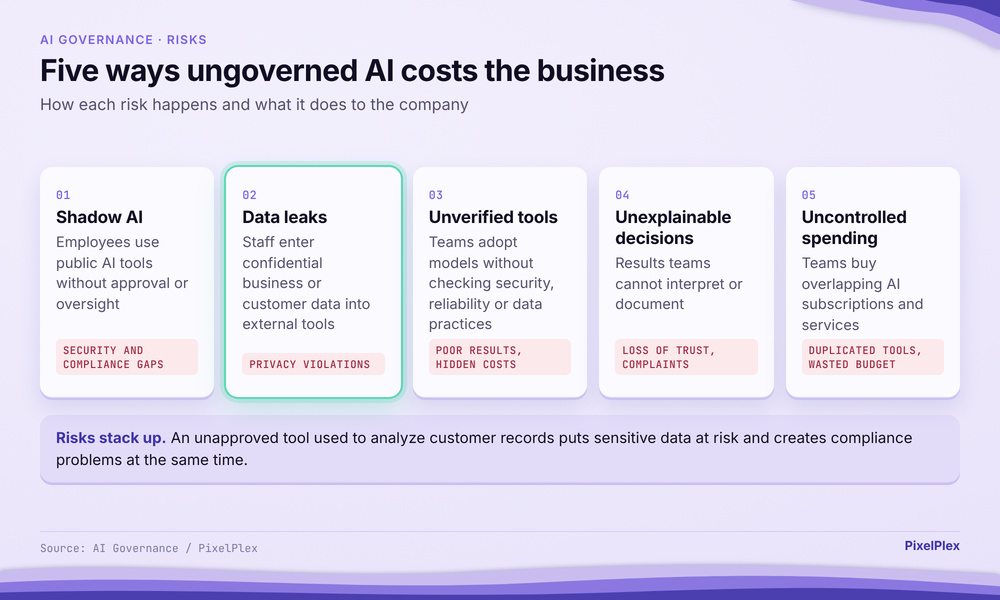
Without proper rules, AI can quickly become hard to manage. Employees might use tools that the company hasn’t approved, share sensitive information with external platforms, or trust AI-generated results without checking them. And even if a company uses an AI model from an outside provider, it’s still responsible for how that model is used in its business.
This can lead to financial losses, legal issues, disruptions to daily work, and damage to the company’s reputation. That’s why AI governance isn’t just an IT task. It involves the whole business, from management and legal teams to security specialists and everyday employees.
The risks of using AI without proper oversight
| Risk | How it happens | Business impact |
| Shadow AI | Employees use public AI tools without company approval or oversight | Uncontrolled AI use, security gaps, and compliance risks |
| Data leaks | Staff enter confidential business or customer information into external AI tools | Exposure of sensitive data and potential privacy violations |
| Unverified AI tools | Teams adopt models or services without checking their security, reliability, or data practices | Poor results, security vulnerabilities, and unexpected costs |
| Unexplainable decisions | AI systems produce results that teams cannot properly interpret or document | Loss of trust, difficulty resolving complaints, and compliance issues |
| Uncontrolled spending | Different teams purchase overlapping AI subscriptions or services | Duplicated tools, wasted budgets, and poor cost control |
These risks can also happen at the same time. For example, an employee might use an unapproved AI tool to analyze customer records. This could put sensitive data at risk and create compliance problems.
A good AI governance framework helps companies keep track of the AI tools their teams use, set rules for them, and decide who is responsible for each system. It also helps spot problems early, before they affect customers, daily work, or the company’s reputation.

How to Create Effective Data Governance Strategy: A Step-By-Step Guide

An In-Depth Guide to the 15 Best Data Governance Practices and Principles for Your Business
Who exactly is responsible for AI governance?
AI governance is a team effort. Different departments have a role to play, but someone needs to be responsible for making sure everything is managed properly. Without assigned responsibilities, important tasks can get overlooked, and employees may not know who should make decisions or deal with problems.
Several roles usually take part in AI governance. Let’s look at what each of them does in the table below.
AI governance roles and responsibilities
| Role | Responsibilities |
| Business owner | Defines the AI system’s purpose and business goals, and takes responsibility for its results |
| Technical owner | Manages technical implementation, integration, maintenance, performance, and updates |
| AI governance team | Develops governance policies, coordinates internal processes, and oversees compliance with company rules |
| Risk and compliance teams | Assess potential AI risks and check AI compliance with regulatory and internal requirements |
| Legal and security teams | Review legal obligations, data protection, access controls, and security risks |
| Senior management or board | Approves key AI policies, oversees significant risks, and makes strategic decisions |
Of course, the exact distribution of responsibilities depends on the company’s structure. Smaller businesses may assign several roles to the same person, while larger organizations may have dedicated AI governance teams and separate approval procedures.
IT consulting services can help companies assess their existing infrastructure and plan how AI tools fit into it.
When everyone understands their responsibilities, AI-related decisions are easier to review, risks are less likely to go unnoticed, and governance becomes a natural part of everyday business operations.
What does a working AI governance program look like?
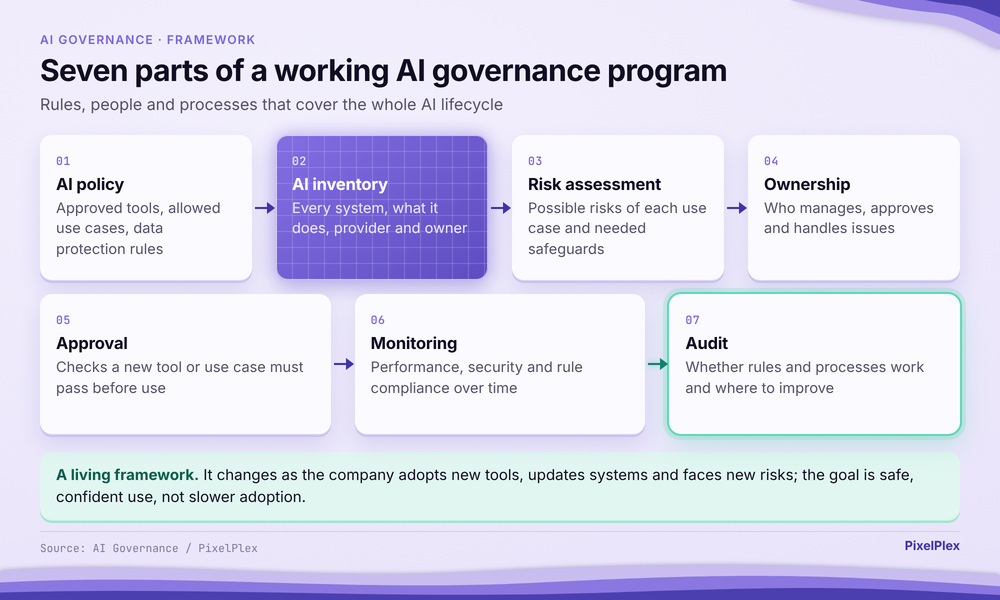
A working AI governance program brings together the rules, people, and processes a company needs to manage AI. It helps employees understand which tools they can use, who is responsible for them, how risks are checked, and what to do when problems arise.
A practical AI governance framework usually includes these key elements:
- AI policy: Sets the rules for using AI across the company, including approved tools, allowed use cases, and data protection requirements.
- AI inventory: Lists the AI systems a company uses, what they do, who provides them, and who is responsible for them.
- Risk assessment: Looks at the possible risks of each AI use case and decides what safeguards are needed.
- Ownership: Defines who manages AI systems, approves their use, and handles any issues.
- Approval: Sets out what checks new AI tools and use cases must pass before employees can use them.
- Monitoring: Tracks how AI systems perform and checks that they remain secure and follow company rules.
- Audit: Checks whether governance rules and processes are working and where they need to improve.
Together, these elements give a company a practical way to manage AI across its operations. The framework should also change as the company adopts new tools, updates existing systems, and faces new risks.
The goal isn’t to slow down AI adoption with too many rules. It’s to give employees the guidance they need to use AI safely and confidently while protecting the business and keeping decisions accountable.
Creating an effective AI governance policy: what does it cover?
A clear AI governance policy helps companies integrate AI governance into everyday business operations. Employees should know which tools they can use, what information they can share, and when AI-generated results need human review.
A good AI governance policy should cover:
- Approved and prohibited use cases: Define which tasks employees can use AI for and which activities are restricted.
- Data handling rules: Explain what confidential, personal, and business-sensitive information can be shared with AI tools.
- Human review: Specify when employees must check AI-generated content before using it.
- AI-assisted decisions: Establish where human approval is required, especially for decisions affecting customers or employees.
- External AI services: List approved tools and requirements for using third-party platforms.
- Reporting and approval: Explain how to report AI-related problems or request permission to use new tools.
So, how can you make an AI policy work in everyday business? You need to make sure employees can easily find and understand it. You can use practical examples to show what they can and can’t do with AI. You also need to provide basic training on data protection and checking AI-generated results.
You have to review the policy regularly to keep it up to date as the company adopts new tools, business needs change, and new risks appear.
AI inventory: what to track and how to keep records up to date
You can’t manage AI risks effectively if you don’t know which AI systems employees use. An AI inventory gives you one place to track all the AI tools, models, and applications used across the company.
Here is what you need to do:
- Identify all AI tools used across the company.
You need to include both approved systems and tools employees have started using on their own. These may include public AI platforms, third-party services, and AI features built into existing software.
- Record key details about each system.
For every tool, you should document the information needed to understand how it’s used, assess potential risks, and assign responsibility.
Key information to include in an AI inventory
| Field | What to record |
| System name and type | Name and category of the AI solution |
| Provider and model | Vendor, model name, and version |
| Business owner | Person responsible for the business use case |
| Technical owner | Person responsible for technical operation |
| Business purpose | Why the company uses the system |
| Data processed | Types of information the system handles |
| Risk level | Assigned AI risk classification |
| Approval status | Whether the system has passed internal checks |
| Last review | Date and outcome of the latest review |
You also need to keep the inventory up to date as the company starts using new AI tools and changes existing ones. You should ask employees to register new tools before they start using them, check the inventory regularly, and update it whenever a model, provider, business purpose, or data-processing practice changes.
If you work with an AI app development company, any new applications or AI features should also be added to the inventory and reviewed before they go live.
AI controls and risk levels: what oversight does each system need?
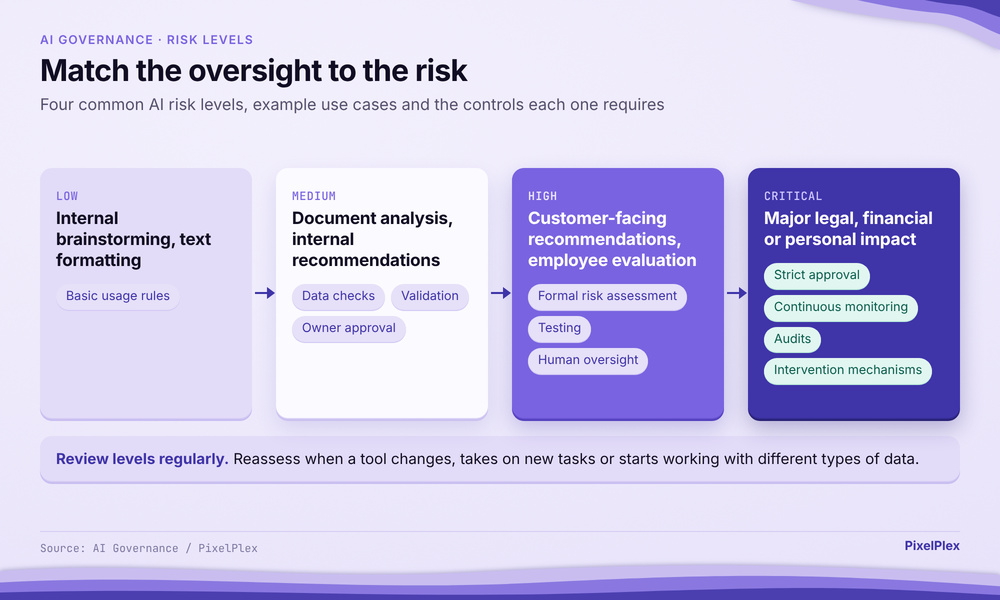
Not all AI systems need the same level of control. For example, a chatbot used for brainstorming doesn’t need as many checks as an AI tool that helps make hiring or loan decisions. You need to look at the potential impact of each AI use case and decide what level of oversight it requires.
The table below shows four common risk levels and the controls you should put in place for each.
AI risk levels and required governance controls
| Risk level | Example use cases | Required controls |
| Low | Internal brainstorming, text formatting | Basic usage rules |
| Medium | Document analysis, internal recommendations | Data checks, validation, owner approval |
| High | Customer-facing recommendations, employee evaluation | Formal risk assessment, testing, human oversight |
| Critical | Decisions with major legal, financial, or personal impact | Strict approval, continuous monitoring, audits, intervention mechanisms |
Effective AI risk management means matching the level of oversight to the risks each system may pose. You need to review risk levels regularly, especially when AI tools change, take on new tasks, or start working with different types of data. This helps you keep controls up to date and focus on the systems that need the most attention.
How to keep AI data and vendors under control
Using external AI tools introduces risks related to data access, storage, processing, and third-party security. Companies need clear rules for handling information shared with AI systems and a process for checking whether vendors meet their security and compliance requirements.
Setting rules for data access and processing
You can start by checking where AI training and operational data comes from and how AI providers handle it. Employees need to know what information they can share with external AI tools and what must stay within company systems. This includes personal data, customer records, financial details, and confidential business documents.
You should also follow the principle of least privilege: give employees and AI systems access only to the data they need for their work. Set rules for how long data can be stored, where it can be kept, and when it must be deleted. You also need to check whether AI providers use the information you submit to train their models.
These steps should be part of your wider data protection strategy. A data security company can help you review existing security practices, find weaknesses, and put the right safeguards in place. This also supports stronger enterprise AI governance.
What to check before choosing an AI vendor
Before you start using an external AI tool, you need to check how the provider protects data, handles information, and meets its contractual obligations. A well-known vendor isn’t always the right fit for your company’s requirements despite its popularity.
You should check where the data is stored, whether the provider uses customer information to train its models, and who owns the AI-generated outputs. You also need to know how the provider handles model updates, informs customers about changes, and supports audits or contract termination.
Use the checklist below to review these points before choosing an AI provider.
AI vendor assessment checklist
| Requirement | What to check | Why it matters |
| Data protection | Storage, processing, and deletion terms | Protects sensitive information |
| Model training | Whether submitted data is reused | Reduces unwanted data exposure |
| Infrastructure | Hosting location and security measures | Helps manage security and regulatory requirements |
| Model updates | Change notifications and version control | Prevents unexpected changes in behavior |
| Audit rights | Access to relevant records and documentation | Supports accountability |
Vendor assessments should not end once a contract is signed. Companies need to monitor providers for changes in security practices, infrastructure, data processing, and model behavior.
For a more comprehensive security assessment, businesses can also work with a cybersecurity services company to evaluate third-party risks, review security controls, and strengthen protection across their AI infrastructure.
The Double-Edged Sword: How AI Is Redefining Cybersecurity in 2026

Essential Cybersecurity Risk Management Frameworks and Best Practices
AI agent governance: managing access and actions
Traditional AI tools mainly generate text or analyze information. AI agents, by contrast, can take actions on behalf of users. They may send emails, update records, trigger workflows, or interact with external systems. This means companies need clear rules for what agents can say, access, and do on their behalf. For example:
- Limit permissions: Give agents access only to the tools, systems, and data they need for their assigned tasks.
- Set action limits: Define financial and operational boundaries, such as maximum transaction amounts or the types of changes an agent can make.
- Require human approval: Ask employees to confirm sensitive actions, including payments, contract changes, or updates to customer records.
- Keep activity logs: Record agent actions, decisions, and interactions with external systems.
- Monitor behavior: Check for unexpected actions, unusual patterns, or attempts to go beyond assigned permissions.
- Provide an emergency stop: Make sure teams can suspend an agent and revoke its access when something goes wrong.
These controls should be considered during development rather than added after deployment. An experienced agentic AI development company can help businesses build autonomous solutions with defined permissions, approval steps, activity logs, and monitoring mechanisms.
Give AI agents enough freedom to complete their assigned tasks while keeping sensitive decisions and actions outside their intended scope under human control.
How to maintain AI performance throughout its lifecycle
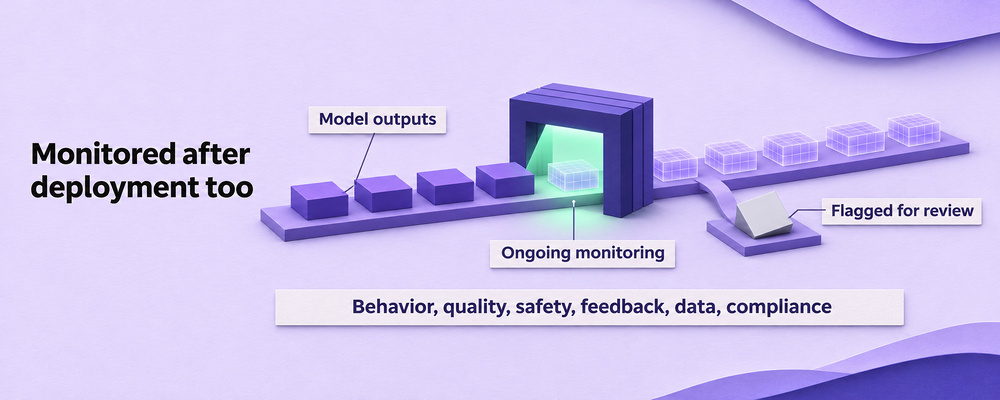
Companies need ongoing monitoring to make sure their AI systems remain reliable, safe, and aligned with internal requirements. After deployment, focus on several key indicators:
- Model behavior: Track changes in how the system responds to different inputs and handles specific tasks.
- Accuracy and output quality: Watch for declining accuracy, inconsistent results, or an increase in errors.
- Safety: Check for unexpected, biased, or potentially harmful responses.
- User feedback: Collect complaints and reports from employees and customers to identify recurring problems.
- Input data: Monitor changes in data quality, format, and distribution that could affect model performance.
- Policy compliance: Check whether the system continues to follow established access rules, usage restrictions, and approval requirements.
Regular performance reviews and model testing give companies a better picture of how their AI systems behave in real business conditions. Machine learning consulting can also support this process by helping teams evaluate model performance, identify data or accuracy issues, and plan necessary improvements.
AI incidents and how to handle them
Even with regular monitoring, AI systems can produce unexpected results or break internal rules. Companies need a clear incident response process that explains how to handle these situations and who should take charge.
A practical response process includes six steps:
- Identify and register the incident. Record what happened, which system was involved, and when the issue occurred.
- Assess the impact. Determine the severity of the incident and whether it affected customers, employees, data, or business operations.
- Contain the problem. Restrict the affected functionality or suspend the system if necessary.
- Notify responsible teams. Inform the relevant technical, security, compliance, and management teams.
- Investigate the cause. Review system logs, input data, model behavior, and recent changes to identify what went wrong.
- Apply corrective measures. Fix the issue, test the changes, and document the outcome to prevent similar incidents.
This process makes AI governance an ongoing responsibility rather than a one-time approval exercise. It also gives companies a consistent way to respond to problems and improve their systems over time.
Measuring AI governance performance and compliance
Companies need to regularly evaluate their AI governance framework to understand whether it works as intended. These assessments show how well teams follow internal policies, manage risks, and maintain control over AI systems. Plus, they reveal gaps that require attention and give businesses a structured way to track progress.
AI governance maturity
An AI governance maturity model helps companies understand how far they have progressed in building and managing their governance framework. It describes five stages, from informal AI use to fully integrated governance.
Five levels of AI governance maturity
| Level | What it looks like | Next step |
| 1.Ad hoc | AI use is largely untracked | Identify existing AI systems |
| 2.Basic | Initial policies and inventory exist | Assign owners and classify risks |
| 3.Defined | Approval and testing procedures are established | Expand monitoring and audits |
| 4.Managed | Controls are consistently applied and measured | Automate governance workflows |
| 5.Optimized | Governance is integrated into business operations | Continuously improve controls |
Companies can use this model to identify gaps and set realistic improvement goals. A strong enterprise AI governance framework should also cover AI model governance, including model selection, testing, validation, performance reviews, and updates.

How to Build an AI Strategy for Your Business
Major AI Bias Examples: Tackling Ageism, Sexism, Racism, and More
Which metrics show that AI governance is effective?
Maturity assessments should reflect actual controls and accountability, not simply the number of policies or documents a company has created. Companies can track several practical metrics to evaluate progress:
- AI inventory coverage: Percentage of AI systems recorded in the central inventory.
- Pre-deployment testing: Percentage of systems tested before launch.
- AI incidents: Number of incidents, their severity, and how quickly teams resolve them.
- Approval time: Average time required to review and approve new AI use cases.
- Monitoring coverage: Percentage of AI systems under active monitoring.
- Overdue reviews: Number of missed assessments and unresolved issues.
These metrics show governance teams where things are working and what needs attention. For model-level metrics, an LLM development company can support model evaluation, testing, and validation, helping businesses build more reliable AI solutions and maintain consistent governance practices as their systems evolve.
How to build and roll out an AI governance framework
In order to build an AI governance framework, companies need to connect internal rules with external requirements, choose suitable tools, assign responsibilities, and introduce controls gradually. The framework should fit the organization’s size, industry, and level of AI adoption.
How to connect internal governance with external requirements
Companies may need to follow different AI regulations depending on where they operate, their industry, and how they use AI. Instead of creating separate processes for each regulation, you can build one governance framework that covers all the requirements.
Several established frameworks can help companies structure this approach. The EU AI Act sets legal requirements for AI systems placed on the EU market, while the NIST AI Risk Management Framework (AI RMF) provides guidance for identifying and managing AI risks. ISO/IEC 42001 offers an international standard for establishing and maintaining an AI management system. Companies often use these frameworks as reference points when developing internal policies and aligning governance practices with external requirements.
This makes AI compliance easier to manage and keeps company policies, risk checks, and approval processes consistent across teams.
Choosing tools to support AI governance
The right tools can make governance easier to manage by bringing records, assessments, and security controls into existing workflows.
Tools that support an AI governance framework
| Tool category | What it helps manage |
| AI governance platforms | AI inventory, risk assessments, approvals, and monitoring |
| Data governance tools | Data access, quality, privacy, and lineage |
| Security tools | Access control, threat detection, and infrastructure protection |
| Internal processes | Ownership, policies, reviews, and incident response |
Tools support the framework, but they cannot replace human accountability. Teams still need to review decisions, manage risks, and take responsibility for how AI systems are used. DevSecOps consulting can also support the integration of security checks into development and deployment workflows.
AI governance implementation roadmap
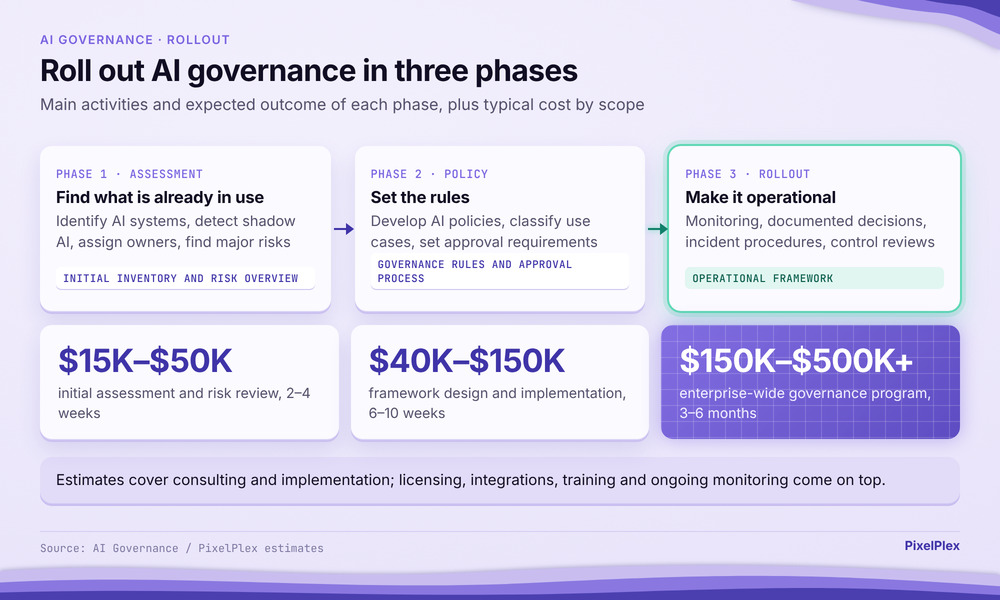
A gradual rollout allows companies to introduce governance without disrupting existing operations. The exact pace will depend on the organization’s resources and the risks associated with its AI systems.
Implementing AI governance
| Phase | Main activities | Expected outcome |
| Phase 1: Assessment | Identify AI systems, detect shadow AI, assign owners, and identify major risks | Initial AI inventory and risk overview |
| Phase 2: Policy development | Develop AI policies, classify use cases, and establish approval requirements | Basic governance rules and approval process |
| Phase 3: Operational rollout | Introduce monitoring, document decisions, establish incident procedures, and review controls | Operational governance framework |
After the initial rollout, companies should review the framework regularly and adjust it as their AI use changes.
How much time and money does AI governance implementation require?
AI governance requires input from several teams. IT manages infrastructure and system access, security oversees technical risks, legal and compliance teams interpret regulatory requirements, and business teams define use cases and expected outcomes.
Implementation costs and timelines depend on the project’s scope. The following figures provide general estimates:
Estimated AI governance implementation costs
| Implementation scope | Estimated cost | Typical timeline |
| Initial assessment and risk review | $15,000–$50,000 | 2–4 weeks |
| Framework design and implementation | $40,000–$150,000 | 6–10 weeks |
| Enterprise-wide governance program | $150,000–$500,000+ | 3–6 months |
These estimates cover consulting and implementation work. Software licensing, integrations, employee training, and ongoing monitoring may add to the budget. AI governance platforms also vary in price: smaller tools may cost a few hundred dollars annually, while enterprise solutions often require custom contracts and can cost tens of thousands of dollars per year.
The final budget depends on the number of AI systems, their risk levels, existing infrastructure, regulatory requirements, and organizational complexity. Generative AI consulting can support businesses in assessing these factors and planning an implementation roadmap that fits their needs.

How Much Does AI Development Cost in 2026?

Custom AI Model Development: Tips and Tricks
Common mistakes when building an AI governance framework
Some common mistakes can make governance difficult to apply in everyday work:
- Creating policies without connecting them to real workflows
- Maintaining an AI inventory without assigning owners
- Banning AI instead of establishing clear usage rules
- Testing systems only before launch
- Applying identical controls to every AI use case
- Ignoring third-party providers and AI agents
AI governance should grow alongside AI adoption. A small company can start with a basic inventory, clear usage rules, and assigned owners, then introduce more advanced controls as its AI use becomes more complex.
How can PixelPlex help with AI governance?
Building an AI governance framework requires both business planning and technical expertise. PixelPlex helps companies assess their AI adoption, identify suitable use cases, evaluate data readiness, and choose technologies that fit their business goals.
Through its AI consulting services, PixelPlex can support several parts of this process:
- Assess AI readiness and feasibility. Review existing systems and data assets, identify gaps, and evaluate whether proposed AI use cases are technically viable and worth pursuing.
- Develop a data and technology strategy. Evaluate data quality and maturity, identify preparation needs, and select suitable AI models, frameworks, and architectures.
- Integrate AI into existing workflows. Design an implementation roadmap and connect AI models with company systems, taking compatibility, data access, and regulatory requirements into account.
- Establish model monitoring and management. Plan model versioning, performance monitoring, retraining, and ongoing optimization to maintain accuracy and reliability.
- Address AI security and risks. Assess risks related to data privacy, system security, model bias, and ethical concerns throughout the AI lifecycle.
PixelPlex also provides related engineering services, including generative AI integration, machine learning, NLP, computer vision, and DevSecOps. These capabilities can support the technical side of governance, from secure data processing and access controls to testing and monitoring AI-powered applications.
A successful AI governance approach requires technical safeguards, reliable data, ongoing oversight, and clear processes for managing AI systems as they evolve. PixelPlex can help businesses turn these requirements into an actionable strategy and working technical solutions.
FAQ
Not every company is subject to the same AI governance requirements. Legal obligations depend on the jurisdiction, industry, and how AI is used. However, even businesses without specific regulatory duties benefit from clear rules for data protection, security, accountability, and responsible AI use.
A designated AI governance lead or cross-functional team usually coordinates the program. IT, security, legal, compliance, and business teams should all contribute because AI governance involves technical, legal, and operational decisions.
Companies should review AI systems regularly, based on their risk levels and internal policies. Additional reviews are necessary when a model is updated, input data changes, a new use case is introduced, or an AI-related incident occurs.
Yes. A company can start with an AI inventory, internal policies, approval procedures, and existing security tools. A dedicated governance platform may become useful as the number of AI systems and the complexity of oversight increase.
AI governance covers the overall management of AI systems, including policies, responsibilities, compliance, monitoring, and accountability. AI risk management is one part of this framework, focused on identifying, assessing, and reducing potential risks.
It depends on how many AI systems the company uses, who has access to them, and what impact they can have. A small business may only need a basic inventory, clear usage rules, assigned owners, and regular reviews. More complex or high-risk applications require stronger controls.